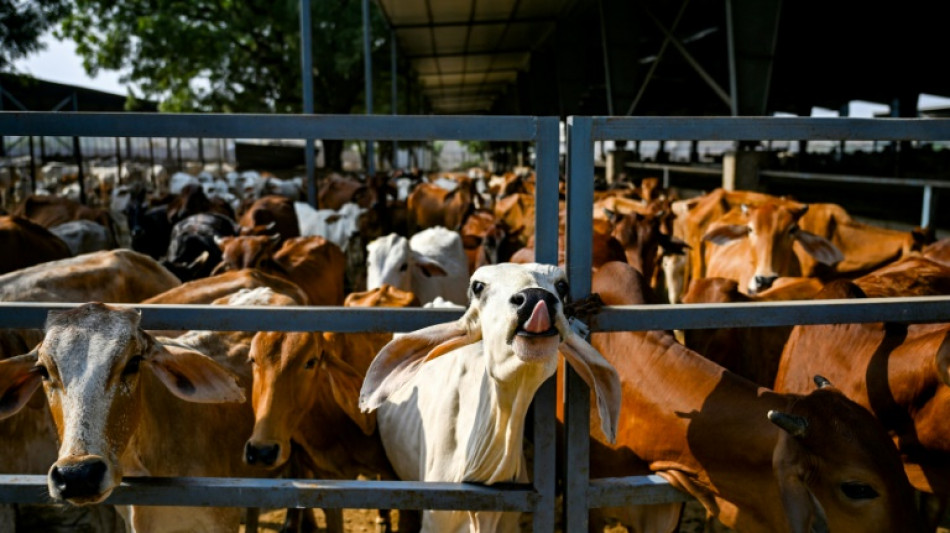
Sacred cow: coal-hungry India eyes bioenergy to cut carbon / Photo: Punit PARANJPE - AFP

 Kyiv's defences, 'hybrid' threat from Moscow headline EU talks
 Oil extends gains, stocks mostly down as Trump issues fresh Iran warning

 ThinkMarkets Expands Weekend Trading Offering, Launches Weekend League Competition

 Tibet activists accuse China of downplaying floods
 Afghanistan war victims left 'without justice', UN says

 Iran president offers US olive branch before Putin meeting

 China-Nepal flood toll tops 1,000 as tunnel rescue offers last hope

 Japan to relax overtime regulation under workaholic PM

 Thwarted Niger mutiny exposes junta's Russia dependence

 Illegal mining ravages S.Africa's economic hub

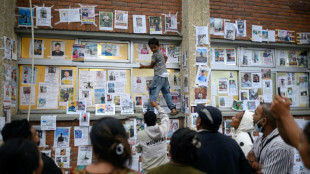 Nepal's wall of missing offers last hope after Himalayan flood

 US to press G20 on light-touch AI regulation

 2 die in Grand Canyon flash flood, only 1 person unaccounted for

 US Army Secretary Driscoll submits resignation: White House
 Oil extends gains, stocks drop as Trump issues fresh Iran warning

 Tsitsipas says Kyrgios's positive cocaine test 'kind of expected'

 In Japan's mountains, a different way to manage bears

 Middle East war a boon for UAE defence giant with global ambitions

 Former gang member found guilty of murdering Tupac Shakur

 Top-seeded Zverev opens US Open campaign

 US regulator, 22 states accuse Amazon of 'manipulating' ad auctions: lawsuit

 TRON Founder Justin Sun Shares Outlook on Bitcoin, Stablecoins and Global Finance at Bitcoin Asia 2026

 Tributes to 'eternal' Messi on Argentina retirement

 Arteta hails Arsenal's 'finishers' after Saka kills off Villa

 Yamal, Raphinha bag braces as Barcelona rout Rayo

Venerated as incarnations of Hindu deities, India's sacred cows are also being touted as agents of energy transition by a government determined to promote biogas production to cut its dependence on coal.
It is an understatement to say that Nakul Kumar Sardana is proud of his new plant at Barsana, in India's northern Uttar Pradesh state.
Firstly, says the vice-president of a biomass joint venture between India's Adani Group and France's TotalEnergies, because it occupies "one of the holiest sites in the world".
A four-hour drive south of the smog-filled capital New Delhi, among fields bristling with brickyard smokestacks, the small town of Barsana welcomes pilgrims who come to honour the Hindu goddess Radha.
But Sardana is also proud because his methanisation plant that opened in March is the "most technologically advanced and the largest biogas facility" in India.
It was built in Barsana to be as close as possible to its raw fuel -- cattle dung and harvest stubble.
"This region is home to a million cows," he said. "Their dung has been used as fuel for centuries in cooking".
Cows have been blamed for contributing to global warming because they produce methane -- a powerful greenhouse gas -- in their manure or when they belch.
But in this case, the region is finding a creative use for the waste produced by the cattle, which are used for their milk. Eating them is taboo for many Hindus.
Stalks left behind after the rice harvest -- that would otherwise be burned -- join the slurry.
"Farmers are traditionally burning them, creating smog and pollution", he added.
"In using natural waste, we are not only producing compressed biogas, but also high-quality organic fertiliser."
Long lines of tractors dump dung and straw in the factory's tanks, from which 10 tonnes of gas and 92 tonnes of fertiliser are produced each day.
- 'Convert waste' -
In its endless quest for power to fuel its economic growth, the world's most populous nation -- and third-largest fossil fuel polluter -- has pushed biogas to achieve a much-promised transition to carbon neutrality by 2070.
In 2018, the government set itself an ambitious goal of building 5,000 biogas plants in six years.
But despite generous subsidies and the introduction of a buyback guarantee, the project attracted little initial interest -- until the government forced the hand of producers.
From April 2025, at least one percent of liquid gas fuelling both vehicles and for domestic use must be biogas -- rising to five percent by 2028.
That prompted a response from key players, starting with billionaires Mukesh Ambani and Gautam Adani -- both close to Prime Minister Narendra Modi -- eying lucrative public contracts.
Ambani promised his Reliance group would build 55 biogas plants by the end of 2025 to convert "food producers to energy producers" and generate 30,000 jobs.
His rival Adani plans to invest around $200 million in the sector in the next three to five years.
"The government is pushing to convert waste for the wealth of the country," said Suresh Manglani, CEO of Adani Total Gas.
The International Energy Agency (IEA) says both China and India are leading global growth in bioenergy, seen as one solution to mitigate global heating.
Even though biofuel remains more expensive than conventional gas, Indian production is expected to grow by 88 percent by 2030, it predicts.
Biogas is considered a clean energy because the waste used to produce it is completely natural, said Suneel Pandey of The Energy and Resources Institute.
It is "a sustainable solution to make wealth from waste," he told AFP.
- 'Potential is huge' -
But the contribution of biogas to India's transition away from heavily polluting coal -- currently fuelling nearly 70 percent of electricity --- will be relatively small.
India plans to more than double the share of gas in its energy mix -- from six to 15 percent by 2030.
But the bulk of that will be liquefied natural gas (LNG), with Adani and TotalEnergies opening an LNG port on India's eastern coast at Dhamra.
Burning gas to produce electricity also releases damaging emissions, although less than coal and oil.
Total argues its backing of biogas is more about environmental responsibility than commercial opportunity.
"Biogas goes way beyond figures and business plans," said Sangkaran Ratnam, TotalEnergies chairman and managing director for India.
"It has also a tremendously positive knock-on effect on the rural communities in terms of jobs, in terms of care for the environment, and alternative forms of income."
Tejpreet Chopra, head of renewable energy company Bharat Light and Power, said the biogas market is "small in the big picture of things" but the "potential is huge".
But the investments required are vast. The Barsana plant cost $25 million, while the price of biogas remains uncompetitive: $14 per cubic metre, compared to $6 for LNG.
Yet Sardana remains more convinced than ever that biogas is key.
"We will learn the nuts and bolts of it and improve all processes," he said.
"We stop wasting energy, we create rural jobs, and we are contributing to a more sustainable environment."
T.Samara--SF-PST