Millions take shelter in UK as Storm Eunice threatens Europe

 Villa sign Senegal winger Mbaye from PSG

 Former Peru minister last-minute contender for UN labour agency helm

 Messi legacy will 'live forever', says Beckham
 'Literally tasting the smoke': Malaysians suffer as haze worsens

 Kyiv's defences, 'hybrid' threat from Moscow headline EU talks
 Oil extends gains, stocks mostly down as Trump issues fresh Iran warning
 ThinkMarkets Expands Weekend Trading Offering, Launches Weekend League Competition

 Tibet activists accuse China of downplaying floods
 Afghanistan war victims left 'without justice', UN says

 Iran president offers US olive branch before Putin meeting

 China-Nepal flood toll tops 1,000 as tunnel rescue offers last hope

 Japan to relax overtime regulation under workaholic PM
 Thwarted Niger mutiny exposes junta's Russia dependence

 Illegal mining ravages S.Africa's economic hub
 Nepal's wall of missing offers last hope after Himalayan flood

 US to press G20 on light-touch AI regulation

 2 die in Grand Canyon flash flood, only 1 person unaccounted for

 US Army Secretary Driscoll submits resignation: White House
 Oil extends gains, stocks drop as Trump issues fresh Iran warning
 Tsitsipas says Kyrgios's positive cocaine test 'kind of expected'

 In Japan's mountains, a different way to manage bears

 Middle East war a boon for UAE defence giant with global ambitions

 Former gang member found guilty of murdering Tupac Shakur
 Top-seeded Zverev opens US Open campaign
 US regulator, 22 states accuse Amazon of 'manipulating' ad auctions: lawsuit

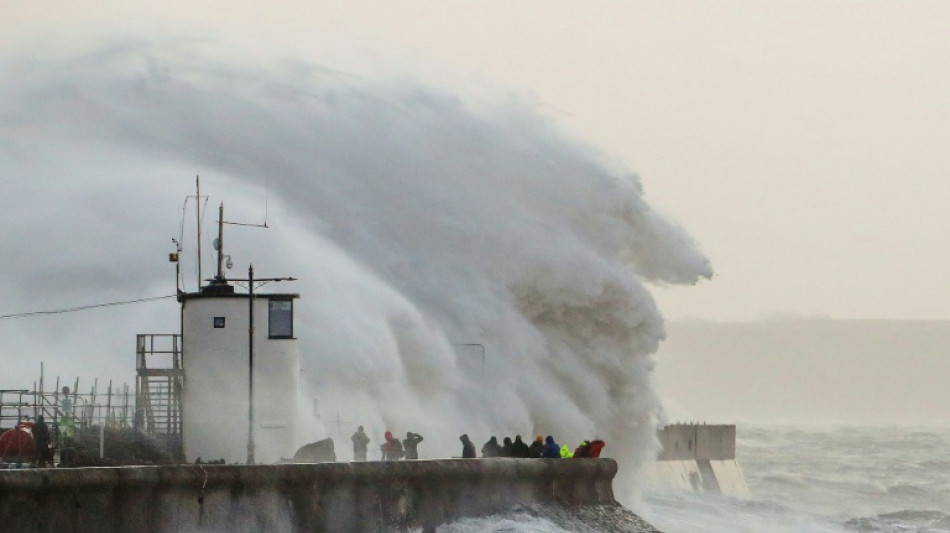
Millions hunkered down as Storm Eunice pummelled southern Britain with fearsome winds and crashing waves on Friday, leaving the streets of London virtually deserted and triggering broader warnings in Europe.
The UK capital was placed under its first ever "red" weather warning, meaning there is "danger to life", and the same level of alert was in place across southern England and South Wales, where schools were closed and public transport paralysed.
Eunice knocked out power in 55,000 homes and businesses in Ireland and hundreds of homes in Cornwall, southwest England, which was hit by gusts of 90 miles (145 kilometres) per hour and waves that breached sea walls along the coast.
It accrued power in a "sting jet", a rarely seen meteorological phenomenon that brought havoc to Britain in the "Great Storm" of 1987, and sparked a red alert also in the Netherlands.
Huge waves battered the Brittany coast in northwest France. Long-distance and regional trains were being gradually halted in northern Germany, while warnings were also in place in Belgium.
Ferries across the Channel, the world's busiest shipping lane, were cancelled, as were flights from northern Europe's aviation hubs, including around 300 from Schiphol in Amsterdam.
Prime Minister Boris Johnson, who has placed the British army on standby, tweeted: "We should all follow the advice and take precautions to keep safe."
The Met Office, Britain's meteorological service, issued its first red weather warning for London -- active until 1500 GMT -- since the alert system was introduced in 2011.
"The whole of the country will be affected by the extremely strong and damaging winds, which will cause significant disruption," Met Office forecaster Annie Shuttleworth said.
The agency warned that roofs could be blown off, trees uprooted and power lines brought down.
Roads, bridges and railway lines have already been hit causing delays and cancellations to bus, train and ferry services in southern Britain. Heavy snow was also forecast in Scotland and northern England.
- Climate impact? -
Environment Agency official Roy Stokes warned weather watchers and amateur photographers against heading to Britain's southern coastline in search of dramatic footage, calling it "probably the most stupid thing you can do".
London's rush-hour streets, where activity has been slowly returning to pre-pandemic levels, were eerily calm as many heeded the advice to stay home as the storm approached.
Trains into the capital were already running limited services during the morning commute, with speed limits in place.
All buses and trains in Wales were cancelled, while the National Highways agency issued a severe weather alert for strong winds covering the whole of Britain's strategic road network until 1800 GMT.
Key river crossings, including the Severn Bridge linking Wales to southwest England and the QEII Bridge south of London, were also closed.
The arriving storm forced Prince Charles, the heir to the throne, to postpone a trip to South Wales on Friday "in the interests of public safety", his office said.
Another storm, Dudley, caused transport disruption and power outages when it hit Britain on Wednesday, although damage was not widespread.
Experts said the frequency and intensity of the storms could not be linked necessarily to climate change, but that storms were causing more damage as a result.
"Yet with more intense rainfall and higher sea levels as human-caused climate change continues to heat the planet, flooding from coastal storm surges and prolonged deluges will worsen still further when these rare, explosive storms hit us in a warmer world."
Y.Shaath--SF-PST