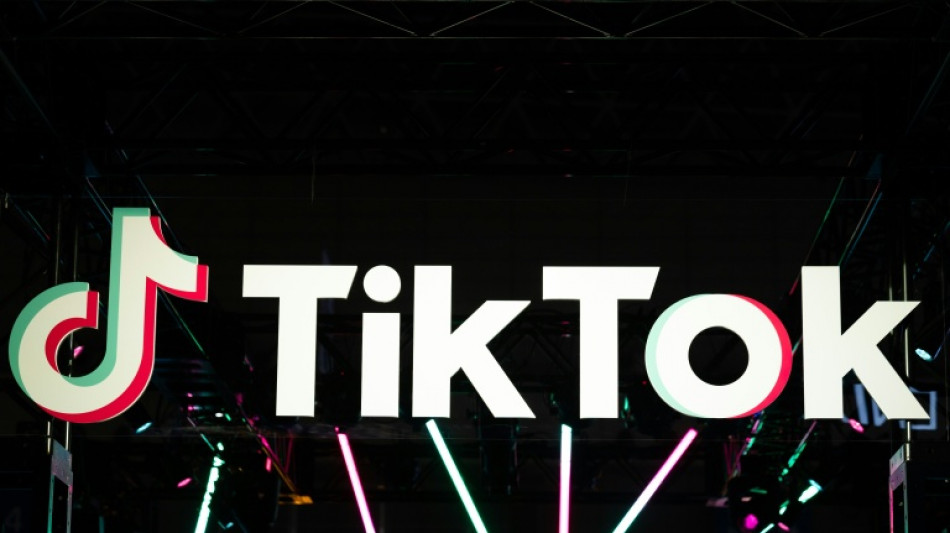
Japan court rules human voice is protected in TikTok AI case / Photo: Yuichi YAMAZAKI - AFP/File

 Energy costs spark inflation surges in France, Italy

 South Korea break China hearts to reach Asian Games football final

 Eala storms into Asian Games semi-finals to thrill adoring fans

 Turkey freezes ex-minister's assets as fund crisis grows

 What we know about the North Korean POW dispute

 Most equities rise after oil price plunge, US data in focus

 Polar oceans transformed as warming melts ice habitats: research
 Lost shark becomes viral star in South Korea

 Dangote to launch $16bn refinery in Kenya

 North Korean leader 'extremely obese': Seoul spy agency
 Yankees and pope-backed White Sox start MLB playoffs with wins

 Malaysia's ex-PM Mahathir in hospital for observation

 'No limits': Marathon world record holder Sawe chasing history

 Countdown begins to biggest-ever Rugby World Cup

 Bangladesh women lose ground after quota reform

 Vietnam admits 'differing opinions' on Hanoi development

 Stocks temper gains as oil pares heavy losses, US data in focus

 New Zealand denies breaching climate commitments to EU

 Albert becomes youngest US scorer in 4-2 win over Chile

 Pirate island's plunging population shows Greece's demographic decline

 With elections ahead, Latvia's Russian-speakers reject Moscow's help

 Brazil football clubs face massive sponsorship blow from betting ban

 ChatGPT maker wants to be the App Store for AI as safety concerns grow

 Women fight fires and sexism in Indonesian Borneo

 Forsling's OT blast lifts Florida over Carolina in NHL opener

A Tokyo court ruled Wednesday that the human voice is legally protected in Japan, after a high-profile anime voice actor took TikTok to court over videos he says feature an artificial intelligence clone of his "lustrous" baritone.
The decision marks a partial victory for Kenjiro Tsuda, known for his starring roles in mega-franchises including "Jujutsu Kaisen" and "Yu-Gi-Oh!", although the court dismissed his request for removal of the videos.
"The unauthorised use of a performer's voice... can be considered an infringement on publicity rights," said presiding judge Aya Takahashi.
AI imitation is a growing concern among performers worldwide, and the threat has roiled Japan's storied animation industry, whose voice actors are sometimes worshipped as much as their characters by fans.
The lawsuit is believed to be the country's first seeking to defend an individual's vocal identity against AI-generated copies.
It centred around a slew of TikTok videos narrated by a distinctively "deep" and "lustrous" voice that Tsuda, 55, said can only be his.
The platform, however, argued it is a "generic male voice" whose perceived similarity to Tsuda's is subjective at best, according to court records accessed by AFP.
Wednesday's verdict is seen as Japan's first declaring that the human voice is protected under publicity rights if "the purpose of using that voice is exclusively to take advantage of its commercial appeal", judge Takahashi said, describing a voice "as symbolic of one's personality as portraits are".
Publicity rights refer to the ability to control and profit from the use of aspects of one's identity.
- 'Balance' -
Takahashi, however, said TikTok was "no longer obliged to delete" the videos in question because the anonymous user behind them had taken them down several months after the lawsuit began.
Tsuda's lawyer Takashi Hirano told reporters that the ruling "ended up making both sides look victorious".
The anonymous account, whose picture resembled a "Jujutsu Kaisen" character dubbed by Tsuda, combined images and seemingly AI-generated speech about urban legends, occult phenomena and conspiracy theories.
It at one point boasted more than 200,000 subscribers and would have brought in upwards of 500,000 yen ($3,200) in monthly revenue, the legal complaint argued.
Tsuda's legal team argued the account only gained traction because "its dubious, sordid content was narrated by the attractive voice of a popular actor".
TikTok told AFP in a statement that it will "respect the court's judgement while considering what steps to take after scrutinising details" of its ruling.
"We will continue to sincerely work on the balance between technology development and rights protection," the platform said.
Interest in the ruling has been high among voice actors in Japan, who worry AI mimicry of the tool of their trade will go a long way toward the decline of the storied industry.
An actor's voice "is the result of years of rigorous training and apprenticeship" to hone talent, Yuko Sasaki, executive director of the Japan Actors Union, told AFP ahead of the ruling.
"It's something we spend lots of time and money perfecting," said Sasaki, a fellow voice actor, adding that "we support Tsuda wholeheartedly".
Parallel to the lawsuit, Sasaki and other Japanese voice actors have launched a campaign, called "No More", against using generative AI to mimic performers without permission.
"Our industry can be crushed" if "unbridled" AI voice cloning spreads on social media, actor Bin Shimada, who is part of the campaign group, had told AFP.
J.Saleh--SF-PST