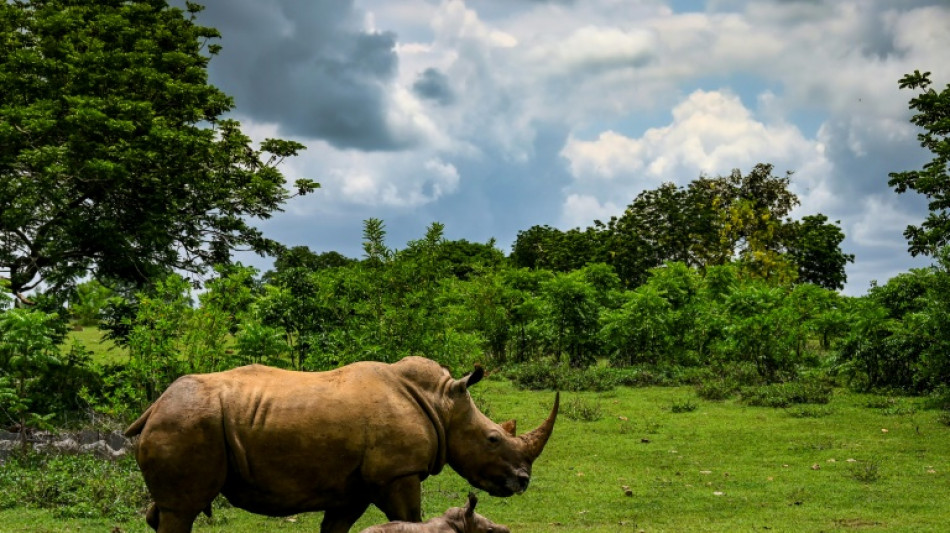
Poaching, horn trade declining but rhinos still threatened / Photo: YAMIL LAGE - AFP/File

 Alcaraz to return for US Open title defence

 China's rapid solar expansion hurt bird diversity: study

 President Paul Biya back in Cameroon after 73 days away

 Newcastle boss Jaissle unfazed by lack of respect

 US Open purse to top $100 mn as Grand Slams form player council

 Hull aim to silence critics after unexpected promotion to Premier League

 Pakistan hit back against England after Cox and Root fifties

 Walmart reports mixed results as gas prices drag on US sales growth

 Wang downs Sindhu to break Indian hearts at badminton worlds

 As Europe's rivers recede, shippers scramble to limit damage

 Alonso won't confirm Fernandez will remain at Chelsea after Man City link

 Milky Way's fastest star discovered spinning around black hole

 Kanye West planned concerts trigger frenzy in Russia

 Hungary music festival basks in post-Orban freedom

 Vatican says 'serious concerns' over Israel-Lebanon deal implementation

 Arteta confirms Arsenal want to sign defender after Konsa link

 What's behind the UAE's decision to cut Iran trade ties?

 Barca seal Cancelo return to bolster defence

 Germany reports record 14,000 heat-related deaths this summer

 Alvarez 'focused' says new Atletico team-mate Romero

 West Ham warn fans about 'offensive' Solomon chant

 Huge questions loom over Prince Harry's shock return to UK

 BYDFi Joins Coinfest Asia 2026, Connecting with Institutions, Builders and Traders in Bali

 Max Verstappen: Natural-born winner

 Van Dijk urges Liverpool to make amends for 'unacceptable' season

Poaching and the illegal trade in horns have fallen in recent years but remain grave threats for the rhino's survival, the International Union for Conservation of Nature (IUCN) said Monday.
The Switzerland-based body said 2,707 rhinos were poached in Africa between 2018 and 2021, of which 90 percent were killed in South Africa, mainly in the Kruger National Park.
South Africa is home to nearly 80 percent of the world's rhinos.
"Rhino poaching rates in Africa have continued to decline from a peak of 5.3 percent of the total population in 2015 to 2.3 percent in 2021," it said in a report.
"The overall decline in poaching of rhinos is encouraging, yet this remains an acute threat to the survival of these iconic animals," said Sam Ferreira, Scientific Officer with the IUCN SSC African Rhino Specialist Group.
The IUCN said 2020 was an abnormal year for rhino poaching with Covid confinement and curbs on trade and movement.
"Global lockdowns and restrictions due to the Covid-19 pandemic saw several African countries experience dramatically reduced poaching rates in 2020 compared to previous years.
"South Africa lost 394 rhinos to poaching in 2020, while Kenya recorded no rhino poaching that year. However, as COVID-19 travel restrictions lifted, some range states reported new increases in poaching activities – for example, South Africa reported 451 and Kenya six poached rhinos in 2021," it said.
"These numbers are still significantly lower than during the peak in 2015, when South Africa alone lost 1175 rhinos to poaching."
The population of rhinos in Africa has fallen by 1.6 percent annually, from 23,562 in 2018 to 22,137 at the end of last year.
IUCN said the number of white rhinos -- which it classifies as vulnerable on its Red List of Threatened Species -- declined by almost 12 percent from 18,067 to 15,942 during this period.
However, the number of black rhinos -- deemed critically endangered by the body -- rose by 12 percent to 6,195.
"To support the growth of rhino numbers, it is essential to continue active population management and anti-poaching activities for all subspecies across different range states," the IUCN said.
Alongside the decline in poaching, data analysed for range and consumer states suggests that, on average, between 575 and 923 rhino horns entered illegal trade markets each year between 2018 and 2020, compared to approximately 2,378 per year between 2016 and 2017.
- 2020 an 'abnormal' year -
However, in 2019, before the COVID-19 outbreak, the reported seized weight of illegal rhino specimens reached its highest point of the decade, perhaps due to increased regulations and law enforcement efforts.
"2020 did represent an abnormal year with low levels of reported illegal activity, law enforcement, and government reporting," said Sabri Zain, TRAFFIC Director of Policy.
IUCN said the numbers of the one-horned rhino, found mainly in India and Nepal, and the critically endangered Javan rhino had increased since 2017.
"Thanks to conservation efforts including strengthened law enforcement, the number of greater one-horned rhinos in India and Nepal increased from an estimated 3,588 in 2018 to 4,014 at the end of 2021, while the total population of Javan rhinos increased from between 65 and 68 individuals in 2018 to 76 at the end of 2021," it said.
But the number of Sumatran rhinos fell to an estimated 34 from 47 in 2021, compared with 40 to 78 individuals in 2018.
The IUCN classifies the Sumatran rhino, the smallest of all rhino species, as critically endangered.
The World Wide Fund for Nature estimates fewer than 80 Sumatran rhinos remain in the world, mainly on the Indonesian island of Sumatra and Borneo.
The IUCN report said 11 rhino poaching incidents were recorded in Asia -- 10 in India and one in Nepal -- since the beginning of 2018, all of which involved greater one-horned rhinos.
"Detection of carcasses in dense rainforests remains a challenge, and there were no reports of illegal killings of Sumatran rhinos despite the substantial population declines recorded," it added.
A.AlHaj--SF-PST