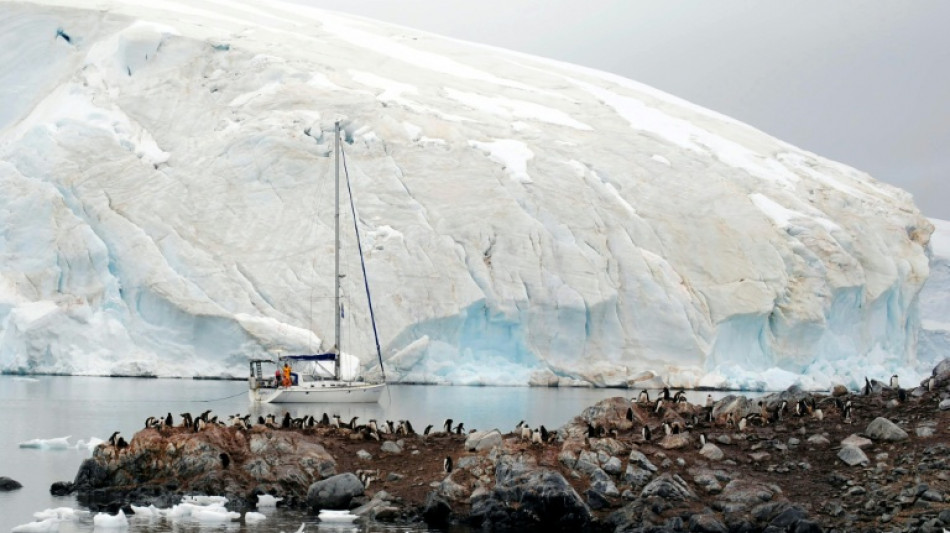
Bird flu ravaging Antarctic wildlife, scientist warns / Photo: Handout - Chilean Antarctic Institute/AFP

 Critical coal inventories affect nearly half of India’s domestic power plants

 FCNR(B) deposit drive puts sharper margin pressure on private banks

 Noel Tata requests records of September 17 Tata Sons board meeting

 Reparations calls to dog King Charles's tough Caribbean trip

 Global rates and foreign outflows remain key risks for Indian markets

 Neha Nagar says ₹3 crore can fund retirement with disciplined planning

 Vikas Satija says steady SIP flows shielded Indian equities from deeper losses

 Brewers rout Rays to reach brink of World Series sweep

 Mbappe dropped by Chinese brands for 'offending national sentiments'

 Kuwait exhibition presents Ukraine’s Islamic heritage and cultural ties

 Tech firms track Wall St rally on mixed day for Asian markets

 Jay-Z to perform at Super Bowl LXI halftime show: NFL

 Climate-threatened Fijian utopia rejects calls to relocate

 Israel to give verdict on Netanyahu in pivotal election

 $1m bounties, dawn arrests: Trump presses voter fraud campaign

 Gasping for air: Borneo residents struggle as island burns

 Doha exhibition charts a millennium of Chinese maritime ceramics trade

 New Zealand ex-PM Ardern to teach leadership in Sydney

 Ballon d'Or 'beyond wildest dreams' but Kane has plenty more to prove

 No envy, no secrets: How Spain's Gipuzkoa became football coaching hotbed

 South Korea economy grows three times faster than expected in Q3

 Al-Thawadi urges technology to deepen human connection through shared experiences

 Ballon d'Or: Harry Kane's crowning moment

 Harry Kane wins men's Ballon d'Or

 تحدي القراءة العربي يوسع أثره ويعزز المشاركة المعرفية

Scientists are sounding the alarm over the spread of bird flu across Antarctica, with a leading Chilean researcher telling AFP Tuesday of an observed strain "capable of killing 100 percent" of infected fauna.
Researchers have been warning in recent years of bird flu's spread on the icy continent, which hosts temporary teams of scientists but no permanent residents.
But a particularly dangerous strain of the disease was detected in April 2024 by Chilean researcher Victor Neira and his team in five skuas, a type of polar seabird.
Since then, the virus has spread to other species, with cases detected along 900 kilometers (560 miles) of coastline studied by scientists.
In a recent expedition to Antarctica, new cases were discovered in Antarctic cormorants, kelp gulls, Adelie and gentoo penguins, and Antarctic fur seals, Neira told AFP.
"The virus has completely spread throughout the Antarctic region where we have the capacity to go and study," said Neira, a scientist at the University of Chile and the Chilean Antarctic Institute (INACH).
"This disease is capable of killing 100 percent of the birds in short periods of time," he said.
"For example, in one or two days it can kill 90 percent or 100 percent of the animals in a given area."
Antarctic species are often small in total population, underscoring the risk of outbreaks.
Animals such as Antarctic cormorants and skuas number around 20,000 in total.
A global wave of bird flu has affected birds and mammals around the world since 2021, spread via bird migration.
In 2023, it killed thousands of Humboldt penguins in Chile.
S.AbuJamous--SF-PST