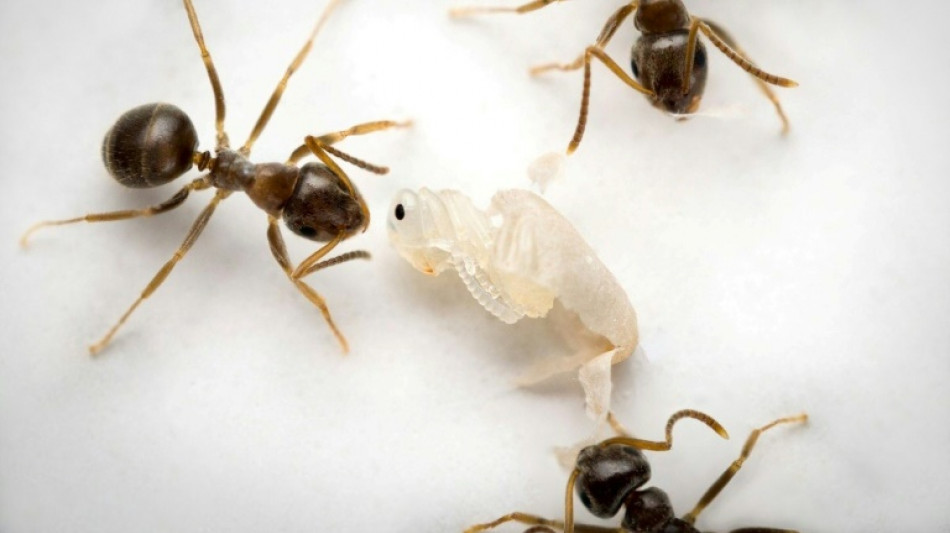
'Come and kill me': sick ants invite destruction to save colony / Photo: Christopher PULL - ISTA/AFP

 Manifesto defends Germany's iconic Bauhaus against 'populist attacks'

 Kenya's Kipyegon ends season with hamstring injury

 Nord Stream bomb suspect arrested while working on movie about attack: media

 German football fans plan widespread VAR protests

 Scorching summer triggers record rockfalls in Alps, scientist says

 Newly-crowned European champ Werro turns focus on 800m record

 Hamilton 'fittest ever' as he chases eighth F1 title

 Stocks retreat as bond yield fears persist, oil rises

 ARKBRIDGE’s David Mali Highlights AI-Driven Risk Management at the Finance Magnates London Summit

 Zuckerberg buys Gothic castle in Ireland: spokesman

 Belgium's fire of the century now 'under control'

 Evergrande's Xu Jiayin: from real-estate tycoon to life in prison

 Spurs eyeing move for Man City's Savinho and Marmoush - reports

 Springboks captain Kolisi to miss first All Blacks Test

 Japan to launch probe for Mars moons in October: space agency

 From beach to Bulls: relaxed Tsunoda savours rare F1 drive

 Prince Harry: key dates in life of returning UK royal

 North Korea launches missiles, Seoul says, after Trump floats Kim meet

 Oil jumps on Iran war tensions, offsetting bond yield fears

 Germany identifies far-right suspect in deadly 1970 antisemitic attack

 PrimeXBT Expands Swap-Free Trading to PXTrader 2.0

 Record number of locations in France top 40C over summer: AFP analysis
 Trump pledges 'economic warfare' on Iran, prompting Tehran derision

 'Girl with a Pearl Earring' in Japan, perhaps for the last time

 Russian strikes kill 13 in Kyiv, surrounding region

Sick young ants release a smell to tell worker ants to destroy them to protect the colony from infection, scientists said Tuesday, adding that queens do not seem to commit this act of self-sacrifice.
Many animals conceal illness for social reasons. For example, sick humans are known to risk infecting others so they can still go to the office -- or the pub.
Ant colonies, however, act as one "super-organism" which works to ensure the survival of all, similar to how infected cells in our bodies send out a "find-me and eat-me" signal, according to an Austria-led team of scientists.
Ant nests are a "perfect place for a disease outbreak to occur because there are thousands of ants crawling over each other," Erika Dawson, a behavioural ecologist at the Institute of Science and Technology Austria and lead author of a new study, told AFP.
When adult worker ants get an illness that could spread through the colony, they leave the nest to die alone.
Young ants, known as pupae, in contrast are still trapped inside a cocoon, making this kind of social distancing impossible.
Scientists had already figured out that when these pupae are terminally ill, there is a chemical change that produces a particular smell.
Adult worker ants then gather around, remove the cocoon, "bite holes in the pupae and insert poison," Dawson said.
The poison acts as a disinfectant, which kills both the colony-threatening pathogen and the pupae.
For the new research, the scientists wanted to figure out whether the pupae "were actively saying: 'hey, come and kill me'," Dawson said.
- 'Altruistic act' -
First, the scientists extracted the smell from the sick pupae of a small black garden ant called Lasius neglectus. When they applied the smell to a healthy brood in the lab, the workers still destroyed them.
Then, the team conducted an experiment showing that the sick pupae only produce the smell when worker ants are nearby, proving it is a deliberate signal for destruction.
"While it is a sacrifice -- an altruistic act -- it's also in their own interest, because it means that their genes are going to survive and be passed on to the next generation," Dawson said.
However, there is one member of the nest that does not sacrifice itself.
When queen pupae are infected inside their cocoons, they do not send out the smelly warning signal, the team found.
"Are they cheating the system?" Dawson said the team asked themselves.
However, they found that the "queen pupae have much better immune systems than the worker pupae, and so they were able to fight off the infection -- and that's why we think that they weren't signalling", she said.
Dawson hopes future research will investigate whether queen pupae sacrifice themselves when it becomes clear they will not beat their infection.
The study was published in the journal Nature Communications.
I.Yassin--SF-PST