S.Africa seeks to save birds from wind turbine risks / Photo: RODGER BOSCH - AFP

 Manifesto defends Germany's iconic Bauhaus against 'populist attacks'

 Kenya's Kipyegon ends season with hamstring injury

 Nord Stream bomb suspect arrested while working on movie about attack: media

 German football fans plan widespread VAR protests

 Scorching summer triggers record rockfalls in Alps, scientist says

 Newly-crowned European champ Werro turns focus on 800m record

 Hamilton 'fittest ever' as he chases eighth F1 title

 Stocks retreat as bond yield fears persist, oil rises

 ARKBRIDGE’s David Mali Highlights AI-Driven Risk Management at the Finance Magnates London Summit

 Zuckerberg buys Gothic castle in Ireland: spokesman

 Belgium's fire of the century now 'under control'

 Evergrande's Xu Jiayin: from real-estate tycoon to life in prison

 Spurs eyeing move for Man City's Savinho and Marmoush - reports

 Springboks captain Kolisi to miss first All Blacks Test

 Japan to launch probe for Mars moons in October: space agency

 From beach to Bulls: relaxed Tsunoda savours rare F1 drive

 Prince Harry: key dates in life of returning UK royal

 North Korea launches missiles, Seoul says, after Trump floats Kim meet

 Oil jumps on Iran war tensions, offsetting bond yield fears

 Germany identifies far-right suspect in deadly 1970 antisemitic attack

 PrimeXBT Expands Swap-Free Trading to PXTrader 2.0

 Record number of locations in France top 40C over summer: AFP analysis
 Trump pledges 'economic warfare' on Iran, prompting Tehran derision

 'Girl with a Pearl Earring' in Japan, perhaps for the last time

 Russian strikes kill 13 in Kyiv, surrounding region

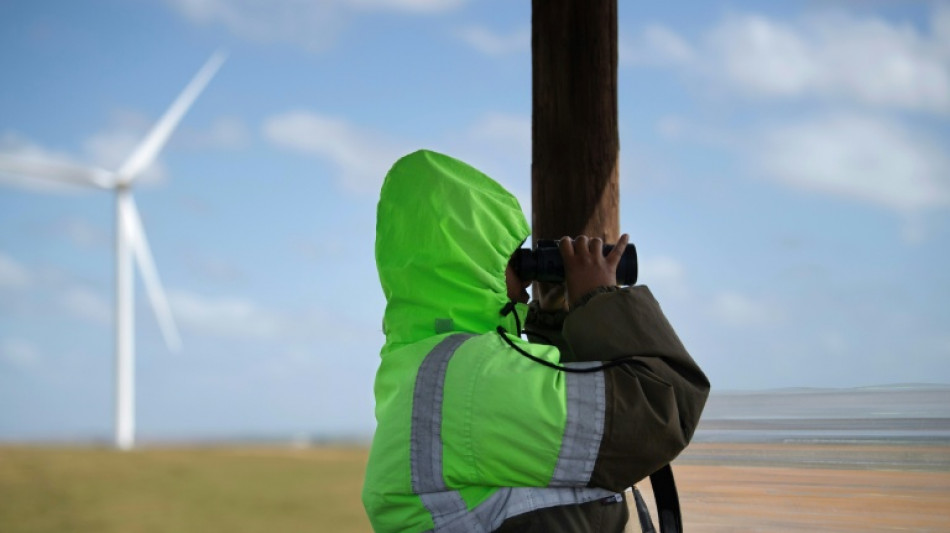
Powerful gusts shook an observation post perched on a hill at a wind farm in South Africa as two monitors scanned the landscape through binoculars.
The Overberg mountains stretched along the horizon, but the monitors -- bundled in scarves -- were focused on activity much closer: around a giant wind turbine, a small, dark silhouette had appeared.
"Stop turbine 11, please. Cape vulture," one said into a walkie-talkie. "Stopping turbine 11," came the reply.
Immediately, the blades of the 150-metre (500-feet) turbine began to slow, coming to a complete stop in less than a minute.
BirdLife South Africa estimates that every year an average 4.25 birds are killed per wind turbine, most often when they fly into blades that can reach speeds of up to 280 kilometres (175 miles) per hour.
With more than 1,400 turbines operating across South Africa, an estimated 6,000 birds die this way a year, the group says. Ten percent are endangered species.
To mitigate the impact, Excelsior Wind Farm has implemented a Shutdown on Demand Protocol that prioritises six vulnerable species, including the Cape vulture and endangered black harrier.
When monitors spot one, "they inform the control room via radio and that's when they will turn off the turbine," said conservationist Clarissa Mars, who oversees the programme at the farm 200 kilometres east of Cape Town.
"That takes approximately 43 seconds," she told AFP.
"There were less than eight fatalities for the site in approximately five years," Mars said. "And I'm just very happy knowing there were no fatalities this year."
The Stop on Demand Protocol -- developed in the late 2010s, notably in Kenya -- has been adopted worldwide and was introduced at Excelsior in 2020.
Its impact on energy output at its small operation of 13 turbines has been negligible, said site manager Jacques Redelinghuys.
"We've lost less than 0.5 percent of revenue due to the programme," he said. "And on days like today, when we do produce more due to our high wind speed, we make up for the losses that we incurred."
- Extinction by wind farm? -
While the shutdown protocol has saved some species from the blades at Excelsior, such as the Cape vulture, it has been less effective for the black harrier, a critically endangered bird of which only around 1,300 remain in the world.
The smaller bird is harder for the monitors to spot, conservationist Odette Curtis-Scott said.
The Overberg region is a vital breeding ground for the black harrier, but 95 percent of its natural habitat here has been lost to agriculture, she said.
This forces the bird to travel further in search of water and prey, increasing the risks of colliding with turbines.
"It's not ideal that the wind farm is where it is," said Curtis-Scott, who heads the Overberg Renosterveld Trust.
In early 2025, the trust bought land five kilometres from Excelsior where there is a black harrier colony and about 40 return to breed each year.
Despite the efforts, around 13 black harriers have been killed at South Africa's more than 30 wind farms in the past decade, according to University of Cape Town professor Rob Simmons.
"If we were to kill an extra three to five adult black harriers per year through wind farms, the population will go extinct within 75 to 100 years," he said.
"It's one of the first species in South Africa, possibly even in Africa, for which we know that wind farms can have a direct effect on the potential extinction."
Another potential solution to this "green-green dilemma" is painting turbine blades, Simmons said.
"Birds do not see black and white contrasts as well as we do," he said. "They, therefore, do not see a white blade spinning against a cloudy sky. This is very likely why they do not avoid it."
An experiment at a wind farm 90 kilometres north of Cape Town, where blades were painted with bold red stripes, resulted in a 87 percent drop in bird mortality over two years, he said.
"We cannot continue burning fossil fuels," he said. "Some species, like the black harrier, will not survive climate change. But we also cannot sacrifice numerous birds on the altar of renewable energy."
O.Salim--SF-PST