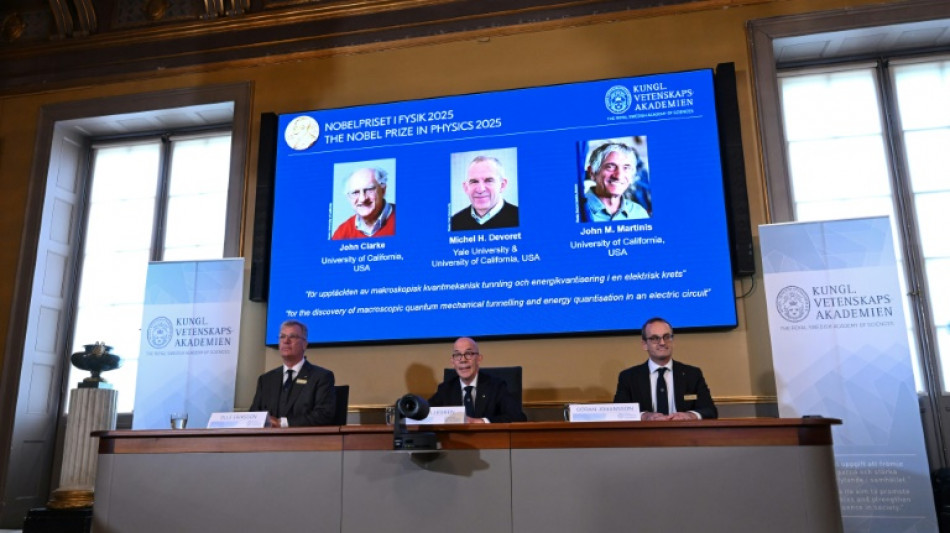
Trio wins physics Nobel for quantum mechanical tunnelling / Photo: Jonathan Nackstrand - AFP

 Alcaraz to return for US Open title defence
 China's rapid solar expansion hurt bird diversity: study
 President Paul Biya back in Cameroon after 73 days away
 Newcastle boss Jaissle unfazed by lack of respect
 US Open purse to top $100 mn as Grand Slams form player council
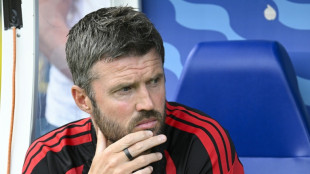
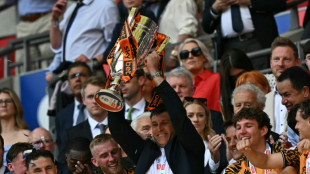 Hull aim to silence critics after unexpected promotion to Premier League
 Pakistan hit back against England after Cox and Root fifties
 Walmart reports mixed results as gas prices drag on US sales growth
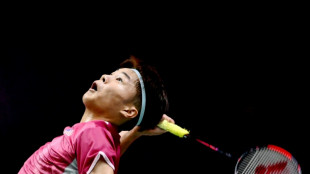 Wang downs Sindhu to break Indian hearts at badminton worlds
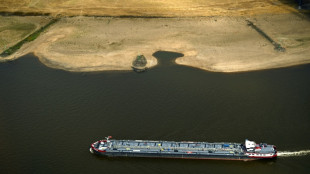 As Europe's rivers recede, shippers scramble to limit damage
 Alonso won't confirm Fernandez will remain at Chelsea after Man City link
 Milky Way's fastest star discovered spinning around black hole
 Kanye West planned concerts trigger frenzy in Russia
 Hungary music festival basks in post-Orban freedom
 Vatican says 'serious concerns' over Israel-Lebanon deal implementation
 Arteta confirms Arsenal want to sign defender after Konsa link
 What's behind the UAE's decision to cut Iran trade ties?

 Barca seal Cancelo return to bolster defence
 Germany reports record 14,000 heat-related deaths this summer

 Alvarez 'focused' says new Atletico team-mate Romero
 West Ham warn fans about 'offensive' Solomon chant
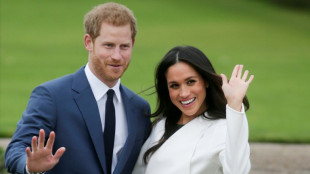 Huge questions loom over Prince Harry's shock return to UK

 BYDFi Joins Coinfest Asia 2026, Connecting with Institutions, Builders and Traders in Bali
 Max Verstappen: Natural-born winner
 Van Dijk urges Liverpool to make amends for 'unacceptable' season
Briton John Clarke, Frenchman Michel Devoret and American John Martinis won the Nobel Prize in Physics on Tuesday for work on quantum physics in action, the Nobel jury said.
The trio was honoured "for the discovery of macroscopic quantum mechanical tunnelling and energy quantisation in an electric circuit," the jury said.
Quantum mechanics describes how differently things work on incredibly small scales.
For example, when a normal ball hits a wall, it bounces back. But on the quantum scale, a particle will actually pass straight through a comparable wall -- a phenomenon called "tunnelling".
Tuesday's prize was awarded for experiments in the 1980s which showed that quantum tunnelling can also be observed on a macroscopic scale – involving multiple particles – by using superconductors.
In a series of experiments, the researchers demonstrated that "the bizarre properties of the quantum world can be made concrete in a system big enough to be held in the hand," the Royal Swedish Academy of Sciences said in a statement.
The jury noted that the discoveries had "provided opportunities for developing the next generation of quantum technology, including quantum cryptography, quantum computers, and quantum sensors."
"It is wonderful to be able to celebrate the way that century-old quantum mechanics continually offers new surprises. It is also enormously useful, as quantum mechanics is the foundation of all digital technology," Olle Eriksson, chair of the Nobel Committee for Physics, said in a statement.
- 'Never occurred to me' -
Clarke, 83, is a professor at the University of California, Berkeley, and Devoret, 72, is a professor at University of California, Santa Barbara and is listed as a professor emeritus at Yale University.
Martinis, born 1958, is also a professor at the University of California, Santa Barbara.
"To put it mildly, it was the surprise of my life," Clarke told reporters via telephone during the prize announcement, about learning of his award.
"It never occurred to me in any way that this might be the basis of a Nobel Prize," Clarke added.
Clarke explained that the scientists were focused on the physics of their experiments and that they didn't realise the practical applications that could follow.
"It certainly had not occurred to us in any way that this discovery would have such a significant impact," Clarke said.
The physics prize is the second Nobel of the season, after the medicine prize was awarded on Monday to a US-Japanese trio for research into the human immune system.
Mary Brunkow and Fred Ramsdell, of the United States, and Japan's Shimon Sakaguchi were recognised by the Nobel jury for identifying immunological "security guards".
Last year, the Nobel Prize in Physics went to British-Canadian Geoffrey Hinton and American John Hopfield for their pioneering work on the foundations of artificial intelligence -- with both of them warning that their discoveries carried profound risks to society and humanity.
The physics prize will be followed by the chemistry prize on Wednesday.
The literature prize will be announced on Thursday, and the highly watched Nobel Peace Prize on Friday.
The economics prize wraps up the 2024 Nobel season on October 14.
The Nobel consists of a diploma, a gold medal and a $1.2 million cheque, to be shared if there is more than one winner in a discipline.
The laureates will receive their prizes from Sweden's King Carl XVI Gustaf at a formal ceremony in Stockholm on December 10.
That date is the anniversary of the death in 1896 of scientist Alfred Nobel, who created the prizes in his will.
I.Matar--SF-PST