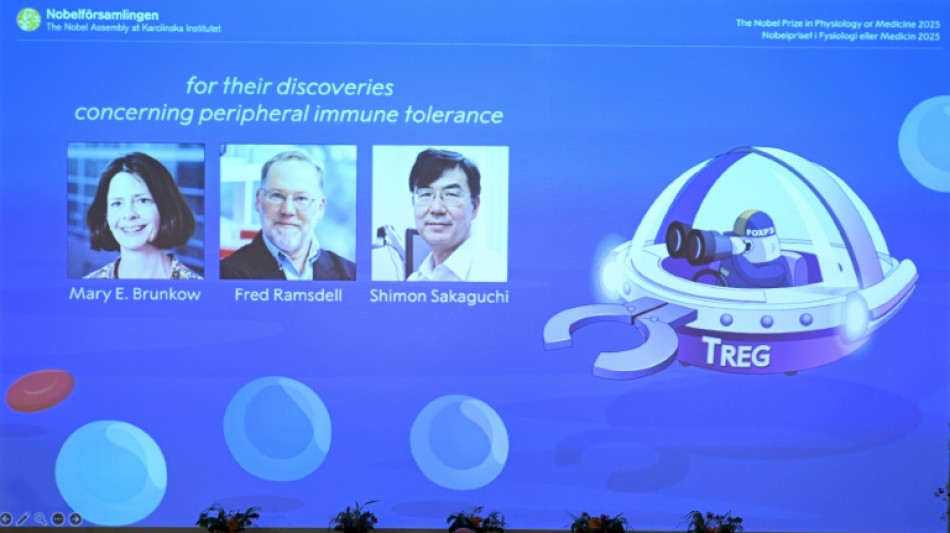
Medicine Nobel to trio who identified immune system's 'security guards' / Photo: Jonathan Nackstrand - AFP

 Alcaraz to return for US Open title defence

 China's rapid solar expansion hurt bird diversity: study
 President Paul Biya back in Cameroon after 73 days away
 Newcastle boss Jaissle unfazed by lack of respect
 US Open purse to top $100 mn as Grand Slams form player council

 Hull aim to silence critics after unexpected promotion to Premier League
 Pakistan hit back against England after Cox and Root fifties
 Walmart reports mixed results as gas prices drag on US sales growth
 Wang downs Sindhu to break Indian hearts at badminton worlds
 As Europe's rivers recede, shippers scramble to limit damage
 Alonso won't confirm Fernandez will remain at Chelsea after Man City link
 Milky Way's fastest star discovered spinning around black hole
 Kanye West planned concerts trigger frenzy in Russia
 Hungary music festival basks in post-Orban freedom
 Vatican says 'serious concerns' over Israel-Lebanon deal implementation
 Arteta confirms Arsenal want to sign defender after Konsa link
 What's behind the UAE's decision to cut Iran trade ties?
 Barca seal Cancelo return to bolster defence
 Germany reports record 14,000 heat-related deaths this summer

 Alvarez 'focused' says new Atletico team-mate Romero
 West Ham warn fans about 'offensive' Solomon chant
 Huge questions loom over Prince Harry's shock return to UK
 BYDFi Joins Coinfest Asia 2026, Connecting with Institutions, Builders and Traders in Bali
 Max Verstappen: Natural-born winner
 Van Dijk urges Liverpool to make amends for 'unacceptable' season
A US-Japanese trio on Monday won the Nobel Prize in Medicine for research into how the immune system is kept in check by identifying its "security guards", the Nobel jury said.
The discoveries by Mary E. Brunkow and Fred Ramsdell of the United States and Japan's Shimon Sakaguchi have been decisive for understanding how the immune system functions and why we do not all develop serious autoimmune diseases.
Sakaguchi, a professor at the Immunology Frontier Research Centre in Osaka, told Swedish broadcaster Sveriges Radio: "It's an honour for me. I'm looking forward to visiting Stockholm in December" to receive the award in person.
The Nobel committee was however unable to reach the two US-based laureates to break the news to them in person.
"If you hear this, call me," the head of the Nobel Assembly, Thomas Perlmann, joked at the press conference announcing the winners.
The three won the prize for research that identified the immune system's "security guards", called regulatory T-cells.
Their work concerns "peripheral immune tolerance" that prevents the immune system from harming the body, and has led to a new field of research and the development of potential medical treatments now being evaluated in clinical trials.
"The hope is to be able to treat or cure autoimmune diseases, provide more effective cancer treatments and prevent serious complications after stem cell transplants," the jury said.
- Protecting the body -
Sakaguchi made the first key discovery in 1995.
At the time, many researchers were convinced that immune tolerance only developed due to potentially harmful immune cells being eliminated in the thymus, through a process called "central tolerance".
Sakaguchi, 74, showed that the immune system is more complex and discovered a previously unknown class of immune cells, which protect the body from autoimmune diseases.
Brunkow, born in 1961 and a senior project manager at the Institute for Systems Biology in Seattle, and Ramsdell, a 64-year-old senior advisor at Sonoma Biotherapeutics in San Francisco, made the other key discovery in 2001, when they were able to explain why certain mice were particularly vulnerable to autoimmune diseases.
"They had discovered that mice have a mutation in a gene that they named Foxp3," the jury said.
"They also showed that mutations in the human equivalent of this gene cause a serious autoimmune disease, IPEX."
Two years later, Sakaguchi was able to link these discoveries.
The trio will receive their prize -- a diploma, a gold medal and $1.2 million split three ways -- at a formal ceremony in Stockholm on December 10.
Researchers from major US institutions typically dominate the Nobel science prizes, due largely to the US' longstanding investment in basic science and academic freedoms.
But that could change down the line following massive US budget cuts to science programmes announced by President Donald Trump.
Since January, the US National Institutes of Health (NIH) has terminated 2,100 research grants totalling around $9.5 billion and $2.6 billion in contracts, according to an independent database called Grant Watch.
- Trump eyeing Peace Prize -
Thomas Perlmann, secretary general of the committee that awards the Nobel Prize for Medicine, told AFP it was "no coincidence that the US has by far the most Nobel laureates".
"But there is now a creeping sense of uncertainty about the US' willingness to maintain their leading position in research," he said.
Trump has meanwhile made no secret of the fact that he wants to win a Nobel himself -- the Peace Prize.
Nobel experts have however said his "America First" policies and divisive style give him little chance.
"It's completely unthinkable," Oeivind Stenersen, a historian who has conducted research and co-written a book on the prize, told AFP.
"(Trump) is in many ways the opposite of the ideals that the Nobel Prize represents," he said, citing "multilateral cooperation" as an example.
Trump "follows his own path, unilaterally," Stenersen added.
Sudan's networks of volunteers Emergency Response Rooms (ERR) helping people survive war and famine -- are seen as a possible contender this year, as are media watchdogs the Committee to Protect Journalists, Reporters Without Borders, and Yulia Navalnaya, the widow of Kremlin critic Alexei Navalny.
D.Qudsi--SF-PST