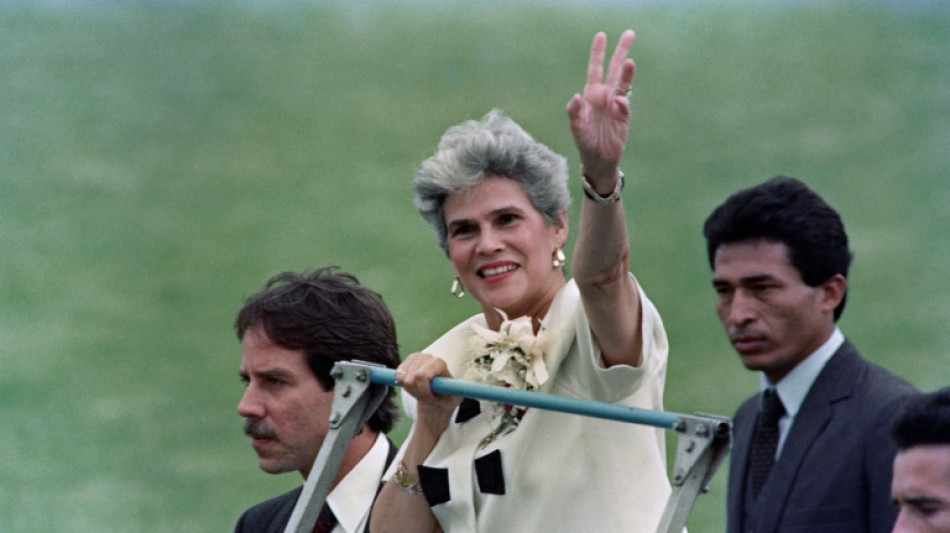
Violeta Chamorro, who brought peace to Nicaragua, dead at 95 / Photo: David AKE - AFP/File

 Ronaldinho returns in search of 'beautiful' 300th goal
 US pushes allies, China to back Trump's economic war on Iran
 Former NBA MVP Harden reportedly set to return to Cavaliers

 Brook makes Pakistan pay for drop as England dominate first Test
 MemeCore Arrives on Nasdaq Through $1 Billion Landmark Treasury Transaction
 First US deportees land in Liberia
 US, Canada resume talks to finalize trade deal as details emerge

 Europe heatwaves scorch 80 million with 40 C heat: AFP analysis

 Carrick insists Man Utd will make more signings after quiet transfer window

 US warns allies, China to back economic war on Iran

 Manifesto defends Germany's iconic Bauhaus against 'populist attacks'

 Kenya's Kipyegon ends season with hamstring injury
 Nord Stream bomb suspect arrested while working on movie about attack: media
 German football fans plan widespread VAR protests

 Scorching summer triggers record rockfalls in Alps, scientist says

 Newly-crowned European champ Werro turns focus on 800m record

 Hamilton 'fittest ever' as he chases eighth F1 title
 Stocks retreat as bond yield fears persist, oil rises
 ARKBRIDGE’s David Mali Highlights AI-Driven Risk Management at the Finance Magnates London Summit

 Zuckerberg buys Gothic castle in Ireland: spokesman

 Belgium's fire of the century now 'under control'
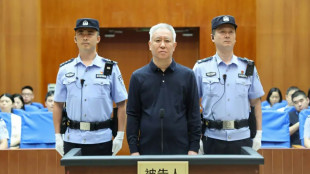 Evergrande's Xu Jiayin: from real-estate tycoon to life in prison

 Spurs eyeing move for Man City's Savinho and Marmoush - reports

 Springboks captain Kolisi to miss first All Blacks Test
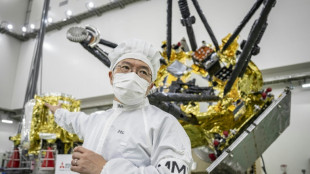 Japan to launch probe for Mars moons in October: space agency
Violeta Chamorro, who brought peace to Nicaragua after decades of war and was the first woman elected president in the Americas, died Saturday at the age of 95, her family said.
Chamorro, who ruled the poor Central American country from 1990 to 1997, "died in peace, surrounded by the affection and love of her children," said a statement issued by her four children.
As president, Chamorro managed to bring to an end a civil war that had raged for much of the 1980s as US-backed rebels known as the 'Contras' fought the leftist Sandinista government.
That conflict made Nicaragua one of the big proxy battlegrounds of the Cold War.
Chamorro put her country on the path to democracy in the difficult years following the Sandinista revolution of 1979, which had toppled the US-backed right-wing regime of Anastasio Somoza.
In a country known for macho culture, Chamorro had a maternal style and was known for her patience and a desire for reconciliation.
When she won the 1990 election at the head of a broad coalition, she defeated Daniel Ortega, the Sandinista guerrilla leader and icon who is now president again.
Ortega has been in power for 17 years and is widely criticized by governments and rights groups as having crushed personal freedoms, all political opposition and judicial independence with autocratic rule.
Chamorro died in Costa Rica, where she moved in 2023, to be close to her children, three of whom are living here in exile because of their opposition to Ortega.
Chamorro -- Nicaraguans referred to her affectionately as "Dona Violeta" -- had been living far removed from public life for decades. In her later years, she suffered from Alzheimer's disease.
"Her legacy is unquestionable," said Felix Madariaga, a Nicaraguan academic and political activist living in exile in the United States.
- 'Typical of a homemaker' -
"She led the transition from war to peace, healing a country destroyed by war. The contrast with Ortega is clear and deep," said Madariaga.
Chamorro was the widow of Pedro Joaquin Chamorro, who came from one of Nicaragua's most prominent families.
As owner and chief editor of the newspaper La Prensa, he was killed in 1978 in an attack blamed on the regime of Anastasio Somoza.
His death propelled Chamorro to take over the newspaper and, eventually, to get into politics.
After the Sandinistas seized power in 1979, she became the only female member of a national reconstruction government.
But she quit that junta in 1980, believing the Sandinistas were moving too far to the left and into the sphere of communist Cuba.
Chamorro became prominent in the opposition to the Sandinistas as they fought the 'Contra' rebels financed by the United States under Ronald Reagan.
In 1990, she stunned the country by winning the presidency -- and beating Ortega -- as leader of a coalition of 14 parties.
During the campaign, she was known for wearing white and had to use a wheelchair because of a knee injury.
In her memoirs, Chamorro said she won because she gained the trust of war-weary Nicaraguans as she spoke in simple language "typical of a homemaker and a mother."
"In the macho culture of my country, few people believed that I, a woman, and what is more, handicapped, had the strength, energy and will" to beat Ortega, she wrote.
"But if the Berlin Wall fell, why not the Sandinistas?"
C.AbuSway--SF-PST