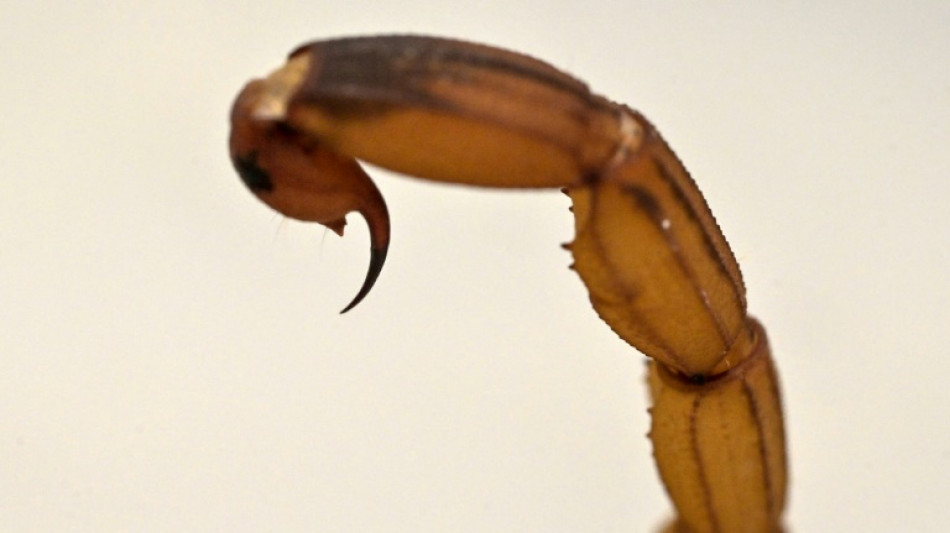
Thriving scorpion population is stinging problem for Brazil / Photo: Nelson ALMEIDA - AFP

 'I'll adapt': First pregnant candidate navigates French presidential race

 Hong Kong convicts Tiananmen vigil activists of inciting subversion

 The Hong Kong Tiananmen vigil activists convicted in national security trial

 Eel-powered Japan whizz-kid, 11, chases Asian Games history

 Asian markets extend rally as traders assess US Treasuries pledge

 Barcelona enter new era as Flick targets La Liga hat-trick

 Pogacar favourite for Vuelta with Grand Tour treble in sight

 Bangladesh coach Simmons wary of Australia backlash in second Test

 Hong Kong Tiananmen activists to receive national security verdict

 Who are the candidates vying to lead the UN?

 Swiatek into Cincinnati semis after Rybakina injury

 University suspends academic behind Jason Arday plagiarism charges

 Key European leaders demand Israel halt West Bank settlement project

 McIlroy bounces back to share BMW Championship lead

 Cobolli fueled by candy in sweet defeat of Paul

 Jailed Pakistan ex-PM Khan moved to hospital on court order: party

 Pogacar eyes 'missing' piece ahead of Vuelta return

 US, Canada 'very close' to trade deal, Ottawa says, as details emerge

 Ronaldinho returns in search of 'beautiful' 300th goal

 US pushes allies, China to back Trump's economic war on Iran

 Former NBA MVP Harden reportedly set to return to Cavaliers

 Brook makes Pakistan pay for drop as England dominate first Test

 MemeCore Arrives on Nasdaq Through $1 Billion Landmark Treasury Transaction

 First US deportees land in Liberia

 US, Canada resume talks to finalize trade deal as details emerge

Forget snakes, it's scorpions Brazilians most need to worry about.
The arachnids -- feared for the toxic stinger poised atop their tails -- are proliferating thanks to urbanization and warming temperatures.
The result is that scorpions have become the most lethal poisonous animal in Brazil, posing a growing danger for people across the whole country -- and spurring demand for antivenom.
The most widely found species in the country, the Brazilian yellow scorpion, is the most dangerous scorpion in South America.
Unusually for scorpions, this all-female species also reproduces asexually, reducing population-control options.
"With a warming habitat, these animals' metabolisms are also warming, so they are more active, eating more and reproducing more," explained Thiago Chiariello, production coordinator of the scorpion antivenom lab at Brazil's Instituto Butantan in Sao Paulo.
Add to that rampant urbanization which both scares away scorpions' natural predators such as lizards and birds while boosting the number of available cockroaches -- tasty meals for the arachnids -- and the problem is evident.
"Cities are growing unchecked" and the spread of trash they bring means more food supply for scorpions, Chiariello said.
"This is leading to more contact with people, which means more accidents."
- Soaring sting numbers -
Last year -- the latest dataset available -- there were 152 deaths from scorpion stings in Brazil, compared with 140 from snakebites. That was an increase from 2019, when 95 deaths by scorpion sting were recorded.
According to Brazil's health ministry, there were more than 200,000 scorpion sting incidents registered last year -- 250 percent more than a decade earlier, and an average of nearly 550 stings per day.
Healthy adults might get mild to moderate symptoms from a Brazilian yellow scorpion sting, including pain, vomiting, profuse sweating and tremors.
But there are more severe symptoms -- including shock, fluid build-up in the lungs, cardiovascular collapse and heart failure -- that can prove deadly, especially for children and the elderly.
- Life-saving antivenom -
That makes the Butantan institute's antivenom very important.
Chiariello's team carry out their serum-making task in making that serum with extreme precision.
They first use tweezers to guide a live scorpion's stinger into a container.
The poison is then injected into horses, which are less vulnerable to the toxin's effects than humans, and which produce more antibodies.
"There is a whole purification process in the horses' blood," explained Paulo Goldoni, a biologist at the institute.
"The serum is the only way to save lives," he said.
Last year saw more than 11,000 people in Brazil receive scorpion antivenom, mostly in the country's heavily populated southeast, according to authorities.
With serum demand growing, but also the number of available scorpions, the Instituto Butantan has a steady supply of venom donors.
"If ever there was a lack of serum, we would certainly see a serious increase in the number of deaths," the biologist said.
F.AbuZaid--SF-PST