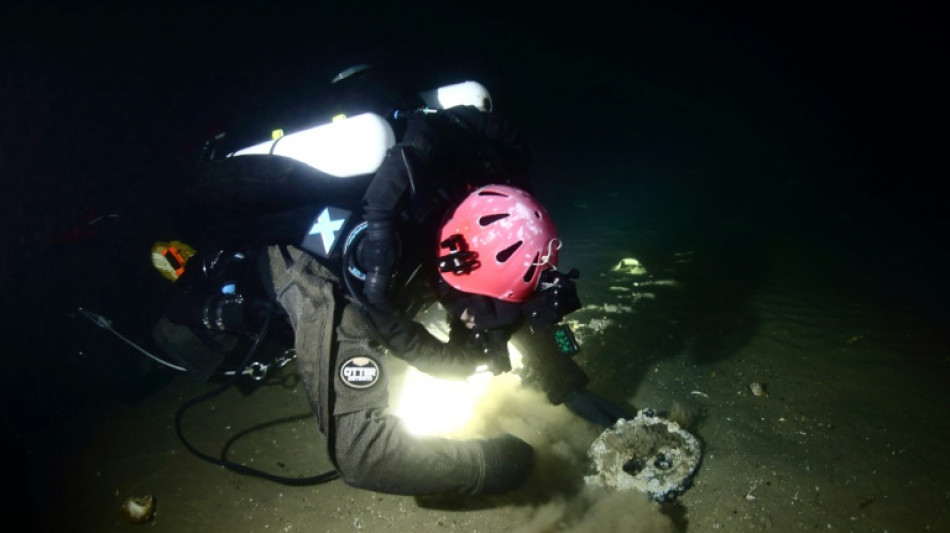
Wreck discovered of French steamship that sank in Atlantic in 1856 / Photo: Andrew Donn - Atlantic Wreck Salvage/AFP

 Drovix Launches In-House Multi-Asset Liquidity and Execution Stack for Sub-Millisecond Fills, Tighter Spreads

 'So bad it's good': rough animated film becomes surprise Chinese hit

 'I'll adapt': First pregnant candidate navigates French presidential race

 Hong Kong convicts Tiananmen vigil activists of inciting subversion

 The Hong Kong Tiananmen vigil activists convicted in national security trial

 Eel-powered Japan whizz-kid, 11, chases Asian Games history

 Asian markets extend rally as traders assess US Treasuries pledge

 Barcelona enter new era as Flick targets La Liga hat-trick

 Pogacar favourite for Vuelta with Grand Tour treble in sight

 Bangladesh coach Simmons wary of Australia backlash in second Test

 Hong Kong Tiananmen activists to receive national security verdict

 Who are the candidates vying to lead the UN?

 Swiatek into Cincinnati semis after Rybakina injury

 University suspends academic behind Jason Arday plagiarism charges

 Key European leaders demand Israel halt West Bank settlement project

 McIlroy bounces back to share BMW Championship lead

 Cobolli fueled by candy in sweet defeat of Paul
 Jailed Pakistan ex-PM Khan moved to hospital on court order: party

 Pogacar eyes 'missing' piece ahead of Vuelta return

 US, Canada 'very close' to trade deal, Ottawa says, as details emerge

 Ronaldinho returns in search of 'beautiful' 300th goal

 US pushes allies, China to back Trump's economic war on Iran

 Former NBA MVP Harden reportedly set to return to Cavaliers

 Brook makes Pakistan pay for drop as England dominate first Test

 MemeCore Arrives on Nasdaq Through $1 Billion Landmark Treasury Transaction

A US dive team has discovered the wreck of a French steamship, Le Lyonnais, that sank in the Atlantic Ocean in 1856 after a "hit-and-run" collision with an American sailing vessel, claiming 114 lives.
Le Lyonnais, which was built in 1855 and was considered state-of-the-art at the time, was returning to France after completing its maiden voyage from Le Havre to New York when the disaster occurred.
Jennifer Sellitti of Atlantic Wreck Salvage, a New Jersey-based company, said a team on the dive boat D/V Tenacious discovered the wreckage of Le Lyonnais last month after a two-decade search.
Sellitti said divers positively identified the ship in waters 200 miles (320 kilometers) off of New Bedford, Massachusetts, in an area known as the Georges Bank. They are not revealing the exact location for now.
"She certainly doesn't look as good as she used to," Sellitti told AFP. "She was really broken apart.
"The North Atlantic is a brutal place to be a shipwreck -- storms, tides," she said. "The Nantucket shoals are known for shifting sands that just completely bury wrecks."
Sellitti said measurements of an engine cylinder were key to identifying the vessel.
The iron-hulled Le Lyonnais, which had both sails and a steam engine, was built by a British shipmaker, Laird & Sons, for Compagnie Franco-Americaine to provide passenger and mail service across the Atlantic.
"The 1850s was the beginning of the transition from sail to steam," Sellitti said. "This was an early attempt by France to have its first successful passenger line."
Le Lyonnais had sailed to New York carrying cargo and mail, she said, and was returning to Le Havre with its first passengers, most of whom were French.
- Hit-and-run -
On the night of November 2, 1856, Le Lyonnais, carrying 132 passengers and crew, collided with the Adriatic, an American barque which was sailing from Maine to Georgia.
Jonathan Durham, the Adriatic's captain, in a statement published in the November 19, 1856 edition of The New York Times, said it was around 11:00 pm on a starlit but "hazy" night when Le Lyonnais "suddenly changed her course, which rendered a collision inevitable."
Durham said the Adriatic suffered significant damage but managed to make it to Gloucester, Massachusetts two days later while Le Lyonnais continued on its way.
The French ship had, in fact, suffered extensive damage -- a hole at the water line and another one lower, probably near its coal bunkers, Sellitti said.
It sank several days later. The handful of survivors were picked up by another ship.
Sellitti, whose book about the incident, "The Adriatic Affair: A Maritime Hit-and-Run Off the Coast of Nantucket," comes out in February 2025, said the sinking of Le Lyonnais was "a really big deal at the time."
The American captain was arrested and put on trial in France, she said, and the collision raised a number of novel maritime liability questions such as what happens when a sailing vessel meets a steamship at sea.
The disaster, which is mentioned in Jules Verne's novel "Twenty Thousand Leagues Under the Sea," was the focus of much international attention, she said, but when the US Civil War broke out in 1861 "everybody stopped talking about this and went on to the Civil War."
L.Hussein--SF-PST