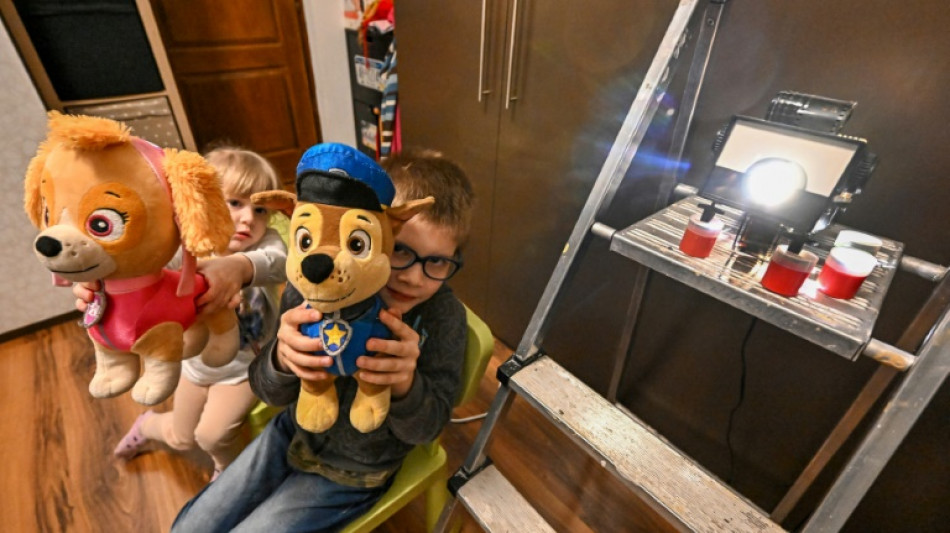
Filmstrip, Hungary's old-school projectors children love / Photo: ATTILA KISBENEDEK - AFP

 Elijah Moore Scores Career-High 29 as McNeese Sets School Records in 135-87 Win

 ترمب يعلن عن رغبة قوية لإنهاء حرب أوكرانيا قبل محادثات أبوظبي

 Honolulu Voters Reject Ranked Choice Voting in Election

 Panthers expected to begin 2027 NRL season away from new stadium

 Sweet As app launches restaurant discovery platform

 MLA seeks inquiry into reported sectarian gestures on Ormeau Road

 Louise O’Reilly attacks Simon Harris over unemployment remarks

 Virginia overwhelms Arkansas 91-72 behind balanced scoring

 Second major storm brings destructive winds and outages to British Columbia

 Godzilla Minus Zero leads North American box office with $31.6m
 Advocate calls for coordinated support for children facing trafficking

 Pennsylvania Democrats secure state trifecta in midterm elections

 Godzilla Minus Zero sets foreign-language box-office opening record

 Villeneuve teases James Bond casting at Los Angeles museum gala

 Nottinghamshire launches specialist rural crime policing team

 China confirms talks over possible Xi-Putin-Trump summit

 The Sourdough Sidekick Review: Can an Automated Feeder Save Your Starter?

 Energy bill plan could use HMRC income data to target support

 Business owner earning £6,000 a month tackles £70,000 debt

 Nvidia chief faces inquiry after disclosing affair with suspected Chinese agent

 Comet returns as online electrical marketplace 14 years after collapse

Tablets and mobile phones may have to be prised from the fingers of children elsewhere, but in Hungary storytime can be all about a 100-year-old piece of tech -- filmstrip.
Generations of kids there have been enthralled with stories told with the help of a projector.
Alexandra Csosz-Horvath turns off the lights and reads "Sleeping Beauty" from a series of still captioned images projected onto the bedroom wall -- her three- and seven-year-old clearly under her spell.
"We're together, it's cozier than the cinema yet it's better than a book," said the 44-year-old lawyer.
Filmstrip -- a century-old storytelling medium that was killed off in the West by the video cassette in the 1980s -- is not just hanging on in Hungary, it is thriving with a new wave of enthusiasts charmed by its slower-paced entertainment.
Printed on rolls of film, the still images were never meant to move.
- Long tradition -
"Between the 1940s and the 1980s filmstrips were used worldwide as a cost-effective visualisation tool in education and other fields," Levente Borsos, of Seoul's Hankuk University of Foreign Studies, told AFP.
But while it was surpassed by more advanced technologies in the West, it became a popular form of home entertainment in the Soviet bloc where TVs and videos were harder to come by.
When communism collapsed, filmstrip began to disappear -- except in Hungary, where the since privatised Diafilmgyarto company survives as the country's sole producer.
"Continuous filmstrip publishing and slide shows at home can be considered a Hungarian peculiarity, a special part of the country's cultural heritage," Borsos said.
- Revival -
Producer Diafilmgyarto has seen sales rebound from 60,000 in the 1990s to 230,000 rolls last year.
Each film -- produced solely for the domestic market -- costs around five euros ($5.50), less than a cinema ticket. Most are adaptations of classic fairy tales or children's books.
One bestseller, Hungarian classic "The Old Lady and the Fawn" about a woman taking care of a young deer, has been in the top 10 since its release in 1957, according to Diafilmgyarto's managing director Gabriella Lendvai.
The company also commissions artists, including some famous Hungarians, to create exclusive content for its filmstrips.
It's "an irreplaceable tradition in Hungarian culture", said Beata Hajdu-Toth, who attended a recent filmstrip screening in a Budapest cinema along with her son to celebrate Diafilmgyarto's 70th anniversary.
"I am very happy it's part of our life and hopefully I will be able to narrate to my grandchildren as well," the 37-year-old added.
At her home in the Budapest suburbs, Csosz-Horvath also hails the tradition, preferring it to fast-paced cartoons, which she said drive the children "wild".
"They just can't understand that what happens in three seconds on the screen happens in three hours in real life," she said.
With filmstrips "they don't believe that everything happens in the blink of an eye."
J.Saleh--SF-PST