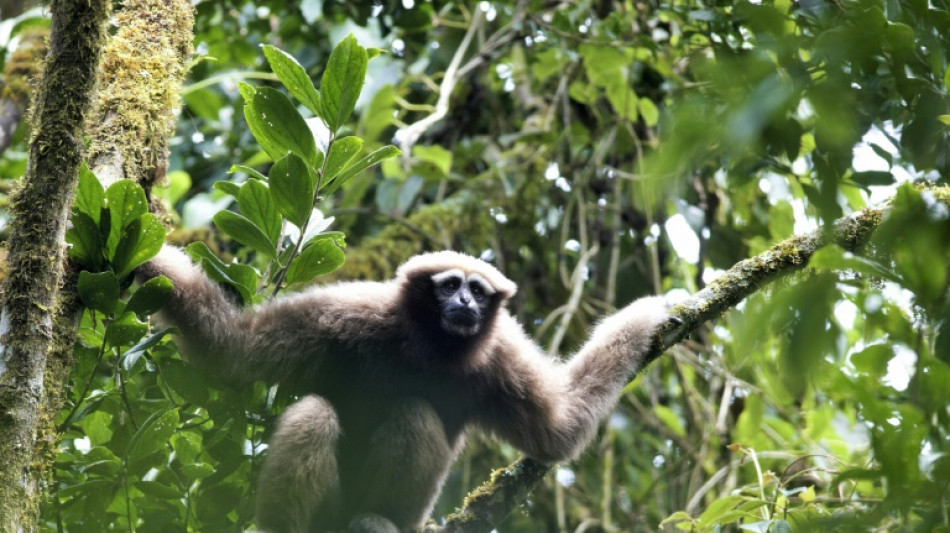
Finding Skywalker gibbons with love songs: study / Photo: Pengfei Fan - Sun Yat-Sen University/AFP

 At least 2 teens seriously wounded in sword attack at Swedish school

 Popular forest near Paris to reopen after wildfire

 UN holds second informal poll of secretary-general candidates

 Shakhtar Donetsk to play Champions League home games at Chelsea

 Arsenal sign Villa centre-back Konsa as champions bolster defence

 The 'hedgehogs' leading Poland's defences on Russian border

 England thrash Pakistan by an innings and 103 runs in first Test

 Fury says Joshua fight 'doesn't look like it's going to happen'

 Argentina's Paredes suspended 10 matches by FIFA for World Cup fight

 Watkins and Martinez could join Villa exodus says Emery

 UK court orders Prince Harry, others to pay Daily Mail £9.5mn

 Aligned Launches $ALIGN, the Native Token of Its Full Ethereum Stack

 Bitcoin jumps, stocks bounce as traders weigh US Treasury action

 Man City boss Maresca hit with Doku injury blow

 Iraola wants to sign wingers to boost Liverpool's attacking options

 Maresca needs time to succeed after 'big changes' at Man City

 Meghan faces difficult return to the UK

 Archer double strengthens England's grip on first Test against Pakistan

 MEXC Lists Ondo Tokenized Stock Moderna (MRNAON), Expanding Access to U.S. Biotech Exposure

 Japan axes Netflix collaboration after outcry over dating show

 Stocks tread cautiously as traders weigh US Treasury action

 STARTRADER Launches XAUUSD247, Extending Gold CFD Access Across the Full Week

 Spurs agree deal to sign Man City's Savinho: reports

 US-sanctioned ICC head warns against 'demise of international rule of law'

 Top India court orders new steps to protect threatened elephants

Valentine's day is over but love's call lingers: the Skywalker gibbons' mating song, scientists reported this week, has revealed a previously unknown population -- the largest in the world -- of the endangered primate in the jungles of Myanmar.
When the Skywalker hoolock gibbon was first discovered in 2017 by a group of Star Wars-loving scientists, its only confirmed population -- less than 200 individuals -- was in neighbouring China's Yunnan Province.
But in a new study published in the International Journal of Primatology, researchers confirmed Myanmar has the largest known population of Skywalker gibbons in a single location.
"This is a significant discovery for the future of primate conservation in Myanmar," Ngwe Lwin, expedition leader and Fauna & Flora country director in Myanmar, said in a statement.
Gibbons do not swim, restricting them to the forest canopy's towering treetops.
This means broad rivers cutting through the jungle can dictate where the species settles.
Though no live Skywalker gibbons have been confirmed in Myanmar over the past century, a team of researchers from Myanmar, the United States, Britain and Germany followed a hunch based on geography that the primates might be found between two rivers in the southeast Asian nation.
Between December 2021 and March 2023, researchers set up acoustic monitoring systems in the hopes of detecting and recording the Skywalker's morning love songs to figure out their location.
Then, the team collected half-eaten plants and fruits favoured by the primates for genetic analysis.
When spotted, the researchers took photographs of Skywalker hoolock gibbons and compared them to other hoolock species, noting that Skywalkers have distinctively thinner eyebrows, a black or brown beard rather than a white one, and females have incomplete white face rings.
After determining viable habitat, analysing recordings and photographs, sequencing DNA and interviewing local wildlife and conservation organisations, the team had no doubts: Myanmar is home to 44 groups of Skywalker gibbons.
While the exact number of Skywalker gibbons in the new location is still unknown, a 2013 population estimate suggested that there could have been up to 65,000 gibbons in the area where Skywalkers were identified.
However, the current number of individuals could be lower due to the threats the primates face.
- Urgent need for protection -
Only four percent of habitat in Myanmar suitable for Skywalker gibbons is found in established protected areas.
Besides habitat loss, other threats the primates face include land fragmentation and degradation, accelerating deforestation, "bush meat" hunting, and the live trade in exotic animals.
More than 95 percent of the skywalker gibbon population in Myanmar exists outside of protected areas, and population decline is projected to continue, and possibly accelerate, according to the study.
Given these threats, the researchers recommended to the International Union for the Conservation of Nature (IUCN) that the species keep its "endangered" status despite the discovery of a new population.
"Now more than ever, it is recognised that the collective efforts of stakeholders, including governments, communities and Indigenous Peoples groups, are the only effective way to protect and save our closest living relatives," Ngwe Lwin said.
M.AbuKhalil--SF-PST