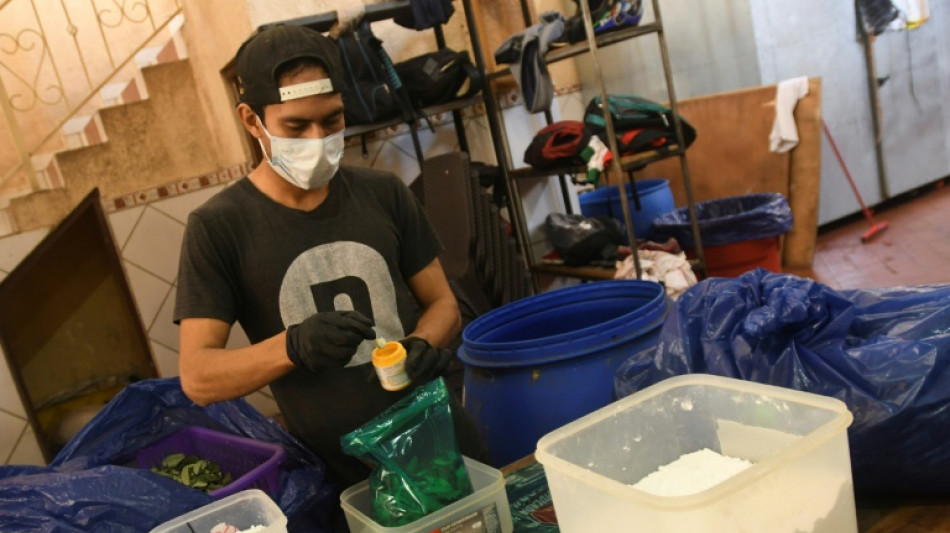
Chewed for millennia, coca leaf gets flavorsome makeover in Bolivia / Photo: RODRIGO URZAGASTI - AFP

 STARTRADER Launches XAUUSD247, Extending Gold CFD Access Across the Full Week

 Spurs agree deal to sign Man City's Savinho: reports

 US-sanctioned ICC head warns against 'demise of international rule of law'

 Top India court orders new steps to protect threatened elephants

 Djibouti football federation accused of misusing funds

 Australia charges man with trying to pass Ukraine military intel to Russia

 Ex-Pakistan PM Khan taken back to jail after hospital checks: govt

 China, Indonesia hold talks on security, defence

 Train to nowhere? South Korea's lonely push for peace with the North

 Australia's Hussey mulls role with England for Ashes series

 Indian captain 'scapegoat' in Britain's Russia shadow fleet case, wife says
 Rosenior seeks to match Paris FC's capital ambition as Ligue 1 returns

 Inter set for Serie A title defence as Milan get Amorim reboot

 'Greatest' Springboks face All Blacks in clash of juggernauts

 William and Harry: Britain's warring royal brothers

 UN holds second informal poll for next leader

 In US mining hub, black lung rates soar

 Champions Arsenal embrace being 'hunted' as Premier League returns

 World No.2 Rybakina retires from Cincinnati clash with Swiatek

 'I heard you missed me': Melania Trump jokes about month out of spotlight

 Amazon Prime Video to invest $2 bn in Latin America productions

 Panama Canal to reduce shipping over El Nino-fueled drought

 Maradona trial on hold over possible medical evidence mix-up

 'Green dilemma': China's solar boom hurt birds, says study

 Pegula hangs on to dispatch Anisimova, reach Cincinnati semi-finals

Bitter and tough, the coca leaf chewed throughout the South American Andes for thousands of years as a natural pick-me-up has been getting an appetizing makeover in Bolivia.
Traditionally sold as untreated, chopped leaves, several small businesses are now bruising the foliage to make it softer, and adding flavors such as strawberry, mango or coffee.
What started as an experiment about a decade ago has really taken off, especially in Bolivia's economic capital of Santa Cruz -- a city of 3.4 million people.
"The flavoring is like adding seasoning to food. Normally flavors such as bubblegum, banana are used, and it adds a special something," consumer Isaac Salazar, 21, told AFP.
"They come already crushed, soft, with a savory or sweet flavor added, which makes it perfect for passing the time."
The practice of chewing coca has its own verb in Bolivia's Indigenous Aymara language: "pijcheo." It means to masticate the leaves, like chewing gum, without swallowing.
The leaf -- from the same plant that cocaine is manufactured from -- has been ascribed with the wide-ranging properties of quelling hunger, inhibiting stress and imparting an energy boost.
Coca is also consumed in infusions, and in some countries it is included in flour used to make special breads and cakes.
- Bruised coca -
The work of transforming the fibrous leaf into a more easily chewable product is laborious.
At the El Dogor factory and store run by 23-year-old Luis Vasquez in Santa Cruz, about 20 workers share the tasks of removing the hard stems, placing what is left of the foliage into plastic bags, adding flavorings, and pounding away with a mallet.
The flattened end product, labeled Machucada (bruised) Coca El Dogor is placed in the fridge, and sold for $4.30 per unit of four ounces (about 113 grams).
The shop does a brisk business.
"We have a variety of coca leaf products, including fruit-flavored leaves and any other flavor a customer may ask for," said Vasquez.
More and more, clients "prefer it mixed with a flavoring," he said.
Consumer Gary Soleto, 45, said the traditional way of consuming unadulterated coca leaf will never disappear.
"But we change and we have taken on new habits... to continue consuming and tasting new flavors," he said.
Official data show that one in three people in a country of 12 million -- almost a third of them Indigenous -- chew coca or use it for medicinal and ritual purposes.
In 2021, there were 30,500 hectares (75,000 acres) of coca plantations in Bolivia, according to a UN estimate -- up four percent from 2020.
Potential coca leaf production was estimated at 44,900 to 56,200 metric tons with an estimated value of $352 million to $431 million, according to a report by the UN Office on Drugs and Crime.
The Bolivian state authorizes the cultivation of a maximum of 22,000 hectares.
In recent years, there have been clashes between coca leaf producers and police in Bolivia in a dispute over control of commercialization of the plant.
G.AbuHamad--SF-PST