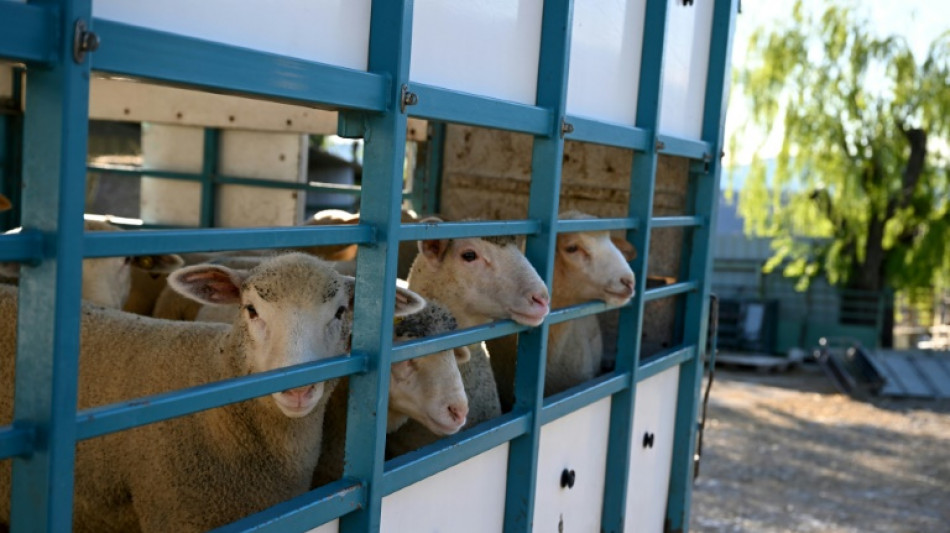
Silence of the lambs as French livestock slaughtered for Easter / Photo: Nicolas TUCAT - AFP

 Drovix Launches In-House Multi-Asset Liquidity and Execution Stack for Sub-Millisecond Fills, Tighter Spreads
 'So bad it's good': rough animated film becomes surprise Chinese hit

 'I'll adapt': First pregnant candidate navigates French presidential race

 Hong Kong convicts Tiananmen vigil activists of inciting subversion
 The Hong Kong Tiananmen vigil activists convicted in national security trial

 Eel-powered Japan whizz-kid, 11, chases Asian Games history

 Asian markets extend rally as traders assess US Treasuries pledge

 Barcelona enter new era as Flick targets La Liga hat-trick

 Pogacar favourite for Vuelta with Grand Tour treble in sight

 Bangladesh coach Simmons wary of Australia backlash in second Test

 Hong Kong Tiananmen activists to receive national security verdict

 Who are the candidates vying to lead the UN?
 Swiatek into Cincinnati semis after Rybakina injury

 University suspends academic behind Jason Arday plagiarism charges

 Key European leaders demand Israel halt West Bank settlement project

 McIlroy bounces back to share BMW Championship lead

 Cobolli fueled by candy in sweet defeat of Paul

 Jailed Pakistan ex-PM Khan moved to hospital on court order: party

 Pogacar eyes 'missing' piece ahead of Vuelta return
 US, Canada 'very close' to trade deal, Ottawa says, as details emerge

 Ronaldinho returns in search of 'beautiful' 300th goal

 US pushes allies, China to back Trump's economic war on Iran
 Former NBA MVP Harden reportedly set to return to Cavaliers

 Brook makes Pakistan pay for drop as England dominate first Test

 MemeCore Arrives on Nasdaq Through $1 Billion Landmark Treasury Transaction
The bleats and human voices have fallen away in an abattoir in southern France, leaving a line of lambs crowding forward to the sound of clanging metal.
As each young sheep passes through the black tarp that shields the slaughtering room from view, it is stunned by a claw that sends an electric current through its skull.
One of the largest sheep abattoirs in France, Sisteron kills 350 animals per hour as it operates at full speed, ahead of the feast days of the three major monotheist religions -- Christianity, Islam and Judaism -- which all fall in April this year.
AFP journalists were granted access to the slaughtering procedure, at a time when the wider industry has faced waves of criticism from activists working undercover to capture videos of animals being mistreated.
The production line at Sisteron in southeast France, renowned for its quality lamb, an abattoir worker uses a frequently sharpened blade to bleed a lamb while another hangs the animal by its back legs.
Within ten minutes, it will be in a fridge after the first butchering steps.
"The lambs have to be in the shops by Thursday" ahead of Easter weekend, sheep farmer and abattoir chief Guillaume Garcin says.
Garcin insists that his business is "hyper-vigilant about animal welfare", calling it a "moral" duty that pushes him beyond regulatory requirements.
Nevertheless, around a quarter of the lambs killed here are meant for the halal market.
Kosher and halal practices are often contested by animal rights advocates, as the animals cannot be stunned for the ritual slaughter -- something allowed for with an exception in French law.
Garcin says that the abattoir simply "can't give up 25 percent" of its business.
- 'No shouting, no-one's angry' -
At the ramp where lambs are unloaded, signs warn that the process is watched over by CCTV.
Past cases of mistreatment have drawn written reprimands and "it doesn't happen anymore," Garcin says.
Video surveillance has even been added inside the slaughterhouse, although a political push to make it compulsory across France came to nothing.
"We shouldn't be afraid to show that there can be good things here too," Garcin says, as images that have escaped from abattoirs in recent years have mostly come from animal rights activists.
"There's no shouting, no-one's angry, we keep an eye on things," says Christophe Chavagnac, head of the Alpes Provence Agneaux company that brings most of the meat slaughtered in Sisteron to market -- while adding that, "in any case, things end the same way."
Garcin whistles to urge the 10 lambs he has brought out of his truck into one of the large pens carpeted with straw and fitted with drinking troughs.
Where ten years ago workers might have used sticks to shove animals into line, these days they use their hands to guide them into the narrow concrete passage towards the slaughter room.
"Off they go," Garcin sighs, adding that "it's not the happiest time of year".
Every part of the lambs -- including their heads, which are cut off and hung on a separate rail -- goes to clothing or food for humans and pets.
"You can see that the animals are respected right to the end," Garcin said.
C.AbuSway--SF-PST