Webb telescope spots its first star -- and takes a selfie

 New four-lane bridge opens between China, North Korea
 Tech stocks lead rout after US inflation fuels rate hike bets

 'No time to recover': UNDP chief sounds alarm on growing poverty after Iran war shock
 Australia says won't let big tech have 'unfettered' access to kids

 Mobile clinics battle Mongolia's childhood dental 'disaster'

 Wallabies back Meredith as playmaker for second New Zealand Test
 Messi's Inter Miami book playoffs with 2-0 win over New York City

 Oil-rich Alberta tests Canada's unity with secession vote
 EU leaders head for showdown over bloc budget
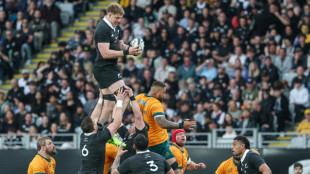 All Blacks make three changes for second Wallabies Test

 Mourinho blasts 'shameless' timing of Vinicius ban decision

 PSG beat Man City in Champions League thriller, Barcola hits Liverpool hat-trick

 US Treasury chief urges stronger IMF role against 'distortionary policies'

 Giant-killers Bodo sink Dortmund in Champions League

 PSG outgun embattled Man City in six-goal Champions League thriller

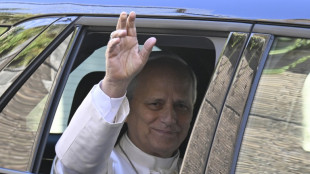 In Chicago, pope's hometown, Catholics express shock and support

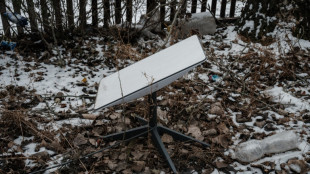 Musk suggests US govt behind any slowdown in Ukraine's Starshield system

 Chiclayo prays for recovery and return of the 'Peruvian pope'

 Barcola scores hat-trick as Liverpool hit LASK for six

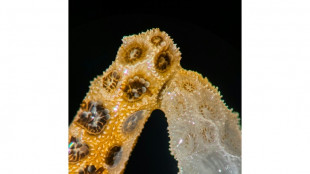 Healthy corals help bleached neighbors regain color: study
 Hope ton helps West Indies level T20 series at 2-2 in India

 Ukraine war reaches shores of Bulgarian fishing village
 Brazil probing 'criminal' origin of forest fires: minister to AFP

 Sally Rooney books cannot be sold in UK amid Palestine Action ban: publisher

 Italian ski stars Goggia and Brignone to miss season opener

Star light, star bright, the James Webb Space Telescope has seen its first star (though it wasn't quite tonight) -- and even taken a selfie, NASA announced Friday.
The steps are part of the months-long process of aligning the observatory's enormous golden mirror that astronomers hope will begin unraveling the mysteries of the early Universe by this summer.
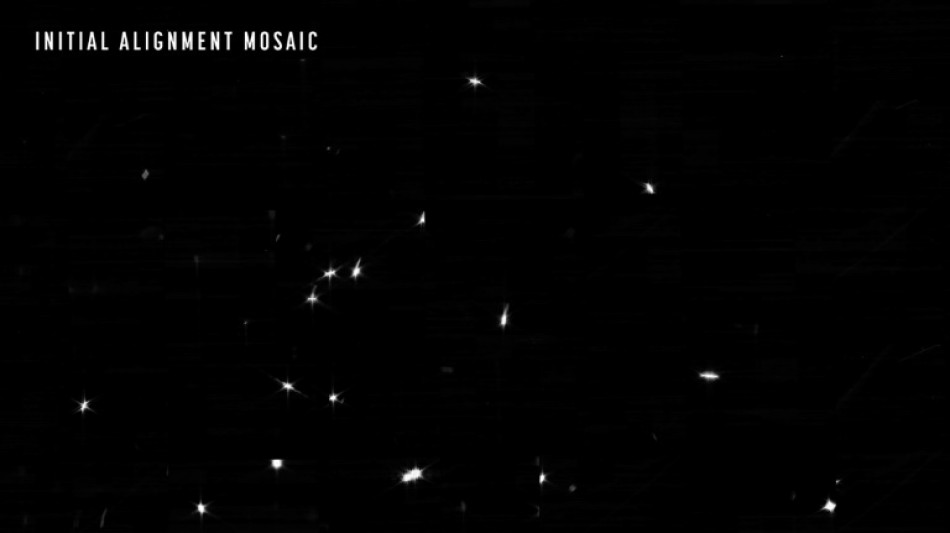
The first picture sent back of the cosmos is far from stunning: 18 blurry white dots on a black background, all showing the same object: HD 84406 a bright, isolated star in the constellation Ursa Major.
But in fact it represents a major milestone. The 18 dots were captured by the primary mirror's 18 individual segments -- and the image is now the basis for aligning and focusing those hexagonal pieces.
The light bounced off the segments to Webb's secondary mirror, a round object located at the end of long booms, and then to the Near Infrared Camera (NIRCam) instrument -- Webb's main imaging device.
"The entire Webb team is ecstatic at how well the first steps of taking images and aligning the telescope are proceeding," said Marcia Rieke, principal investigator for the NIRCam instrument and regents professor of astronomy, University of Arizona, in a statement.
"We were so happy to see that light make its way into NIRCam."
The image capturing process began on February 2, with Webb pointing at different positions around the predicted location of the star.
Though Webb's initial search covered an area of the sky about equal to the size of the full Moon, the dots were all located near the center portion, meaning the observatory is already relatively well positioned for final alignment.
To aid the process, the team also captured a "selfie" taken not through an externally mounted camera but through a special lens on board NIRCam.
NASA had previously said a selfie wasn't possible, so the news comes as a welcome bonus for space fans.
"I think pretty much the reaction was holy cow," Lee Feinberg, Webb optical telescope element manager, told reporters in a call, explaining that the team wasn't sure it was possible to obtain such an image using starlight alone.
The $10 billion observatory launched from French Guiana on December 25 and is now in an orbit that is aligned with the Earth's around the Sun, one million miles (1.5 million kilometers away) from our planet, in a region of space called the second Lagrange point.
Webb will begin its science mission by summer, which includes using its high resolution instruments to peer back in time 13.5 billion years to the first generation of galaxies that formed after the Big Bang.
Visible and ultraviolet light emitted by the very first luminous objects has been stretched by the Universe's expansion, and arrives today in the form of infrared, which Webb is equipped to detect with unprecedented clarity.
Its mission also includes the study of distant planets, known as exoplanets, to determine their origin, evolution and habitability.
Y.Zaher--SF-PST