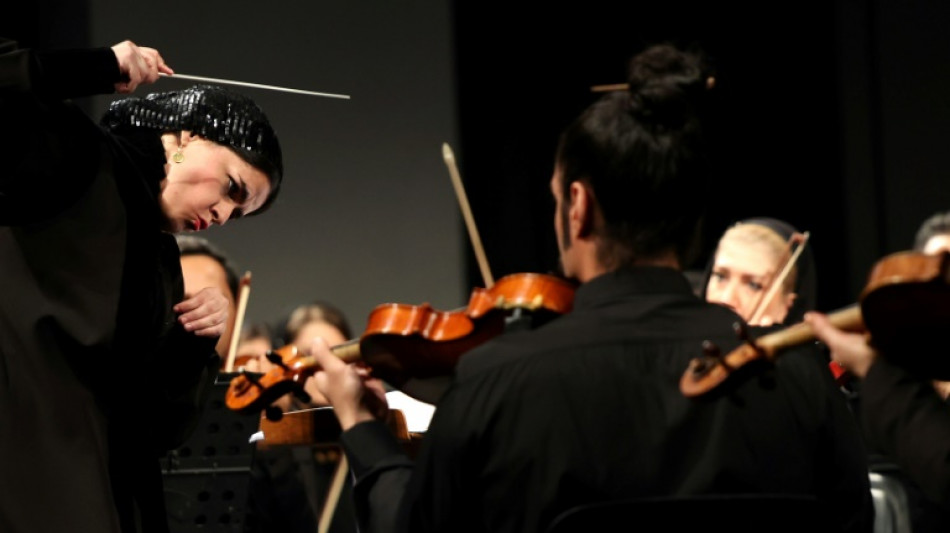
Iran's first woman orchestra conductor inspires / Photo: - - AFP

 فاطمة بوش ترفع شعار 'ليحيا المسيح الملك' في ختام ملكة جمال الكون

 أين الأمن القومي العربي؟.. تحليل نقدي لغياب الرؤية المشتركة

 Crude Oil Prices Rise on Reports of Houthi Attack on Saudi Refinery

 El Nino’s Weakening Grip on Tamil Nadu Rainfall Hinges on Potential Cyclone

 Black Friday Discounts Cut Prices on Two Top-Rated Wiper Blades

 Twickenham Grounds Team Prepares Pitch for Six Matches in Three Days

 Luxembourg City Plans €13 Million Abrigado Centre for 2029

 Two A1 Crashes Create Kilometres of Rush-Hour Congestion

 South Africa Places 36 Hospitals on Standby for Possible Imported Ebola Cases

 Tamil Nadu Secures Rs 58,214 Crore in Investments at Vettri Conclave

 فرنسا تدعو لتجريم "الفصل العنصري القائم على الجنس" دولياً
When Paniz Faryoussefi mounts the podium and reaches for her baton, she represents more than just the hope of a thrilling orchestral performance.
The eyes turned towards her in Tehran's renowned Vahdat Hall include those of many young women musicians inspired by her taking her place as Iran's first woman philharmonic conductor.
Women's professional and cultural lives are still heavily restricted in the conservative Islamic republic, particularly in terms of public performance before mixed-gender audiences.
Women, for example are not allowed to sing solo in front of men.
But, as exemplified by 42-year-old Faryoussefi, they can now conduct an orchestra.
"When I stepped onto the stage, I noticed that all eyes were on a woman conducting the orchestra, and I felt an immense responsibility," she told AFP after the performance.
- Close eye on dissent -
Widespread street protests shook Iran for several months following the death in custody in 2022 of a young woman arrested for violating the country's strict dress code for women.
In the wake of the disturbances, the government has relaxed certain restrictions and young women have become more prominent in some areas of social and cultural life.
And since a 12-day war with Israel earlier this year, Iranians have been pushing social boundaries further still.
Analysts say the authorities have shown greater tolerance, while keeping as close an eye as ever for any signals of political dissent.
Several women in the audience at the concert did not wear their scarves. The conductor wore hers, covering her hair as the law demands, but her arrival at the podium was in itself a sign of greater openness.
The crowd shared Faryoussefi's enthusiasm, particularly the young women, who seemed aware that they were witnessing a historic moment.
In some Iranian cities, women musicians are not allowed to perform on stage, and even in the capital Tehran they cannot raise their voices in song in public.
Faryoussefi was born into an artistic family and her mother dreamed of her becoming a cheffe d'orchestre -- but Iranian performing arts academies do not teach conducting.
She briefly attended classes in Armenia before returning to build a trailblazing career.
"Young women need to persevere and follow their dreams," she said.
At the podium, she led the 50-strong orchestra through works by Austria's Franz Schubert, Finland's Jean Sibelius and the Soviet-Armenian composer Aram Khachaturian.
"I hope this marks a new era for young Iranian women and that they will understand that... they should not be afraid," she said. "It is the only gateway to emancipation.
"A friend saw a little girl in the audience mimicking my movements. He thought a dream was already taking root in her, that she was thinking she too could one day achieve the same thing."
The concerts took place over two days and attracted large crowds.
Said Shourabi, 53, works in metal fabrication and wasn't a big concertgoer until his daughter, who was out of town, bought him the tickets and insisted he go along.
"In Iran," he said, "women have always been held back and haven't been able to fully express their talents, even if I'm sure they're just as capable as men."
Hairdresser Fariba Aghai, 44, was delighted to see a woman take up the baton at the orchestra, lamenting that women singers still can't perform at concerts or publish their own songs.
"They shouldn't have to sell themselves short and should know that they're capable of anything," she said.
B.Mahmoud--SF-PST

