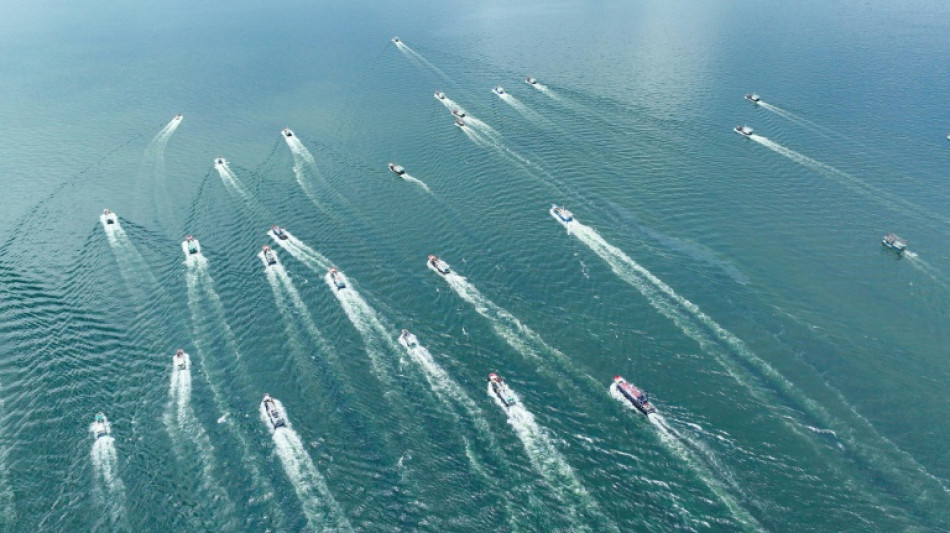
UN session on high seas biodiversity ends without agreement / Photo: STR - AFP/File

 'Severe drought' declared in parts of UK

 IUX Announces New Web Client Portal Built for Enhanced Browser-Based Trading

 School roof collapse kills teacher, 32 children in NW Pakistan

 Inter skipper Martinez facing month out with thigh injury

 Spanish prosecutors back abuse probe into Julio Iglesias

 Tech sell-off deepens as US inflation sparks AI jitters

 Southgate does not forsee a return to management

 Two dead as Istanbul endures heaviest rainfall in 80 years

 After latest Nepal flood, survivors fear for future

 EU leaders clash over budget as spectre of French elections looms

 'No place to breathe': life in Indonesia's fire epicentre

 'Can't sleep': Spain's housing crunch upends lives

 Musk calls on Ukraine's Zelensky to 'go' after satellite slowdown row

 Still smiling at 117, Albanian may be world's oldest woman

 Pope has 'good night' in hospital: Vatican

 China's economy seen missing target as global shocks bite: AFP poll

 Costa Rica opens jail inspired by El Salvador mega-prison

 Same-sex couple takes fight for equality to Slovakian court

 'High hopes' as Indonesian women get a football league, again

 'Expectations high' for Bordeaux-Begles' Champions Cup hat-trick bid, says Depoortere

 Rennie urges All Blacks to stay focused against 'hurting' Wallabies

 Palmeiras beat Fluminense 2-1 in Libertadores semi-final first leg

 Brewers blasts leave Dodgers on brink

 Tech stock lead rout after US inflation fuels rate hike bets

 Al-Fayed survivors say UK police missing 'bigger picture'

UN member states ended two weeks of negotiations Friday without a treaty to protect biodiversity in the high seas, an agreement that would have addressed growing environmental and economic challenges.
After 15 years, including four prior formal sessions, negotiators have yet to reach a legally binding text to address the multitude of issues facing international waters -- a zone that encompasses almost half the planet.
"Although we did make excellent progress, we still do need a little bit more time to progress towards the finish line," said conference chair Rena Lee.
It will now be up to the UN General Assembly to resume the fifth session at a date still to be determined.
Many had hoped the session, which began on August 15 at the United Nations headquarters in New York, would be the last and yield a final text on "the conservation and sustainable use of marine biodiversity beyond national jurisdiction," or BBNJ for short.
"While it's disappointing that the treaty wasn't finalized during the past two weeks of negotiations, we remain encouraged by the progress that was made," said Liz Karan with the NGO Pew Charitable Trusts, calling for a new session by the end of the year.
One of the most sensitive issues in the text revolved around the sharing of possible profits from the development of genetic resources in international waters, where pharmaceutical, chemical and cosmetic companies hope to find miracle drugs, products or cures.
Such costly research at sea is largely the prerogative of rich nations, but developing countries do not want to be left out of potential windfall profits drawn from marine resources that belong to no one.
-'Missed opportunity'-
Similar issues of equity arise in other international negotiations, such as on climate change, in which developing nations that feel outsized harm from global warming have tried in vain to get wealthier countries to help pay to offset those impacts.
The high seas begin at the border of a nation's exclusive economic zone (EEZ) -- which by international law reaches no more than 200 nautical miles (370 kilometers) from its coast -- and are under no state's jurisdiction.
Sixty percent of the world's oceans fall under this category.
And while healthy marine ecosystems are crucial to the future of humanity, particularly to limit global warming, only one percent of international waters are protected.
One of the key pillars of an eventual BBNJ treaty is to allow the creation of marine protected areas, which many nations hope will cover 30 percent of the Earth's ocean by 2030.
"Without establishing protections in this vast area, we will not be able to meet our ambitious and necessary 30 by 30 goal," US State Department official Maxine Burkett said at an earlier press conference.
But delegations still disagree on the process for creating these protected areas, as well as on how to implement a requirement for environmental impact assessments before new activity on the high seas.
"What a missed opportunity...", tweeted Klaudija Cremers, a researcher at the IDDRI think tank, which, like multiple other NGOs, has a seat with observer status at the negotiations.
D.AbuRida--SF-PST