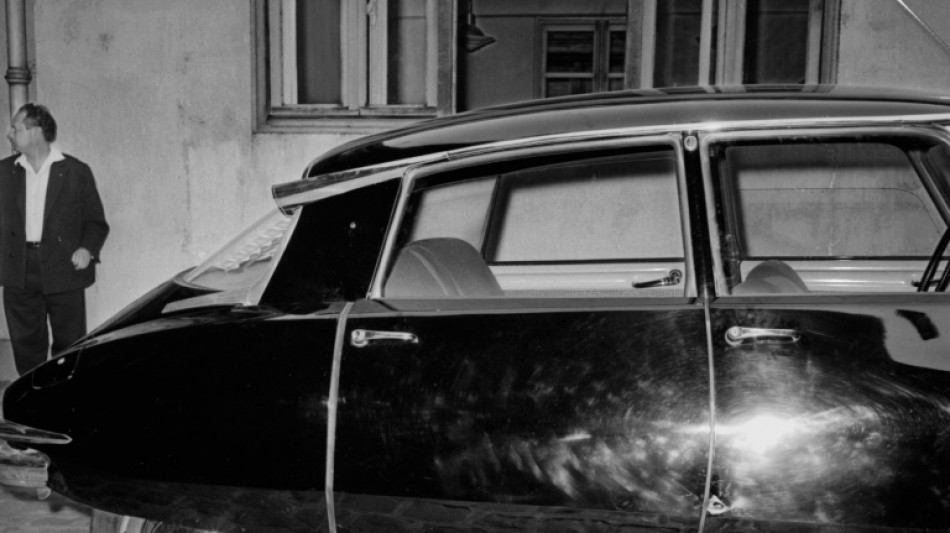
'Close shave!' How De Gaulle escaped assassin's bullets 60 years ago / Photo: © AFP/File

 'Severe drought' declared in parts of UK
 IUX Announces New Web Client Portal Built for Enhanced Browser-Based Trading
 School roof collapse kills teacher, 32 children in NW Pakistan
 Inter skipper Martinez facing month out with thigh injury
 Spanish prosecutors back abuse probe into Julio Iglesias
 Tech sell-off deepens as US inflation sparks AI jitters
 Southgate does not forsee a return to management
 Two dead as Istanbul endures heaviest rainfall in 80 years
 After latest Nepal flood, survivors fear for future
 EU leaders clash over budget as spectre of French elections looms
 'No place to breathe': life in Indonesia's fire epicentre
 'Can't sleep': Spain's housing crunch upends lives

 Musk calls on Ukraine's Zelensky to 'go' after satellite slowdown row
 Still smiling at 117, Albanian may be world's oldest woman
 Pope has 'good night' in hospital: Vatican
 China's economy seen missing target as global shocks bite: AFP poll

 Costa Rica opens jail inspired by El Salvador mega-prison
 Same-sex couple takes fight for equality to Slovakian court
 'High hopes' as Indonesian women get a football league, again
 'Expectations high' for Bordeaux-Begles' Champions Cup hat-trick bid, says Depoortere
 Rennie urges All Blacks to stay focused against 'hurting' Wallabies

 Palmeiras beat Fluminense 2-1 in Libertadores semi-final first leg

 Brewers blasts leave Dodgers on brink
 Tech stock lead rout after US inflation fuels rate hike bets
 Al-Fayed survivors say UK police missing 'bigger picture'
August 22, 1962: French President Charles de Gaulle and his wife are being whisked by car through the Paris suburb of Petit-Clamart for a flight back to their country home, when a man on the side of the road waves a newspaper.
The signal has been given.
A group of right-wing extremists spring into action and rake the presidential Citroen DS with gunfire.
Three of the bullets penetrate the bodywork and pass within inches of De Gaulle's head but he and his wife Yvonne miraculously escape unharmed.
"They're such bad shots!," France's World War II hero later jokes about the attempt on his life which shocks the country and gives De Gaulle an opportunity to boost the powers of his office.
Yvonne's immediate concern meanwhile is for the jellied chicken she has in the boot of the car, having stocked up on the delicacy while in the capital.
- Hail of bullets -
Speeding along that summer evening towards a military airfield where they will board a plane taking them to their estate in the village of Colombey-les-Deux-Eglises, the presidential car is flanked by an escort vehicle and two motorcycle outriders.
Night is falling when the signal comes from the mastermind of the attack, Jean-Marie Bastien-Thiry, an engineer in the Air Ministry with the rank of lieutenant-colonel.
Bastien-Thiry is a member of the Secret Armed Organization, known by its French acronym OAS, a far-right paramilitary group incensed by De Gaulle's decision to grant independence to Algeria after a brutal eight-year liberation war.
The dozen-strong hit squad is a mix of "pieds-noirs" -- Europeans born in Algeria during French rule which lasted from 1830 to 1962 -- as well as former soldiers and students. The youngest is just 20 years old.
They open fire first with a machine gun from a yellow van, then from a second vehicle parked further down the road.
The attack lasts just 45 seconds.
More than 150 bullets are fired and there are eight impacts on the car body. One bullet goes through to the back passenger seat, shattering the window by the president and his wife, showered in glass.
The De Gaulles owe a debt of gratitude to the sangfroid of their driver Francis Marroux, who had also been at the wheel a year earlier when the presidential car survived a first assassination attempt -- later attributed to Bastien-Thiry -- in the northeastern village of Pont-sur-Seine.
Marroux manages to keep control of the vehicle and speeds off on two flat tyres under more fire.
De Gaulle's son-in-law Alain de Boissieu also plays a key role. Sitting in the front of the car he shouts "Get down, father!" to France's leader.
- 'Close shave' -
The unflappable De Gaulle, aged 71 at the time, initially acts as if nothing has happened. On arrival at Villacoublay military airport he reviews the troops as usual.
But when boarding the plane with Yvonne he admits to de Boissieu: "This time, it was a close shave!"
Jean-Noel Jeanneney, French historian and author of a book on the attack, says a combination of factors explains the failure of the 1962 hit, notably that none of those involved were ready to die for the cause.
Interviewed by AFP in 2012, one survivor of the cell blamed weapons jamming and shooters not being sufficiently trained.
"They're such bad shots," De Gaulle tells Prime Minister Georges Pompidou in a phone call on the night of the attack.
News of the assassination attempt spreads quickly.
"Failed attack against De Gaulle" AFP writes in a first "flash" at 8:55 pm.
Another follows: "Shots were fired shortly after 8:00 pm against General De Gaulle's car near Villacoublay. No one was hit".
Later it emerges that a man driving in the opposite direction was hit on the hand by a stray bullet but only lightly injured.
- Mastermind executed -
The hunt for the culprits is swift and efficient, with one of the suspects spilling the beans on the whole operation after his arrest.
Nearly all those involved are caught, including Bastien-Thiry. Nine men are put on trial, three of whom are sentenced to death.
De Gaulle pardons two of them but refuses clemency for Bastien-Thiry, who is the last person to be executed by firing squad in France on March 11, 1963 at the age of 35.
Ever the strategist, De Gaulle harnesses public outrage over the attack to build support for a constitutional amendment to have the president elected by popular vote, rather than by an electoral college.
The attack he confides to one of his ministers came "at just the right time."
K.AbuDahab--SF-PST