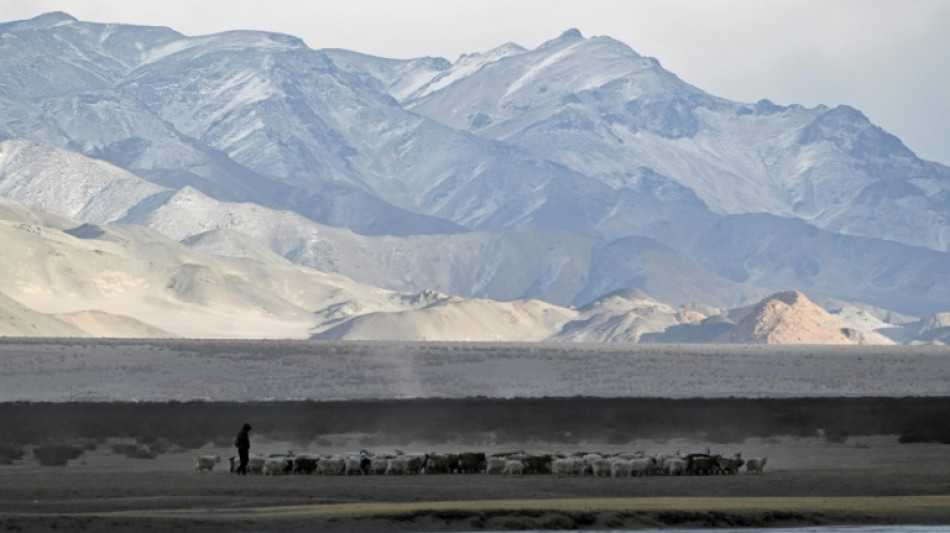
Tibetan Plateau water stores under threat: study / Photo: Parvaiz BUKHARI - AFP/File

 Two dead as Istanbul endures heaviest rainfall in 80 years

 After latest Nepal flood, survivors fear for future

 EU leaders clash over budget as spectre of French elections looms

 'No place to breathe': life in Indonesia's fire epicentre

 'Can't sleep': Spain's housing crunch upends lives

 Musk calls on Ukraine's Zelensky to 'go' after satellite slowdown row

 Still smiling at 117, Albanian may be world's oldest woman

 Pope has 'good night' in hospital: Vatican

 China's economy seen missing target as global shocks bite: AFP poll

 Costa Rica opens jail inspired by El Salvador mega-prison

 Same-sex couple takes fight for equality to Slovakian court

 'High hopes' as Indonesian women get a football league, again

 'Expectations high' for Bordeaux-Begles' Champions Cup hat-trick bid, says Depoortere

 Rennie urges All Blacks to stay focused against 'hurting' Wallabies

 Palmeiras beat Fluminense 2-1 in Libertadores semi-final first leg

 Brewers blasts leave Dodgers on brink

 Tech stock lead rout after US inflation fuels rate hike bets

 Al-Fayed survivors say UK police missing 'bigger picture'

 Online 'witch hunt' sweeps up Asians misidentified as US rape accused

 Prospect of Bolsonaro win looms large over Brazil's Indigenous

 Freed from Belarus, founder of Lady Gaga's biggest fan site tells his story

 Behind AI's carbon footprint, a potential climate tool

 Trump's new press secretary faces scrutiny over credentials

 PSG 'got lucky' to win Man City thriller, says Luis Enrique

 Real Madrid comeback stuns Roma as Mourinho enjoys happy reunion

The Tibetan Plateau will experience significant water loss this century due to global warming, according to research published Monday that warns of severe supply stress in a climate change "hotspot".
The reservoirs of the Tibetan Plateau, which covers much of southern China and northern India, are fed by monsoons and currently supply most of the water demand for nearly two billion people.
But the plateau's complex terrain has made it difficult for scientists to predict how warming temperatures and altered weather patterns linked to climate change will affect the region's water stores.
Researchers based in China and the United States used satellite-based measurements to determine the net change in water and ice mass over the past two decades.
They added in direct measurements of glaciers, lakes and sub-surface water levels to estimate changes in the water mass, then used a machine learning technique to predict storage changes under scenarios such as higher air temperature and reduced cloud cover.
They found that due to an increasingly warm and wet climate, the Tibetan Plateau has lost just over 10 billion tonnes of water a year since 2002.
Writing in the journal Nature Climate Change, the team projected changes in water storage across the plateau under a middle-of-the-road emissions scenario, where levels of carbon pollution stay roughly at current levels before falling gradually after 2050.
They found two river basins were particularly vulnerable to water loss.
For the Amu Darya, central Asia's largest river, water loss could be equivalent to 119 percent of the current demand.
Communities reliant on the Indus basement for water supply could see a loss equivalent to 79 percent of current demand, the study showed.
The authors recommended that governments begin to explore alternative water supply options, including more groundwater extraction, to make up for the anticipated shortfall.
Michael Mann, director of the Penn Center for Science, Sustainability and the Media, said "substantial reductions in carbon emissions over the next decade" would limit global warming and the "predicted collapse of the Tibetan Plateau water towers".
"But even in a best-case scenario, further losses are likely unavoidable, which will require substantial adaptation to decreasing water resources in this vulnerable, highly populated region of the world. Just what that would look like is hard to say -- we're in unchartered waters," Mann, a study co-author, told AFP.
"Suffice it to say, some amount of suffering is locked in."
N.AbuHussein--SF-PST



