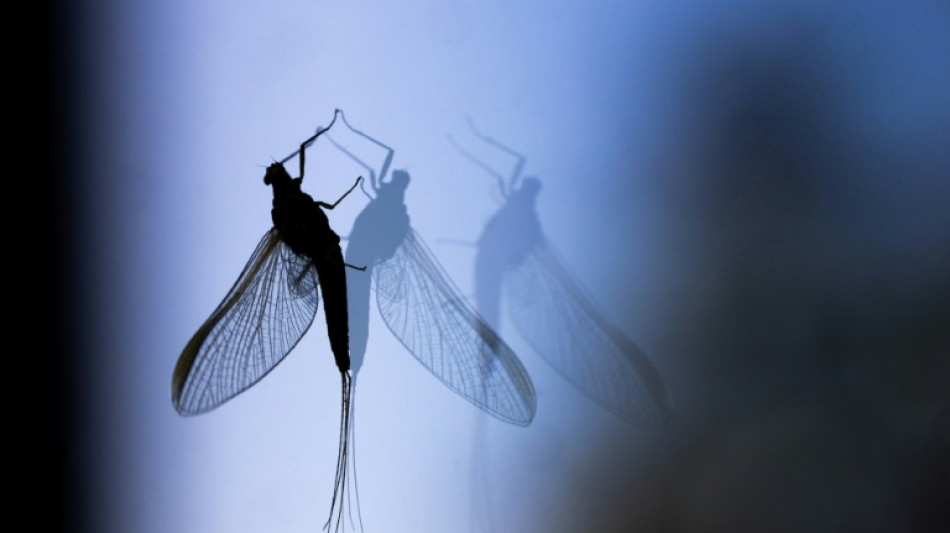
Drivers help study road-trip mystery: what became of bug splats? / Photo: JOEL SAGET - AFP

 Two dead as Istanbul endures heaviest rainfall in 80 years

 After latest Nepal flood, survivors fear for future

 EU leaders clash over budget as spectre of French elections looms

 'No place to breathe': life in Indonesia's fire epicentre

 'Can't sleep': Spain's housing crunch upends lives

 Musk calls on Ukraine's Zelensky to 'go' after satellite slowdown row

 Still smiling at 117, Albanian may be world's oldest woman

 Pope has 'good night' in hospital: Vatican

 China's economy seen missing target as global shocks bite: AFP poll

 Costa Rica opens jail inspired by El Salvador mega-prison

 Same-sex couple takes fight for equality to Slovakian court
 'High hopes' as Indonesian women get a football league, again

 'Expectations high' for Bordeaux-Begles' Champions Cup hat-trick bid, says Depoortere

 Rennie urges All Blacks to stay focused against 'hurting' Wallabies

 Palmeiras beat Fluminense 2-1 in Libertadores semi-final first leg

 Brewers blasts leave Dodgers on brink

 Tech stock lead rout after US inflation fuels rate hike bets
 Al-Fayed survivors say UK police missing 'bigger picture'

 Online 'witch hunt' sweeps up Asians misidentified as US rape accused

 Prospect of Bolsonaro win looms large over Brazil's Indigenous

 Freed from Belarus, founder of Lady Gaga's biggest fan site tells his story

 Behind AI's carbon footprint, a potential climate tool

 Trump's new press secretary faces scrutiny over credentials

 PSG 'got lucky' to win Man City thriller, says Luis Enrique

 Real Madrid comeback stuns Roma as Mourinho enjoys happy reunion

Long an emblem of the summer road trip, squashed bugs on the car have become less numerous over the years, many people say -- causing concern about the health of the world's insect populations.
While drivers may be happy to have less yuckiness to clean from their windscreens, a perceived decline in flying insects hit by vehicles has some experts worried about the creatures, which play a vital role in the environment as pollinators, ecosystem balancers and food sources for other species.
But anecdotal evidence is one thing. Studying the so-called "windshield phenomenon" is another.
So scientists in France have launched an app-based study that enlists drivers as volunteer researchers.
Users download the free app, Bugs Matter, count the number of squished bugs on their number plates at the end of a trip, and send the results to be compiled as part of what the programme's creators hope will be a massive citizen science project.
The study is being run by the National Museum of Natural History (MNHN), the environmental groups OPIE and Noe and the French Biodiversity Office.
One app user, Marjorie, brought AFP on a car trip with her to Enghien-les-Bains, north of Paris, to take the app for a test drive before using it on a long road trip.
Step one: wipe the licence plate clean. Step two: enter geolocation data. Step three: drive.
"I'm 53, and I remember how as a kid, on long car trips when we stopped to fill the tank, there was always the obligatory clean-the-windscreen stage," said Marjorie.
"We hardly do that anymore."
- 'Pretty incredible' -
The study follows others around the world that have found declining insect numbers, including previous car-based studies in Denmark and the United Kingdom that both found sharp reductions in splats.
The two-decade-long Danish study, which ran until 2017, found reductions of 80 and 97 percent on two stretches of road in Denmark, while the UK study -- which also used the Bugs Matter app and is still ongoing -- found a decline of nearly 63 percent from 2021 to 2024.
A German study published in 2017 found a "dramatic decline" of more than 75 percent in the average biomass of flying insects in protected nature reserves.
"It's pretty incredible. Imagine going into the supermarket and finding only two out of every 10 products are in stock," said MNHN's Gregoire Lois.
Scientists say the decline is driven by human activity, including habitat loss, pesticide use, pollution and climate change.
But part of the study's goal is to understand the exact mechanisms behind the decline, and whether the results vary between urban areas, agricultural regions and forest land, Lois said.
Researchers hope to eventually expand the project to collect the insects' DNA and identify which species are being hit, he said.
Why use number plates as a reference?
"It's the only shared, standardised thing on every car, in both size and position: facing the road, perpendicular to the ground and travelling forward," said Lois.
After making her test trip, Marjorie parked her car, went to count her specimens and found a troubling data point.
"We just drove 22 kilometres" (14 miles), she said, "and there are absolutely no insects."
F.AbuShamala--SF-PST