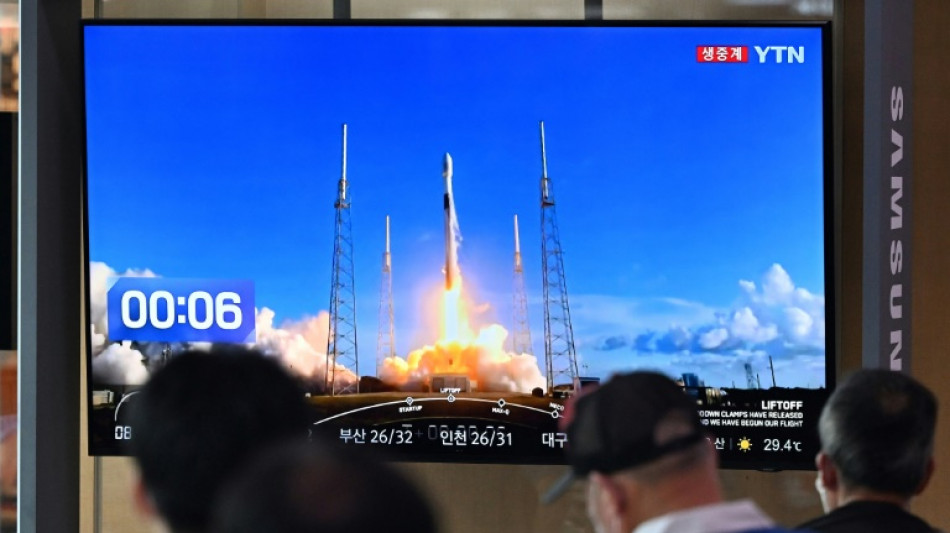
South Korea's first lunar orbiter launched by SpaceX / Photo: Jung Yeon-je - AFP

 Two dead as Istanbul endures heaviest rainfall in 80 years

 After latest Nepal flood, survivors fear for future

 EU leaders clash over budget as spectre of French elections looms

 'No place to breathe': life in Indonesia's fire epicentre

 'Can't sleep': Spain's housing crunch upends lives

 Musk calls on Ukraine's Zelensky to 'go' after satellite slowdown row

 Still smiling at 117, Albanian may be world's oldest woman

 Pope has 'good night' in hospital: Vatican

 China's economy seen missing target as global shocks bite: AFP poll

 Costa Rica opens jail inspired by El Salvador mega-prison

 Same-sex couple takes fight for equality to Slovakian court

 'High hopes' as Indonesian women get a football league, again

 'Expectations high' for Bordeaux-Begles' Champions Cup hat-trick bid, says Depoortere

 Rennie urges All Blacks to stay focused against 'hurting' Wallabies

 Palmeiras beat Fluminense 2-1 in Libertadores semi-final first leg

 Brewers blasts leave Dodgers on brink

 Tech stock lead rout after US inflation fuels rate hike bets

 Al-Fayed survivors say UK police missing 'bigger picture'

 Online 'witch hunt' sweeps up Asians misidentified as US rape accused

 Prospect of Bolsonaro win looms large over Brazil's Indigenous

 Freed from Belarus, founder of Lady Gaga's biggest fan site tells his story

 Behind AI's carbon footprint, a potential climate tool

 Trump's new press secretary faces scrutiny over credentials

 PSG 'got lucky' to win Man City thriller, says Luis Enrique

 Real Madrid comeback stuns Roma as Mourinho enjoys happy reunion

South Korea's first lunar orbiter successfully launched on a year-long mission to observe the Moon, Seoul said Friday, with the payload including a new disruption-tolerant network for sending data from space.
Danuri -- a portmanteau of the Korean words for "Moon" and "enjoy" -- was on a Falcon 9 rocket launched from Cape Canaveral in Florida by Elon Musk's aerospace company SpaceX. It aims to reach the Moon by mid-December.
"South Korea's first lunar orbiter 'Danuri' left for space at 8:08 am on August 5, 2022," Seoul's science ministry said in a tweet, sharing a video of the rocket blasting off trailing a huge column of smoke and flames.
"Danuri will be the first step towards the Moon and the farther universe," it said, apparently referring to the country's ambitious space program, which includes plans for a Moon mission by 2030.
SpaceX tweeted that the launch had been a success.
"Deployment of KPLO confirmed," it said, referring to Danuri using an acronym of its official name, the Korea Pathfinder Lunar Orbiter.
During its mission, Danuri will use six different instruments, including a highly sensitive camera provided by NASA, to conduct research, including investigating the lunar surface to identify potential landing sites.
One of the instruments will evaluate disruption-tolerant, network-based space communications, which, according to South Korea's science ministry, is a world first.
- BTS in space -
Danuri will also try to develop a wireless Internet environment to link satellites or exploration spacecraft, they added.
The lunar orbiter will stream K-pop sensation BTS' song "Dynamite" to test this wireless network.
Another instrument, ShadowCam, will record images of the permanently shaded regions around the poles of the Moon where no sunlight can reach.
Scientists also hope that Danuri will find hidden sources of water and ice in areas of the Moon, including the permanently dark and cold regions near the poles.
"This is a very significant milestone in the history of Korean space exploration," said Lee Sang-ryool, head of the Korea Aerospace Research Institute, in a video shown before the launch.
"Danuri is just the beginning, and if we are more determined and committed to technology development for space travel, we will be able to reach Mars, asteroids, and so on in the near future."
South Korean scientists say Danuri -- which took seven years to build -- will pave the way for the nation's more ambitious goal of landing on the Moon by 2030.
"South Korea will become the seventh country in the world to have launched an unmanned probe to the Moon," an official at the Korea Aerospace Research Institute told AFP.
"We hope to continue contributing to the global understanding of the Moon with what Danuri is set to find out."
- Lunar ambitions -
Danuri was launched by a private company -- SpaceX -- but South Korea recently became one of a handful of countries to successfully launch a one-tonne payload using their own rockets.
In June, the country's homegrown three-stage rocket nicknamed Nuri -- a decade in development at a cost of 2 trillion won ($1.5 billion) -- launched successfully and put a satellite into orbit, on its second attempt after a failure last October.
That launch -- coupled with Danuri's launch Friday -- helps bring South Korea ever closer to achieving its space ambitions.
In Asia, China, Japan and India all have advanced space programmes -- and the South's nuclear-armed neighbour North Korea has also demonstrated satellite launch capability.
Ballistic missiles and space rockets use similar technology and Pyongyang put a 300-kilogram (660-pound) satellite into orbit in 2012 in what Washington condemned as a disguised missile test.
Z.AlNajjar--SF-PST