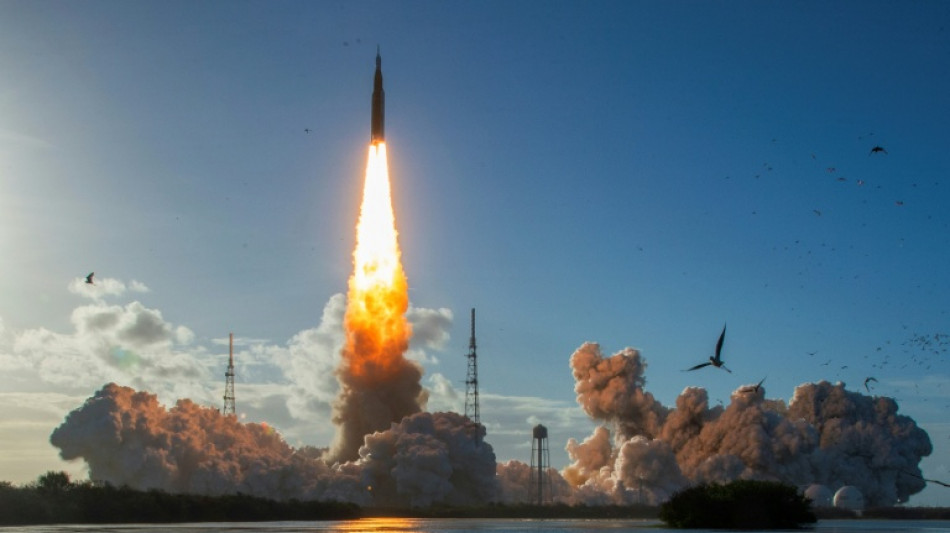
Artemis astronauts blast towards Moon on historic mission / Photo: Jim WATSON - AFP

 'Severe drought' declared in parts of UK

 IUX Announces New Web Client Portal Built for Enhanced Browser-Based Trading

 School roof collapse kills teacher, 32 children in NW Pakistan

 Inter skipper Martinez facing month out with thigh injury

 Spanish prosecutors back abuse probe into Julio Iglesias

 Tech sell-off deepens as US inflation sparks AI jitters

 Southgate does not forsee a return to management

 Two dead as Istanbul endures heaviest rainfall in 80 years

 After latest Nepal flood, survivors fear for future

 EU leaders clash over budget as spectre of French elections looms

 'No place to breathe': life in Indonesia's fire epicentre

 'Can't sleep': Spain's housing crunch upends lives

 Musk calls on Ukraine's Zelensky to 'go' after satellite slowdown row

 Still smiling at 117, Albanian may be world's oldest woman

 Pope has 'good night' in hospital: Vatican

 China's economy seen missing target as global shocks bite: AFP poll

 Costa Rica opens jail inspired by El Salvador mega-prison

 Same-sex couple takes fight for equality to Slovakian court

 'High hopes' as Indonesian women get a football league, again

 'Expectations high' for Bordeaux-Begles' Champions Cup hat-trick bid, says Depoortere

 Rennie urges All Blacks to stay focused against 'hurting' Wallabies

 Palmeiras beat Fluminense 2-1 in Libertadores semi-final first leg

 Brewers blasts leave Dodgers on brink

 Tech stock lead rout after US inflation fuels rate hike bets

 Al-Fayed survivors say UK police missing 'bigger picture'

Four Artemis astronauts were zooming towards the Moon on Thursday after a major engine firing, a milestone that commits NASA to the first crewed lunar flyby in more than half a century.
With enough thrust to accelerate a stationary car to highway driving speed in less than three seconds, the Orion capsule engine blasted the astronauts on their trajectory towards the Moon, which they now will loop as part of the 10-day Artemis 2 mission.
"Human beings have left Earth orbit" for the first time since 1972, said NASA official Lori Glaze at a briefing in Houston following the nearly six-minute burn.
In the moments that followed what the US space agency dubbed a "flawless" firing, astronaut Jeremy Hansen said that "humanity has once again shown what we are capable of."
Later on the astronauts said they were "glued to the window" taking pictures.
"We are getting just a beautiful view of the dark side of the Earth right now, lit by the Moon," said Hansen. "Phenomenal."
Thursday's burn, the last major ignition of the mission, came one day after the enormous orange-and-white Space Launch System (SLS) rocket carrying the Orion capsule launched from Kennedy Space Center in Florida for the long-anticipated journey around the Moon.
Now that they're Moonbound, there's no turning back: The astronauts are on a "free-return" trajectory, which uses the Moon's gravity to slingshot around it before heading back towards Earth without propulsion.
"From this point forward, the laws of orbital mechanics are going to carry our crew to the Moon, around the far side and back to Earth," said Glaze.
The astronauts are wearing suits that also serve as "survival systems" -- in the unlikely case of a cabin depressurization or leak, they'll maintain oxygen, temperature controls and the correct pressure for up to six days.
The astronauts -- Americans Reid Wiseman, Victor Glover and Christina Koch along with Canadian Hansen -- spent their first hours in space performing checks and troubleshooting minor problems on the spacecraft that has never carried humans before, including a communications issue and a malfunctioning toilet.
Howard Hu, who oversees the Orion spacecraft, said during Thursday's briefing that the team had accomplished the objectives of tests designed to demonstrate the capsule's ability to dock with a future lunar lander.
The crew did "a terrific job," Hu said.
"I'm just really happy that we're headed to the Moon," he added.
- Historic journey -
The astronauts began the second day of their mission by playing "Green Light" by John Legend and Andre 3000, NASA said -- a reference to the go signal they would soon get to fire up the engine and get moving towards the Moon.
They also had their first workouts of the mission on the spacecraft's "flywheel exercise device" -- each astronaut will carve out 30 minutes a day for fitness, a bid to minimize the muscle and bone loss that happens without gravity.
The 10-day mission is aimed at paving the way for a Moon landing in 2028.
Artemis 2 marks a series of historic accomplishments: sending the first person of color, the first woman and the first non-American on a lunar mission.
If all proceeds smoothly, the astronauts will set a record by venturing farther from Earth than any human before.
It is also the inaugural crewed flight of SLS, NASA's new lunar rocket.
That rocket is part of a system NASA aims to use to repeatedly return to the Moon with the goal of establishing a permanent base that will offer a platform for further exploration.
It was meant to take off as early as February after years of delays and massive cost overruns. But repeated setbacks stalled the launch.
The current era of American lunar investment has frequently been portrayed as an effort to compete with China, which aims to land humans on the Moon by 2030.
But the projected date of 2028 for a landing has raised eyebrows among some experts, in part because Washington is relying heavily on the private sector's technological headway.
N.AbuHussein--SF-PST