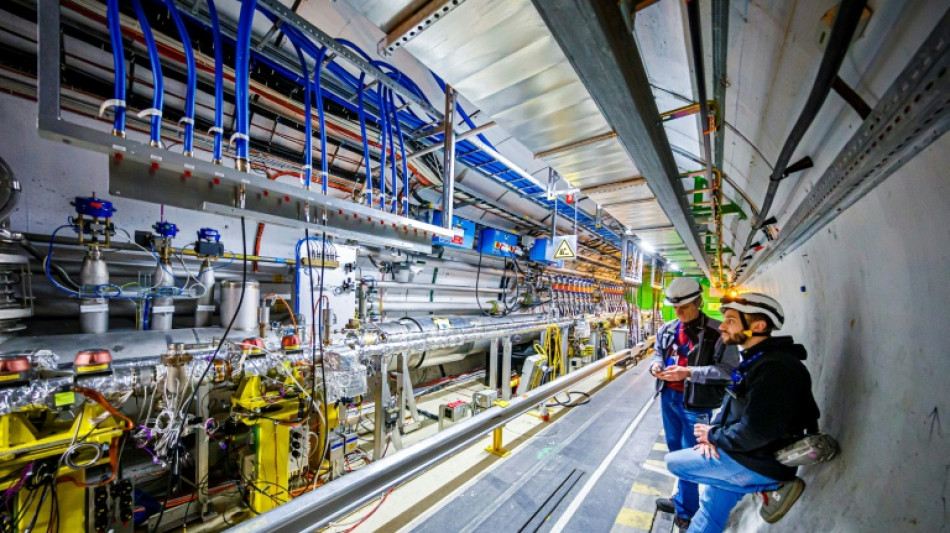
New particle discovered by Large Hadron Collider / Photo: VALENTIN FLAURAUD - AFP/File

 El Nino a 'terrifying' threat to coral reefs: UN biodiversity expert

 Barcola must get used to Liverpool highs and lows, says Iraola

 Versus Trade Wins Best ECN/STP Broker APAC 2026, Marking Third UF Awards Recognition

 Three dead as Istanbul sees heaviest rainfall in 80 years

 US producer prices see biggest jump since 2022 in added challenge to Trump

 Swiatek avoids seed exodus to breeze into Wuhan last eight

 PM condemns 'chaos' as violent protests grip Albania

 'I couldn't breathe', Russell Brand's alleged rape victim says

 Pope's cancer operation already reshaping papacy

 Zverev cruises past De Minaur to reach Shanghai semi-finals

 Ukraine's Zelensky defies Trump with Russian refinery strikes

 Holders Australia edge New Zealand 24-22 to open Rugby league World Cup

 'Ocarina of Time': Nintendo gives Zelda classic a modern makeover

 France charges teen shooter citing revenge for bullying in school

 Martinez blames 'anger' for dig at Man Utd hierarchy

 Crowds build as Albanian PM tours protest aftermath

 China-North Korea bridge opens, 12 years late

 Asian Cup in Saudi Arabia could be postponed but 'no hurry' to decide: AFC

 Conrad wields axe after South Africa loss to Australia

 School roof collapse kills teacher, 27 children in NW Pakistan

 Haze turns Indonesia skies orange, shuts schools in East Timor

 California puts first US billionaire tax to the vote

 School headscarf ban meets resistance in Austria

 World's top cocoa producer aims for a climate-tough bean

 Why is Shell facing lawsuits over climate disasters in Brazil and the Philippines?

The Large Hadron Collider has discovered a new particle, the 80th identified so far by the world's most powerful particle smasher, Europe's CERN physics laboratory announced Tuesday.
The new particle has been named "Xi-cc-plus". Scientists hope the particle -- which is similar to a proton but four times heavier -- will reveal more about the strange behaviour of quantum mechanics.
All the matter around us -- including the protons and neutrons that make up the nucleus of atoms -- are made of baryons.
These common particles are composed of three quarks, which are fundamental building blocks of matter.
Quarks come in six "flavours": up, down, charm, strange, top and bottom. Each has varying mass, electric charge and quantum properties.
In theory, there could be many different types of baryons that mix these flavours -- however most are extremely difficult to observe.
To chase them down, the Large Hadron Collider sends particles whizzing around an underground ring at phenomenal speeds until they smash into each other.
This gives scientists a brief chance to measure how the more stable elements decay, then deduce the properties of the original particle.
The newly discovered "Xi-cc-plus" contains two "charm" quarks and one "down" quark.
Normal protons have two "up" quarks and one "down" quark. Because the new particle has two heavier "charm" quarks instead of "up" ones, it has a much greater mass.
Vincenzo Vagnoni, spokesman for the Large Hadron Collider beauty (LHCb) experiment, said it was "only the second time a baryon with two heavy quarks has been observed".
It is also "the first new particle identified after the upgrades to the LHCb detector that were completed in 2023," he said in a statement.
"The result will help theorists test models of quantum chromodynamics, the theory of the strong force that binds quarks into not only conventional baryons and mesons but also more exotic hadrons such as tetraquarks and pentaquarks."
In 2017, the LHCb experiment announced that it had discovered a similar particle, made of two "charmed" quarks and one "up" quark.
The new particle has an expected lifetime six times shorter than this earlier one, making it far more tricky to spot, CERN said.
The Large Hadron Collider is a 27-kilometre (17 mile) long proton-smashing ring running about 100 metres below France and Switzerland. Mostly famously, it proved the existence of the Higgs boson -- known as the "God particle" -- in 2012.
The latest discovery comes as CERN plans to build an even bigger particle smasher, the Future Circular Collider, to continue probing the mysteries of the universe.
R.AbuNasser--SF-PST