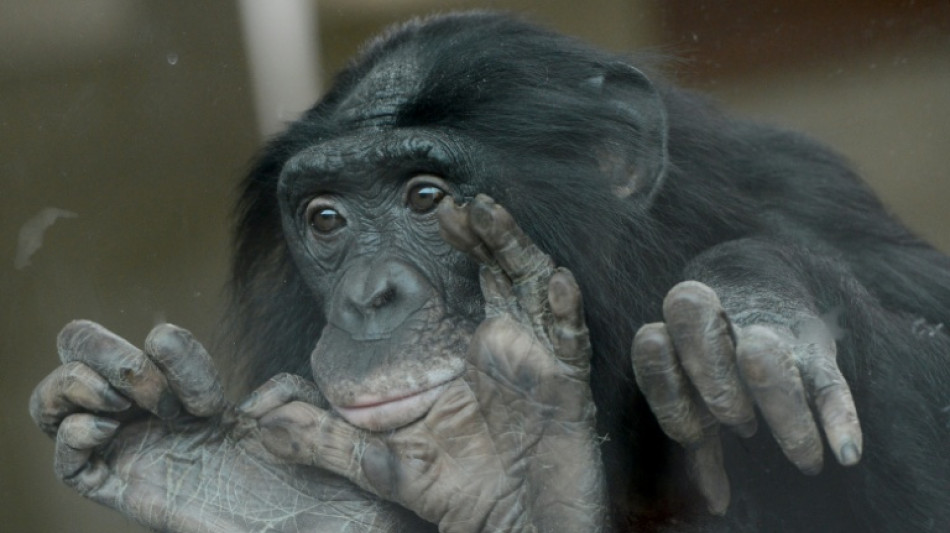
Despite reputation, bonobos are aggressive, particularly toward males: study / Photo: FRANZISKA KRAUFMANN - DPA/AFP

 El Nino a 'terrifying' threat to coral reefs: UN biodiversity expert

 Barcola must get used to Liverpool highs and lows, says Iraola

 Versus Trade Wins Best ECN/STP Broker APAC 2026, Marking Third UF Awards Recognition

 Three dead as Istanbul sees heaviest rainfall in 80 years

 US producer prices see biggest jump since 2022 in added challenge to Trump

 Swiatek avoids seed exodus to breeze into Wuhan last eight

 PM condemns 'chaos' as violent protests grip Albania

 'I couldn't breathe', Russell Brand's alleged rape victim says

 Pope's cancer operation already reshaping papacy

 Zverev cruises past De Minaur to reach Shanghai semi-finals

 Ukraine's Zelensky defies Trump with Russian refinery strikes

 Holders Australia edge New Zealand 24-22 to open Rugby league World Cup

 'Ocarina of Time': Nintendo gives Zelda classic a modern makeover

 France charges teen shooter citing revenge for bullying in school

 Martinez blames 'anger' for dig at Man Utd hierarchy

 Crowds build as Albanian PM tours protest aftermath

 China-North Korea bridge opens, 12 years late

 Asian Cup in Saudi Arabia could be postponed but 'no hurry' to decide: AFC

 Conrad wields axe after South Africa loss to Australia

 School roof collapse kills teacher, 27 children in NW Pakistan

 Haze turns Indonesia skies orange, shuts schools in East Timor

 California puts first US billionaire tax to the vote

 School headscarf ban meets resistance in Austria

 World's top cocoa producer aims for a climate-tough bean

 Why is Shell facing lawsuits over climate disasters in Brazil and the Philippines?

Historically considered a more peaceful species than their chimpanzee cousins, bonobos are actually just as aggressive -- but target their ire most often at males, according to a study published Wednesday.
Living in matriarchal societies, the gentle-eyed primates once dubbed "hippy apes" are far from violence-free, a group of European researchers reported in the journal Science Advances.
They studied 13 groups of bonobos and nine groups of chimpanzees -- who conversely live in patriarchal systems and are well known for their aggressivity -- in zoos, seeking to find out which is more prone to attacks.
Measuring different types of aggressive behavior, both physical and not -- such as throwing objects, intimidation, or biting and slapping -- they found "no overall differences in absolute aggression rates between the two species."
However, differences emerged "in how the aggression is distributed among group members," co-author Nicky Staes told AFP.
"In chimpanzees aggression mostly comes from males and is directed towards both males and females, whereas in bonobos aggression levels are quite equal in both sexes but are mostly directed at males," she said.
Emile Bryon, another co-author, said that, as bonobos live in female-dominant groups, the fact that both females and males direct most of their aggression toward males surprised researchers.
"Dominant individuals compete amongst each other for resources," he said, so "one could expect aggression among bonobo females. But our study says otherwise."
The relative lack of aggression among female bonobos could be explained by the species' well-studied use of sex to defuse conflicts, or the aggression may be "redirected towards males, who become buffers in the females' competitive dynamics," Bryon said.
- Aggressive ancestors? -
The authors noted limitations to their findings due to the apes living in captivity, where food is not as much of a source of tension, but highlighted the variability of aggressiveness in both species.
Some groups of bonobos and chimpanzees appeared particularly prone to violence and others more peaceful, which "suggests that limiting our understanding of a species to a handful of groups can prevent grasping the full species-wide diversity in behavioral expressions," said Bryon.
As our closest primate relatives, the behavior of chimpanzees and bonobos are of particular interest to science.
"There is big debate in evolutionary anthropology whether humans descended from a violent ape or a more cooperative, peaceful one," Staes explained.
The new study suggests that "aggression was likely present in the common ancestor of humans, chimpanzees, and bonobos."
They also show that aggression can vary widely among apes, said Bryon.
"Recognizing this variation and understanding its roots suggests that it can be better understood, managed, and even reduced."
G.AbuOdeh--SF-PST