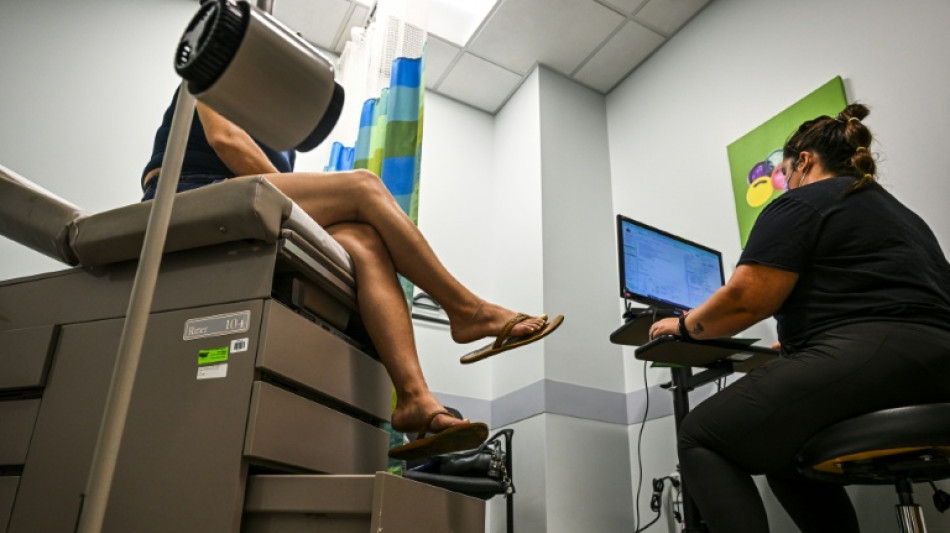
New study probes why chronic pain lasts longer in women / Photo: CHANDAN KHANNA - AFP/File

 Rahm reaches separation deal with LIV in bankruptcy court

 UN chief urges nations to end 'war on nature'

 Newcastle boss Jaissle says Fernandez-Pardo just needs a goal

 Infantino offers apology but 'no answers' at FIFA meeting over World Cup plan

 Don't exclude Turkey from 'Made in Europe' plan: minister to AFP

 French duo Justice to score 'GTA VI': game maker

 El Nino a 'terrifying' threat to coral reefs: UN biodiversity expert

 Barcola must get used to Liverpool highs and lows, says Iraola

 Versus Trade Wins Best ECN/STP Broker APAC 2026, Marking Third UF Awards Recognition

 Three dead as Istanbul sees heaviest rainfall in 80 years

 US producer prices see biggest jump since 2022 in added challenge to Trump

 Swiatek avoids seed exodus to breeze into Wuhan last eight

 PM condemns 'chaos' as violent protests grip Albania

 'I couldn't breathe', Russell Brand's alleged rape victim says

 Pope's cancer operation already reshaping papacy

 Zverev cruises past De Minaur to reach Shanghai semi-finals

 Ukraine's Zelensky defies Trump with Russian refinery strikes

 Holders Australia edge New Zealand 24-22 to open Rugby league World Cup

 'Ocarina of Time': Nintendo gives Zelda classic a modern makeover

 France charges teen shooter citing revenge for bullying in school

 Martinez blames 'anger' for dig at Man Utd hierarchy

 Crowds build as Albanian PM tours protest aftermath

 China-North Korea bridge opens, 12 years late

 Asian Cup in Saudi Arabia could be postponed but 'no hurry' to decide: AFC

 Conrad wields axe after South Africa loss to Australia

To all the women who've heard the frustrating "it's all in your head" in response to medical maladies, a new study out Friday feels your pain.
Research published in the journal Science Immunology shows that women actually do experience exacerbated chronic pain compared to men -- a gap that can be explained by biological differences in the immune system.
"The pain of women has been overlooked in clinical practice," lead author Geoffroy Laumet told AFP, "with the idea that it's more in the mind, or that it's because women are softer and more emotional."
"But here, our study shows that the difference is real... it's not a social construct. It has a real biological mechanism that is behind it."
Pain occurs when neurons react to stimuli: stubbing your toe, or tripping and skinning your knee, for example.
But chronic pain persists with mild to no stimulation -- and women constitute 60 to 70 percent of the patients experiencing it, Laumet said.
The scientist at Michigan State University said his team set out to explore how hormone-regulated immune cells, known as monocytes, impacted pain resolution.
Researchers learned those monocytes play a key role in communicating with the neurons that sense pain -- and then working to shut down those pain-sensing neurons by producing the anti-inflammatory interleukin 10, or IL-10.
Their studies weren't originally aimed at exploring potential differences related to sex, but the data was clear: it took longer for pain to resolve in female mice, and the monocytes producing IL-10 were less active in them.
Those cells are more active in males, according to the study, which cited higher levels of sex hormones like testosterone as an explanation why.
Laumet is hopeful the new research could open new doors to improved pain treatment.
In the long-term, he said research can probe how to stimulate the monocytes and boost IL-10 production to "enhance the body's ability to resolve pain."
And in the short-term, he sees the potential for topical testosterone to prove a viable option to alleviate localized suffering.
- 'More equitable care' -
Elora Midavaine -- a researcher at the University of California, San Francisco who also studies chronic pain -- told AFP the new study adds "important nuance" to how we understand the interactions of hormones and the immune system, and their influence on pain.
Midavaine, who was not involved in the study, said it fits into a broader movement focused on intersections of neuroscience with both immunology and endocrinology -- an approach she said "has potential to advance our understanding of chronic pain in women."
Laumet said he hopes that improved understanding and potential new treatment avenues could reduce prescriptions of opioid painkillers, which have high risks of side effects and addiction.
And more broadly, both researchers voiced optimism that as our knowledge of women's health improves, they will receive better treatment.
"I hope that we can contribute to erase this common idea that women's pain is exaggerated," Laumet said. "The standard of care should be adapted to the sex."
But why has it taken so long to begin understanding the bodies of half the population?
For decades women were excluded from clinical trials, and most pain studies analyzing animals only used males, Midavaine noted -- a medical bias that operated on the notion that female hormones created "too much variability."
Diagnosis of pain relies almost wholly on reporting from patients -- and the symptoms of women are "often interpreted as emotional or mood-driven rather than rooted in biology," Midavaine said.
But "the landscape is changing," Midavaine said. "As the science advances, I believe it will help shift outdated cultural beliefs and lead to more equitable care for women."
S.Barghouti--SF-PST