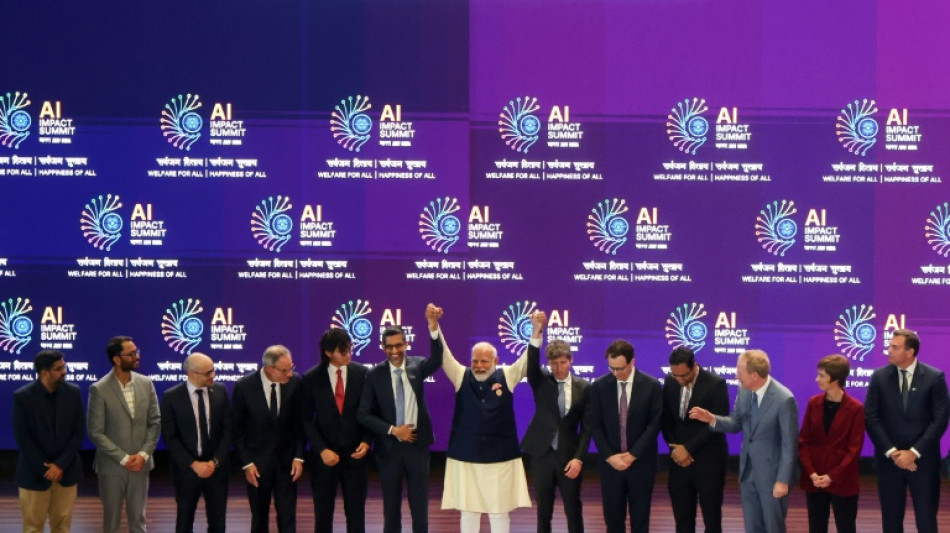
India chases 'DeepSeek moment' with homegrown AI / Photo: Ludovic MARIN - AFP

 Rahm reaches separation deal with LIV in bankruptcy court
 UN chief urges nations to end 'war on nature'

 Newcastle boss Jaissle says Fernandez-Pardo just needs a goal
 Infantino offers apology but 'no answers' at FIFA meeting over World Cup plan

 Don't exclude Turkey from 'Made in Europe' plan: minister to AFP

 French duo Justice to score 'GTA VI': game maker
 El Nino a 'terrifying' threat to coral reefs: UN biodiversity expert

 Barcola must get used to Liverpool highs and lows, says Iraola
 Versus Trade Wins Best ECN/STP Broker APAC 2026, Marking Third UF Awards Recognition
 Three dead as Istanbul sees heaviest rainfall in 80 years

 US producer prices see biggest jump since 2022 in added challenge to Trump

 Swiatek avoids seed exodus to breeze into Wuhan last eight

 PM condemns 'chaos' as violent protests grip Albania

 'I couldn't breathe', Russell Brand's alleged rape victim says

 Pope's cancer operation already reshaping papacy

 Zverev cruises past De Minaur to reach Shanghai semi-finals
 Ukraine's Zelensky defies Trump with Russian refinery strikes
 Holders Australia edge New Zealand 24-22 to open Rugby league World Cup

 'Ocarina of Time': Nintendo gives Zelda classic a modern makeover

 France charges teen shooter citing revenge for bullying in school

 Martinez blames 'anger' for dig at Man Utd hierarchy

 Crowds build as Albanian PM tours protest aftermath
 China-North Korea bridge opens, 12 years late

 Asian Cup in Saudi Arabia could be postponed but 'no hurry' to decide: AFC

 Conrad wields axe after South Africa loss to Australia

Fledgling Indian artificial intelligence companies showcased homegrown technologies this week at a major summit in New Delhi, underpinning big dreams of becoming a global AI power.
But analysts said the country was unlikely to have a "DeepSeek moment" -- the sort of boom China had last year with a high-performance, low-cost chatbot -- any time soon.
Still, building custom AI tools could bring benefits to the world's most populous nation.
At the AI Impact Summit, Prime Minister Narendra Modi lauded new Indian AI models, along with other examples of the country's rising profile in the field.
"All the solutions that have been presented here demonstrate the power of 'Made in India' and India's innovative qualities," Modi said Thursday.
One of the startups making a buzz at the five-day summit was Sarvam AI, which this week released two large language models it says were trained from scratch in India.
Its models are optimised to work across 22 Indian languages, says the company, which received government-subsidised access to advanced computer processors.
The five-day summit, which wraps up Friday, is the fourth annual international meeting to discuss the risks and rewards of the fast-growing AI sector.
It is the largest yet and the first in a developing country, with Indian businesses striking deals with US tech giants to build large-scale data centre infrastructure to help train and run AI systems.
On Friday, Abu Dhabi-based tech group G42 said the United Arab Emirates would deploy an AI supercomputer system in India, in a project "designed to lower barriers to AI innovation".
- 'Realistic trajectory' -
So-called sovereign AI has become a priority for many countries hoping to reduce dependence on US and Chinese platforms while ensuring that systems respect local regulations, including on data privacy.
AI models that succeed in India "can be deployed all over the world", Modi said on Thursday.
But experts said the sheer computational might of the United States would be hard to match.
"Despite the headline pledges, we don't expect India to emerge as a frontier AI innovation hub in the near term," said Reema Bhattacharya, head of Asia research at risk intelligence company Verisk Maplecroft.
"Its more realistic trajectory is to become the world's largest AI adoption market, embedding AI at scale through digital public infrastructure and cost-efficient applications," she said.
Another Indian company that drew attention with product debuts this week was the Bengaluru-based Gnani.ai, which introduced its Vachana speech models at the summit.
Trained on more than a million hours of audio, Vachana models generate natural-sounding voices in Indian languages that can process customer interactions and allow people to interact with digital services out loud.
Job disruption and redundancies, including in India's huge call centre industry, have been one key focus of discussions at the Delhi summit.
- 'Biggest market' -
Prihesh Ratnayake, head of AI initiatives at think-tank Factum, told AFP that the new Indian AI models were "not really meant to be global".
"They're India-specific models, and hopefully we'll see their impact over the coming year," he said.
"Why does India need to build for the global scale? India itself is the biggest market."
And Nanubala Gnana Sai at the Cambridge AI Safety Hub said that homegrown models could bring other benefits.
Existing models, even those developed in China, "have intrinsic bias towards Western values, culture and ethos -- as a product of being trained heavily on that consensus", Sai told AFP.
India already has some major strengths, including "technology diffusion, eager talent pool and cheap labour", and dedicated efforts can help startups pivot to artificial intelligence, he said.
"The end-product may not 'rival' ChatGPT or DeepSeek on benchmarks, but will provide leverage for the Global South to have its own stand in an increasingly polarised world."
L.AbuAli--SF-PST