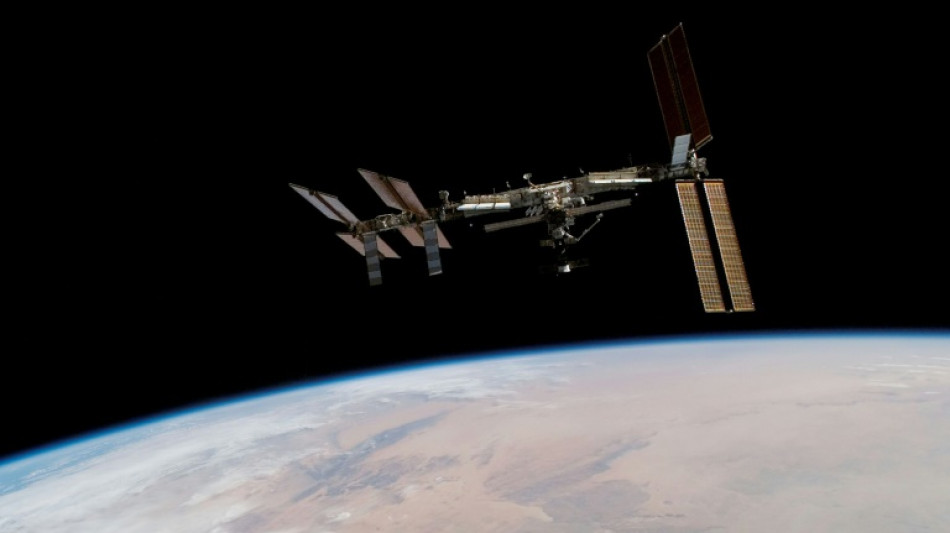
Russia to quit International Space Station 'after 2024' / Photo: Handout - NASA/AFP/File

 Two dead as Istanbul endures heaviest rainfall in 80 years

 After latest Nepal flood, survivors fear for future

 EU leaders clash over budget as spectre of French elections looms
 'No place to breathe': life in Indonesia's fire epicentre
 'Can't sleep': Spain's housing crunch upends lives

 Musk calls on Ukraine's Zelensky to 'go' after satellite slowdown row
 Still smiling at 117, Albanian may be world's oldest woman

 Pope has 'good night' in hospital: Vatican
 China's economy seen missing target as global shocks bite: AFP poll

 Costa Rica opens jail inspired by El Salvador mega-prison

 Same-sex couple takes fight for equality to Slovakian court

 'High hopes' as Indonesian women get a football league, again

 'Expectations high' for Bordeaux-Begles' Champions Cup hat-trick bid, says Depoortere
 Rennie urges All Blacks to stay focused against 'hurting' Wallabies

 Palmeiras beat Fluminense 2-1 in Libertadores semi-final first leg
 Brewers blasts leave Dodgers on brink
 Tech stock lead rout after US inflation fuels rate hike bets

 Al-Fayed survivors say UK police missing 'bigger picture'

 Online 'witch hunt' sweeps up Asians misidentified as US rape accused

 Prospect of Bolsonaro win looms large over Brazil's Indigenous

 Freed from Belarus, founder of Lady Gaga's biggest fan site tells his story

 Behind AI's carbon footprint, a potential climate tool

 Trump's new press secretary faces scrutiny over credentials
 PSG 'got lucky' to win Man City thriller, says Luis Enrique

 Real Madrid comeback stuns Roma as Mourinho enjoys happy reunion
Russia said on Tuesday it was leaving the International Space Station "after 2024", amid tensions with the West, in a move analysts warned could lead to a halt to manned flights.
The confirmation of the long-mooted move comes as ties unravel between the Kremlin and the West over Moscow's military intervention in Ukraine and several rounds of devastating sanctions against Russia, including its space sector.
Space experts said the departure from the International Space Station would seriously affect the country's space sector and deal a major blow to the programme of manned flights, a major source of Russian pride.
"Of course we will fulfil all our obligations to our partners but the decision to leave this station after 2024 has been made," Yury Borisov, the new head of Russian space agency Roscosmos, told President Vladimir Putin, according to a Kremlin account of their meeting.
"I think that by this time we will start putting together a Russian orbital station," Borisov added, calling it the domestic space programme's main "priority".
"Good," Putin replied.
The ISS is due to be retired after 2024, although US space agency NASA says it can remain operational until 2030.
The ISS was launched in 1998 at a time of hope for US-Russia cooperation following their Space Race competition during the Cold War.
Washington has not received "any official word" from Russia yet, Robyn Gatens, director of the ISS for NASA, said during a conference on the outpost.
Asked whether she wanted the US-Russia space relationship to end, she replied: "No, absolutely not."
Until now, space exploration has been one of the few areas where cooperation between Russia and the United States and its allies had not been wrecked by tensions over Ukraine and elsewhere.
- 'Like an old woman's flat'-
Russia is heavily reliant on imports of everything from manufacturing equipment to consumer goods and the effects of Western sanctions are expected to wreak havoc on the country's economy in the long term.
Space expert Vadim Lukashevich said space science cannot flourish in a heavily-sanctioned country.
"If the ISS ceases to exist in 2024, we will have nowhere to fly," Lukashevich told AFP. "At stake is the very preservation of manned flights in Russia, the birthplace of cosmonautics."
Pointing to Russia's growing scientific and technological isolation amid the offensive in Ukraine, Lukashevich said the authorities could not plan more than several months in advance and added that even if Russia builds an orbiting station, it would be a throwback to the 1980s.
"It will be archaic, like an old woman's flat, with a push-button telephone and a record-player," he said.
Space analyst Vitaly Yegorov struck a similar note, saying it was next to impossible to build a new orbiting station from scratch in a few years.
"Neither in 2024, nor in 2025, nor in 2026 will there be a Russian orbital station," Yegorov told AFP.
He added that creating a full-fledged space station would take at least a decade of "the most generous funding".
Yegorov said Russia's departure from the ISS meant Moscow might have to put on ice its programme of manned flights "for several years" or even "indefinitely".
The move could also see Russia abandon its chief spaceport, Baikonur, which it is renting from Kazakhstan, Yegorov said.
- 'Difficult to restore' -
The Soviet space programme can boast of several key accomplishments, including sending the first man into space in 1961 and launching the first satellite four years earlier. These feats remain a major source of national pride in Russia.
But experts say Roscosmos is now a shadow of its former self and has in recent years suffered a series of setbacks, including corruption scandals and the loss of a number of satellites and other spacecraft.
Borisov, appointed in mid-July, replaced Dmitry Rogozin, a firebrand politician known for his bombastic statements.
Rogozin had previously warned that without cooperation from Moscow, the ISS could de-orbit and fall on US or European territory.
In a possible sign of disagreement with Borisov, Vladimir Solovyov, chief designer at spacecraft manufacturer Energia, said Russia should not rush to quit the ISS.
"If we halt manned flights for several years, then it will be very difficult to restore what has been achieved," he was quoted as telling the Russky Cosmos magazine.
S.AbuJamous--SF-PST