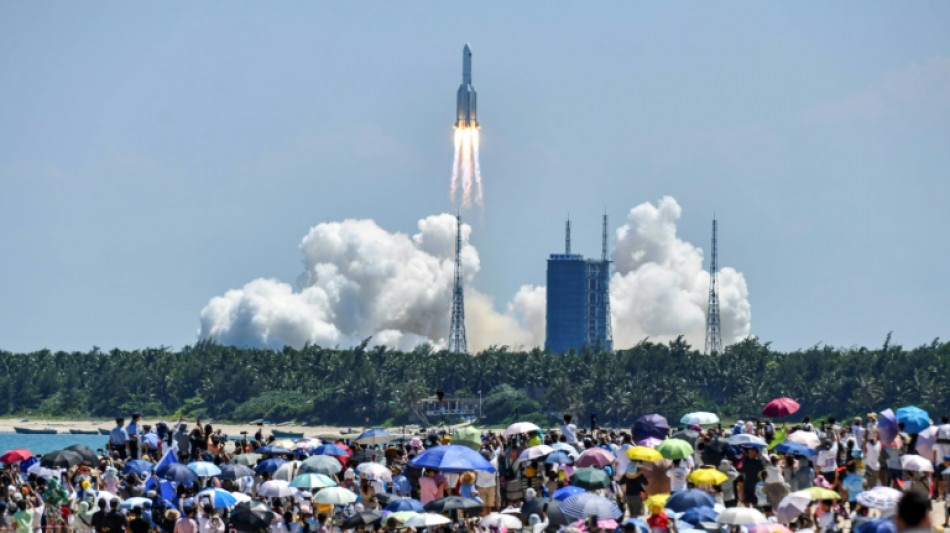
Chinese astronauts set up new lab on space station / Photo: - - CNS/AFP/File

 Two dead as Istanbul endures heaviest rainfall in 80 years
 After latest Nepal flood, survivors fear for future

 EU leaders clash over budget as spectre of French elections looms

 'No place to breathe': life in Indonesia's fire epicentre
 'Can't sleep': Spain's housing crunch upends lives
 Musk calls on Ukraine's Zelensky to 'go' after satellite slowdown row
 Still smiling at 117, Albanian may be world's oldest woman
 Pope has 'good night' in hospital: Vatican
 China's economy seen missing target as global shocks bite: AFP poll

 Costa Rica opens jail inspired by El Salvador mega-prison

 Same-sex couple takes fight for equality to Slovakian court
 'High hopes' as Indonesian women get a football league, again
 'Expectations high' for Bordeaux-Begles' Champions Cup hat-trick bid, says Depoortere
 Rennie urges All Blacks to stay focused against 'hurting' Wallabies
 Palmeiras beat Fluminense 2-1 in Libertadores semi-final first leg
 Brewers blasts leave Dodgers on brink
 Tech stock lead rout after US inflation fuels rate hike bets
 Al-Fayed survivors say UK police missing 'bigger picture'
 Online 'witch hunt' sweeps up Asians misidentified as US rape accused

 Prospect of Bolsonaro win looms large over Brazil's Indigenous

 Freed from Belarus, founder of Lady Gaga's biggest fan site tells his story

 Behind AI's carbon footprint, a potential climate tool

 Trump's new press secretary faces scrutiny over credentials

 PSG 'got lucky' to win Man City thriller, says Luis Enrique

 Real Madrid comeback stuns Roma as Mourinho enjoys happy reunion
Astronauts entered the new lab module of China's space station for the first time Monday, in a major step towards completing the orbital outpost by the end of the year.
The station is one of the crown jewels of Beijing's ambitious space programme, which has landed robotic rovers on Mars and the Moon, and made China only the third nation to put humans in orbit.
Once completed, Tiangong -- or "heavenly palace" -- will be constantly crewed by rotating teams of three astronauts, who will conduct scientific experiments and help test new technologies.
Wentian, the second of Tiangong's three main sections, docked with the station's core module Tianhe on Monday after successfully launching from southern China a day earlier, state media reported.
A few hours after docking, the three astronauts -- who have been living in the core module since June -- opened the hatch and entered Wentian, footage from state broadcaster CCTV showed.
The crew, dressed in blue jumpsuits, were seen floating around the brightly lit module before facing the camera and saluting.
Wentian will focus on life sciences and biotechnology research, according to official news agency Xinhua, including cell research and growth experiments on plants, fruit flies and zebrafish.
The module will have living space for three additional astronauts, housing up to six people during crew transitions, state media said.
The third and final module, another lab named Mengtian, is scheduled for launch in October.
Tiangong, once completed, is expected to remain in low orbit 400-450 kilometres (250-280 miles) above Earth for at least 10 years.
Next year, China is also planning to launch a space telescope with a field of view 350 times that of NASA's Hubble Space Telescope.
The telescope will be positioned in the same orbit as Tiangong, allowing the station to dock with it for refuelling and servicing when needed.
China has poured billions of dollars into space flight and exploration as it seeks to build a programme that reflects its stature as a rising global power.
The programme has rapidly yielded successes in the last two decades, including launching the first Chinese astronauts, a historic first controlled landing on the far side of the Moon, and delivering a rover to the surface of Mars.
And after several missions to test the technologies needed for a constantly crewed outpost, it is set to finish Tiangong this year.
The station when completed is expected to have a mass of 90 tonnes, around a quarter of the International Space Station -- from which China has been excluded by the United States.
The ISS -- a collaboration between the United States, Russia, Canada, Europe and Japan -- is due to be retired after 2024, although NASA has said it could potentially remain functional beyond 2028.
B.AbuZeid--SF-PST