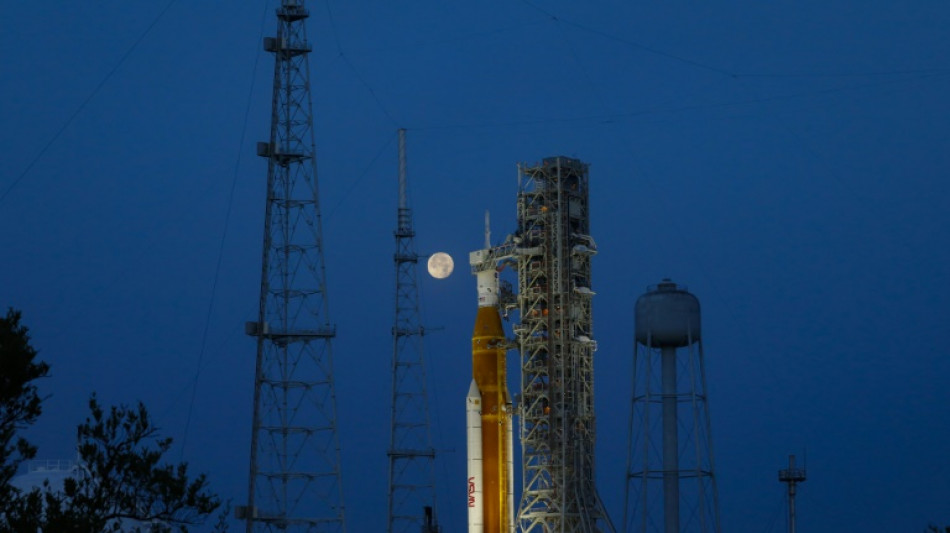
NASA's new Moon rocket to launch as soon as August 29 / Photo: Eva Marie UZCATEGUI - AFP/File

 Two dead as Istanbul endures heaviest rainfall in 80 years

 After latest Nepal flood, survivors fear for future

 EU leaders clash over budget as spectre of French elections looms

 'No place to breathe': life in Indonesia's fire epicentre

 'Can't sleep': Spain's housing crunch upends lives

 Musk calls on Ukraine's Zelensky to 'go' after satellite slowdown row

 Still smiling at 117, Albanian may be world's oldest woman

 Pope has 'good night' in hospital: Vatican

 China's economy seen missing target as global shocks bite: AFP poll

 Costa Rica opens jail inspired by El Salvador mega-prison

 Same-sex couple takes fight for equality to Slovakian court

 'High hopes' as Indonesian women get a football league, again

 'Expectations high' for Bordeaux-Begles' Champions Cup hat-trick bid, says Depoortere

 Rennie urges All Blacks to stay focused against 'hurting' Wallabies

 Palmeiras beat Fluminense 2-1 in Libertadores semi-final first leg

 Brewers blasts leave Dodgers on brink

 Tech stock lead rout after US inflation fuels rate hike bets

 Al-Fayed survivors say UK police missing 'bigger picture'

 Online 'witch hunt' sweeps up Asians misidentified as US rape accused

 Prospect of Bolsonaro win looms large over Brazil's Indigenous

 Freed from Belarus, founder of Lady Gaga's biggest fan site tells his story

 Behind AI's carbon footprint, a potential climate tool

 Trump's new press secretary faces scrutiny over credentials

 PSG 'got lucky' to win Man City thriller, says Luis Enrique

 Real Madrid comeback stuns Roma as Mourinho enjoys happy reunion

Mark your calendars: NASA's Artemis program to return to the Moon could launch its first uncrewed test flight as soon as August 29, the agency said Wednesday.
Artemis-1 is the first in a series of missions as the United States seeks to return humans to the Moon, build a sustained presence there, and use the lessons gained to plan a trip to Mars sometime in the 2030s.
NASA associate administrator Jim Free told reporters the first window of possible launch dates for the giant Space Launch System (SLS) and Orion crew capsule were August 29, September 2, and September 5.
The decision follows final checks on the ground at the Kennedy Space Center in Florida known as "wet dress rehearsals."
The last of these tests, carried out in June, met 90 percent of the team's goals, and on Wednesday Cliff Lanham, senior vehicle operations manager, said engineers have now replaced faulty seals that had caused a hydrogen leak on SLS during the final trial.
Artemis-1 is set to journey around the far side of the Moon in a mission lasting four to six weeks -- longer than any ship for astronauts has done without docking, before returning home faster and hotter than every vessel before.
It will also deploy a number of small satellites called CubeSats to perform experiments in space.
Artemis mission manager Mike Sarafin told reporters: "Our first and our primary objective is to demonstrate Orion's heat shield in lunar reentry conditions."
When the capsule returns from the Moon, it will be traveling about 24,500 miles an hour (39,400 kilometers per hour) and experience temperatures half as hot as the Sun outside its heat shield.
The second objective is to demonstrate the flight worthiness of the rocket and crew capsule as they perform all their maneuvers over the course of the mission.
Finally, NASA will look to successfully retrieve Orion after splashdown, and thoroughly inspect it.
Artemis-2 will be the first crewed test, flying around the Moon but not landing, while Artemis-3 will see the first woman and first person of color touch down on the lunar south pole.
D.Khalil--SF-PST