NASA reveals Webb telescope's first cosmic targets / Photo: NASA/ESA - NASA/ESA/AFP/File

 Asian Cup in Saudi Arabia could be postponed but 'no hurry' to decide: AFC
 Conrad wields axe after South Africa loss to Australia

 School roof collapse kills teacher, 27 children in NW Pakistan
 Haze turns Indonesia skies orange, shuts schools in East Timor

 California puts first US billionaire tax to the vote

 School headscarf ban meets resistance in Austria

 World's top cocoa producer aims for a climate-tough bean

 Why is Shell facing lawsuits over climate disasters in Brazil and the Philippines?

 New four-lane bridge opens between China, North Korea
 Tech stocks lead rout after US inflation fuels rate hike bets

 'No time to recover': UNDP chief sounds alarm on growing poverty after Iran war shock
 Australia says won't let big tech have 'unfettered' access to kids

 Mobile clinics battle Mongolia's childhood dental 'disaster'

 Wallabies back Meredith as playmaker for second New Zealand Test
 Messi's Inter Miami book playoffs with 2-0 win over New York City

 Oil-rich Alberta tests Canada's unity with secession vote
 EU leaders head for showdown over bloc budget
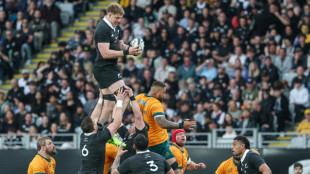 All Blacks make three changes for second Wallabies Test

 Mourinho blasts 'shameless' timing of Vinicius ban decision

 PSG beat Man City in Champions League thriller, Barcola hits Liverpool hat-trick

 US Treasury chief urges stronger IMF role against 'distortionary policies'

 Giant-killers Bodo sink Dortmund in Champions League

 PSG outgun embattled Man City in six-goal Champions League thriller

 In Chicago, pope's hometown, Catholics express shock and support

 Musk suggests US govt behind any slowdown in Ukraine's Starshield system

NASA said Friday the first cosmic images from the James Webb Space Telescope will include unprecedented views of distant galaxies, bright nebulae, and a faraway giant gas planet.
The US, European and Canadian space agencies are gearing up for a big reveal on July 12 of early observations by the $10 billion observatory, the successor to Hubble that is set to reveal new insights into the origins of the universe.
"I'm looking very much forward to not having to keep these secrets anymore, that will be a great relief," Klaus Pontoppidan, an astronomer at the Space Telescope Science Institute (STSI) that oversees Webb, told AFP last week.
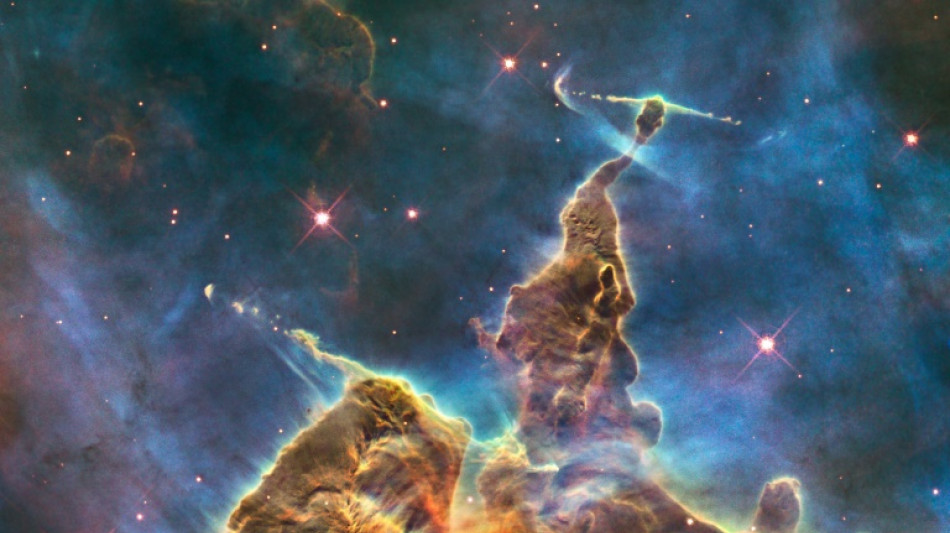
An international committee decided the first wave of full-color scientific images would include the Carina Nebula, an enormous cloud of dust and gas 7,600 light years away, as well as the Southern Ring Nebula, which surrounds a dying star 2,000 light years away.
Carina Nebula is famous for its towering pillars that include "Mystic Mountain," a three-light-year-tall cosmic pinnacle captured in an iconic image by Hubble.
Webb has also carried out a spectroscopy -- an analysis of light that reveals detailed information -- on a faraway gas giant called WASP-96 b, which was discovered in 2014.
Nearly 1,150 light-years from Earth, WASP-96 b is about half the mass of Jupiter and zips around its star in just 3.4 days.
Next comes Stephan's Quintet, a compact galaxy 290 million light years away. Four of the five galaxies within the quintet are "locked in a cosmic dance of repeated close encounters," NASA said.
Finally, and perhaps most enticing of all, Webb has gathered an image using foreground galaxy clusters called SMACS 0723 as a kind of cosmic magnifying glass for the extremely distant and faint galaxies behind it.
This is known as "gravitational lensing" and uses the mass of foreground galaxies to bend the light of objects behind them, much like a pair of glasses.
Dan Coe, an astronomer at STSI, told AFP on Friday that even in its first images, the telescope had broken scientific ground.
"When I first saw the images... of this deep field of this galaxy cluster lensing, I looked at the images, and I suddenly learned three things about the universe that I didn't know before," he said.
"It's totally blown my mind."
Webb's infrared capabilities allow it to see deeper back in time to the Big Bang, which happened 13.8 billion years ago, than any instrument before it.
Because the Universe is expanding, light from the earliest stars shifts from the ultraviolet and visible wavelengths it was emitted in, to longer infrared wavelengths -- which Webb is equipped to detect at an unprecedented resolution.
I.Saadi--SF-PST