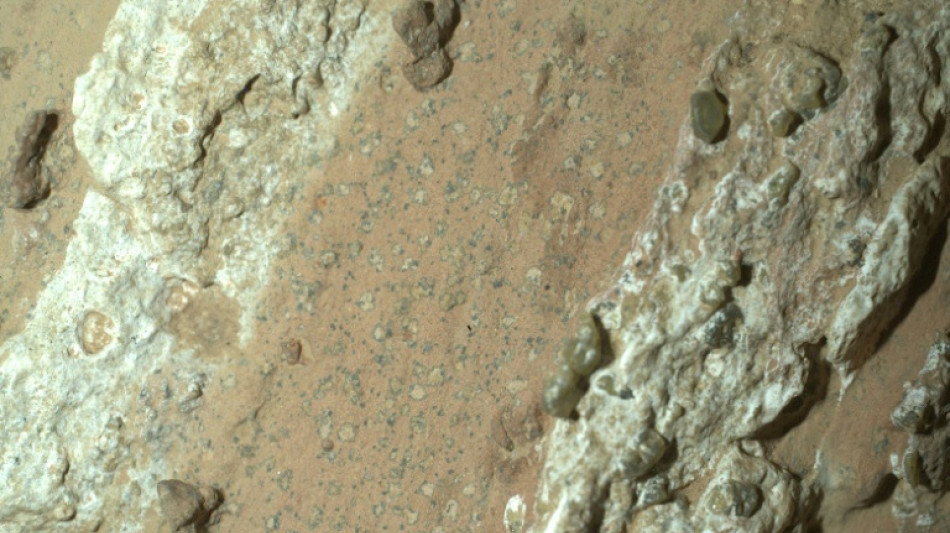
Martian rocks offer clues that might indicate ancient life / Photo: HANDOUT - NASA/JPL-Caltech/MSSS/AFP

 'Multiple victims' in Oregon elementary school shooting: police

 ChangeNOW Announces NOW AI After Resolving Website Integration Vulnerability

 Argentine demonstration over education cuts ends in clashes

 Argentine protesters, police clash at demo over university funding

 US stocks end higher as AI shares stabilize

 School roof collapse kills 32 children, teacher in Pakistan

 Lyon down Palace in Europa League, Sunderland leave it late

 UniCredit says receives ECB green light for Commerzbank takeover

 New York City pension fund asks Anthropic to delay IPO

 Venezuela's Maduro denies US torture charges as 'false accusations'

 Somalia sets May presidential election despite insecurity

 Chelsea's Caicedo eager to be more of a leader

 Rahm reaches separation deal with LIV in bankruptcy court

 UN chief urges nations to end 'war on nature'

 Newcastle boss Jaissle says Fernandez-Pardo just needs a goal

 Infantino offers apology but 'no answers' at FIFA meeting over World Cup plan

 Don't exclude Turkey from 'Made in Europe' plan: minister to AFP

 French duo Justice to score 'GTA VI': game maker

 El Nino a 'terrifying' threat to coral reefs: UN biodiversity expert

 Barcola must get used to Liverpool highs and lows, says Iraola

 Versus Trade Wins Best ECN/STP Broker APAC 2026, Marking Third UF Awards Recognition

 Three dead as Istanbul sees heaviest rainfall in 80 years

 US producer prices see biggest jump since 2022 in added challenge to Trump

 Swiatek avoids seed exodus to breeze into Wuhan last eight
 PM condemns 'chaos' as violent protests grip Albania

Colorful, speckled rocks found on the surface of Mars have offered among the most encouraging evidence yet of ancient life on our neighboring planet, scientists at NASA announced Wednesday.
The Perseverance Mars rover collected the "Sapphire Canyon" rock samples in July 2024 from what's thought to be an ancient lakebed, and its poppyseed and leopard-esque spots pointed to potential chemical reactions that piqued the interest of researchers.
If the features resulted from microbial activity that created minerals in the way they do on Earth -- well, that might point to life on Mars.
It's far too soon for scientists to say that definitively, but the findings, which were detailed in research published in the journal Nature, are alluring, scientists said.
"It's kind of the equivalent of seeing like leftover fossils, you know, leftovers from a meal, and maybe that meal has been excreted by a microbe. And that's what we're seeing in this sample," Nicky Fox, administrator of NASA's Science Mission Directorate, told journalists.
When those kinds of mineral and textured features form in sediment on Earth, it's frequently the product of reactions from mud and organic matter, explained the study's lead author Joel Hurowitz -- a potential "biosignature," or sign of life.
Specifically, Perserverance's instruments identified the minerals vivianite and greigite. On Earth, vivianite is often found in sediments, peat bogs, and around decaying organic matter. Some forms of microbial life on Earth can produce greigite.
"But there are non-biological ways to make these features that we cannot completely rule out on the basis of the data that we collected," Hurowitz said.
Still, the findings are "exciting," he told journalists, explaining that researchers would need to analyze the sample in person to better understand if microbial activity had created the "fantastic textures" and colors including blue and green.
- Return to Earth -
That's no small feat, particularly in light of President Donald Trump administration's plans to cancel the Mars Sample Return program -- a robotic mission planned for the 2030s to bring Perseverance's samples back to Earth.
Asked by journalists if that was still the plan, acting director of NASA Sean Duffy was non-committal, hinting the samples might be brought back by a future crewed mission instead.
"We care about resources, we care about the timeframe, we believe there's a better way to do this, a faster way to get these samples back. And so that is the analysis that we've gone through. Can we do it faster? Can we do it cheaper? And we think we can," he said.
"We're going to actually figure out a different way to bring it back again, and we think we can do it faster and more cost effectively."
There are several rovers ambling across Mars -- Perseverance has been there since 2021 -- seeking signs of life that could have existed millions to billions of years ago, when the planet was thought to have been more habitable.
Evidence that ancient rivers and lakes carved into the planet's surface would indicate that water once flowed there.
And the latest discovery, said Fox, brought researchers "one step closer" to answering the burning question: "Are we truly alone in the universe?"
J.AbuHassan--SF-PST