Climate watchers fret over Trump's cut to sciences / Photo: Patrick T. Fallon - AFP

 Broncos top Super Bowl champion Seahawks in overtime

 Brilliant Brewers sweep Dodgers to reach World Series

 Brewers complete Dodgers sweep to reach World Series
 High-flying Freiburg try to shut out the noise as fairytale run continues

 Flamengo secure 0-0 draw in La Plata in Copa Libertadores semi
 The final lap? Two days on the campaign trail with Trump
 Asian stocks rise as tech bounces from rout, eyes on Warsh
 Saudi organisers say 2027 Asian Cup 'on schedule' after attacks
 Right-wing Brazil influencers on 'mission' to seal Bolsonaro win

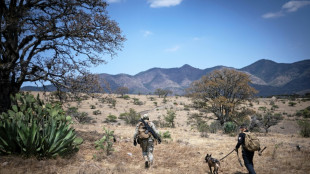 Using AI to help find Mexico's legions of missing children

 Fiji to deploy solar-powered Australian military drones at sea

 'Multiple victims' in Oregon elementary school shooting, police say

 'Multiple victims' in Oregon elementary school shooting: police
 ChangeNOW Announces NOW AI After Resolving Website Integration Vulnerability

 Argentine demonstration over education cuts ends in clashes
 Argentine protesters, police clash at demo over university funding
 US stocks end higher as AI shares stabilize

 School roof collapse kills 32 children, teacher in Pakistan
 Lyon down Palace in Europa League, Sunderland leave it late

 UniCredit says receives ECB green light for Commerzbank takeover

 New York City pension fund asks Anthropic to delay IPO

 Venezuela's Maduro denies US torture charges as 'false accusations'

 Somalia sets May presidential election despite insecurity
 Chelsea's Caicedo eager to be more of a leader
 Rahm reaches separation deal with LIV in bankruptcy court

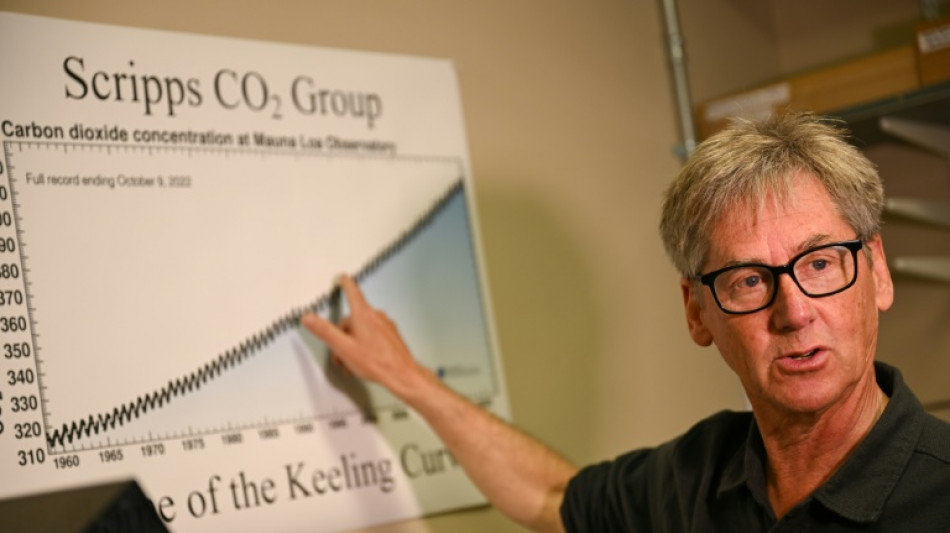
In his California laboratory, Ralph Keeling examines a graph created from data his father began collecting that keeps a record of the amount of carbon dioxide in the atmosphere.
After 67 years, the fate of this "major indicator of climate change" is uncertain under President Donald Trump's administration.
The United States "needs this information, there's no doubt about it," the geochemistry professor at the Scripps Institution of Oceanography in San Diego told AFP.
His father, Charles David Keeling, decided in 1958 to measure atmospheric CO2 concentrations at the summit of the Mauna Loa volcano in Hawaii.
This gave rise to the Keeling curve, which today represents the oldest continuous measurement of this greenhouse gas, which is produced by the burning of fossil fuels.
This graph "showed early on that humans were having an impact on the whole planet," even before the effects of climate change were palpable, Ralph Keeling said.
Even as science as evolved, the project remains an essential climate watchdog.
It provides a basis for thinking about how farmers can modify their crops in the face of a warming atmosphere, or how insurers can adapt their coverage to cope with increasingly fierce fires and more frequent flooding.
"This is very rock solid data, but the program that makes this is fragile," Keeling said.
- 'Concerning' -
Concerns arose in early March, when Elon Musk's so-called Department of Government Efficiency recommended canceling the lease on the National Oceanic and Atmospheric Administration (NOAA) office in Hawaii by the end of August.
This office, located in the town of Hilo, is responsible for maintaining the measurements at the summit of Mauna Loa.
But it's not just buildings. NOAA, a key agency for American climate research, has been targeted by hundreds of layoffs since the return to the White House of Trump, who has repeatedly called climate change a "hoax".
The administration also wants to cut the agency's budget by $1.6 billion, according to documents revealed in mid-April by The New York Times.
The plan also envisages eliminating the branch dedicated to oceanic and atmospheric research.
"It's concerning," said Keeling.
At the summit of Mauna Loa, an observatory houses machines from the Scripps Institute and NOAA, which simultaneously measure atmospheric CO2 concentrations at an altitude of 3,400 meters (11,000 feet).
To ensure they're working properly, local scientists also regularly collect air samples in glass carboys, following the method developed by Charles Keeling more than six decades ago in San Diego.
Since then, other countries have begun recording the amount of CO2 in the atmosphere, thanks to new methods sometimes involving satellites.
But these alone are not enough, according to Keeling.
"Although there's a bigger community now, and there's a constellation of methods being used, those additional efforts have assumed that this backbone from Scripps and NOAA is there," he said.
"A satellite measurement of CO2... gives you a lot of fine grained information, but it doesn't give you reliable long term trends, and it doesn't give you certain other measures that we can get from direct atmospheric measurements.
"You have to ground truth it, you need the calibration."
- Attack on climate science -
NOAA declined to comment on the potential impact of the proposed cuts on its program.
"We are not discussing internal management matters and we do not do speculative interviews," the agency told AFP.
"NOAA remains dedicated to its mission, providing timely information, research, and resources that serve the American public and ensure our nation's environmental and economic resilience."
For Tim Lueker, who spent his career with the atmospheric measurement program launched by the Scripps Institute, that is cold comfort.
The Trump administration "is not making these cuts to save money. It's so transparent what's going on," he said.
At 67, he is worried about a full-scale attack on climate science, with the government ordering the NOAA to identify funding for projects that mention the terms "climate crisis," "clean energy," "environmental quality," or "pollution."
"The idea of saving money... is kind of silly when you consider how much one fighter plane costs compared to the annual funding of NOAA Climate Research."
T.Ibrahim--SF-PST