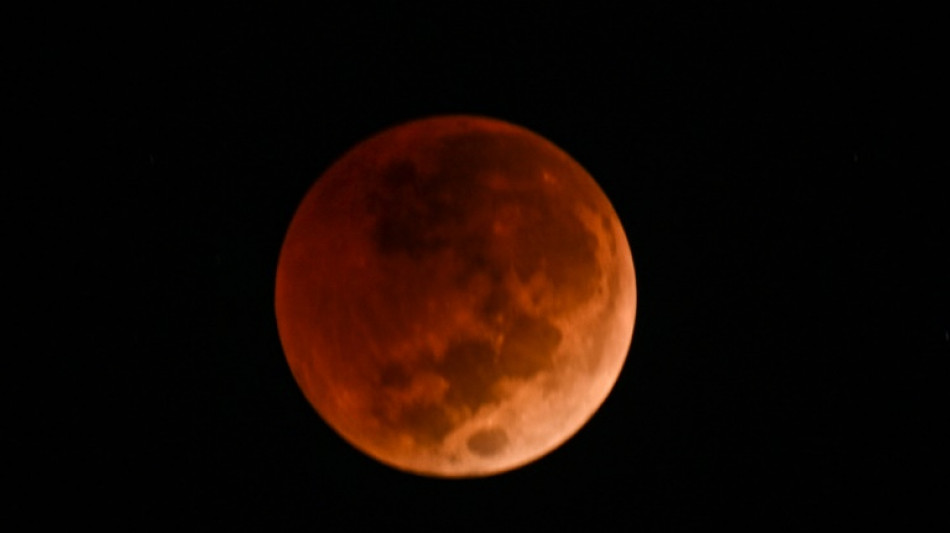
'Blood Moon' rising: Rare total lunar eclipse tonight / Photo: Johan ORDONEZ - AFP/File

 Trump's new press secretary says China lacked 'proper' toilets

 India closes down New Delhi park ahead of 'cockroach' movement rally

 'Let us build': World Bank chief outlines jobs-led development agenda
 Broncos top Super Bowl champion Seahawks in overtime

 Brilliant Brewers sweep Dodgers to reach World Series
 Brewers complete Dodgers sweep to reach World Series
 High-flying Freiburg try to shut out the noise as fairytale run continues

 Flamengo secure 0-0 draw in La Plata in Copa Libertadores semi
 The final lap? Two days on the campaign trail with Trump
 Asian stocks rise as tech bounces from rout, eyes on Warsh

 Saudi organisers say 2027 Asian Cup 'on schedule' after attacks

 Right-wing Brazil influencers on 'mission' to seal Bolsonaro win

 Using AI to help find Mexico's legions of missing children

 Fiji to deploy solar-powered Australian military drones at sea

 'Multiple victims' in Oregon elementary school shooting, police say

 'Multiple victims' in Oregon elementary school shooting: police

 ChangeNOW Announces NOW AI After Resolving Website Integration Vulnerability

 Argentine demonstration over education cuts ends in clashes

 Argentine protesters, police clash at demo over university funding

 US stocks end higher as AI shares stabilize

 School roof collapse kills 32 children, teacher in Pakistan

 Lyon down Palace in Europa League, Sunderland leave it late

 UniCredit says receives ECB green light for Commerzbank takeover
 New York City pension fund asks Anthropic to delay IPO

 Venezuela's Maduro denies US torture charges as 'false accusations'

A "Blood Moon" will bathe a large swathe of the world in red light overnight Thursday during a rare total lunar eclipse.
Skygazers will be able to witness the celestial spectacle in the Americas and Pacific and Atlantic oceans, as well as in the westernmost parts of Europe and Africa.
The phenomenon happens when the Sun, Earth and Moon line up, causing our planet to cast a giant shadow across its satellite.
But as the Earth's shadow creeps across the Moon, it does not entirely blot out its white glow -- instead the Moon turns a reddish colour.
This is because the only sunlight that reaches the Moon is "bent and scattered" as it goes through Earth's atmosphere, Daniel Brown, an astronomer at the UK's Nottingham Trent University, told AFP.
It is similar to how the light can become pink or red during sunrises or sunsets on Earth, he added.
And the more clouds and dust there are in Earth's atmosphere, the redder the Moon will appear.
The lunar eclipse, which will last around six hours on Friday morning, "is an amazing way to see the solar system in action", Brown said.
The period when the Moon is completely in Earth's shadow -- called the totality -- will be just over an hour.
This particular event has been dubbed the "Blood Worm Moon", after one of the names given to March full moons by some Native Americans.
- When can you see it? -
In North America, the moon will start to look like a bite is being taken out of it from 1:09 am Eastern Time (0509 GMT), then the totality will be from 2:26 am to 3:31 am, according to NASA.
In France, the totality will be from 7:26 am to 8:31 am local time (0626-0731 GMT), according to the French Institute of Celestial Mechanics and Ephemeris Calculation.
However only the most western parts of Europe, such as France's Brittany region, will get any chance to see the totality before the Moon sets.
People in New Zealand will have the opposite problem, with the eclipse only partially visible as the Moon rises.
In the United Kingdom, the weather forecast is poor but Brown said he hoped to "snatch a peak at the Moon with clouds above the horizon".
Brown dislikes the term "Blood Moon", saying it has a negative connotation and "originates from a misinformed theory of the end of the world".
But not all societies took a negative view of these celestial shows.
Some people in Africa traditionally viewed a lunar eclipse as a conflict between the Sun and Moon that could be resolved by people "demonstrating on Earth how we work together" and laying old feuds aside, Brown said.
"An amazing story that should inspire us all at the moment," he said.
- Solar eclipse soon -
It will be the first total lunar eclipse since 2022, but there will be another one this September.
Thursday's event will be a "Micromoon", meaning the Moon is the farthest away it gets from Earth, making it appear about seven percent smaller than normal, according to the website Earthsky.
This is the opposite of a "Supermoon", as was seen during 2022's lunar eclipse.
Some skygazers will be in for another treat later this month -- a partial solar eclipse, which is when the Moon blocks out the Sun's light on Earth.
This eclipse will be visible on March 29 in eastern Canada, parts of Europe, northern Russia and northwest Africa.
Viewing even a partial solar eclipse with the naked eye is dangerous, and people advised to use special eclipse glasses or pinhole projectors.
I.Matar--SF-PST