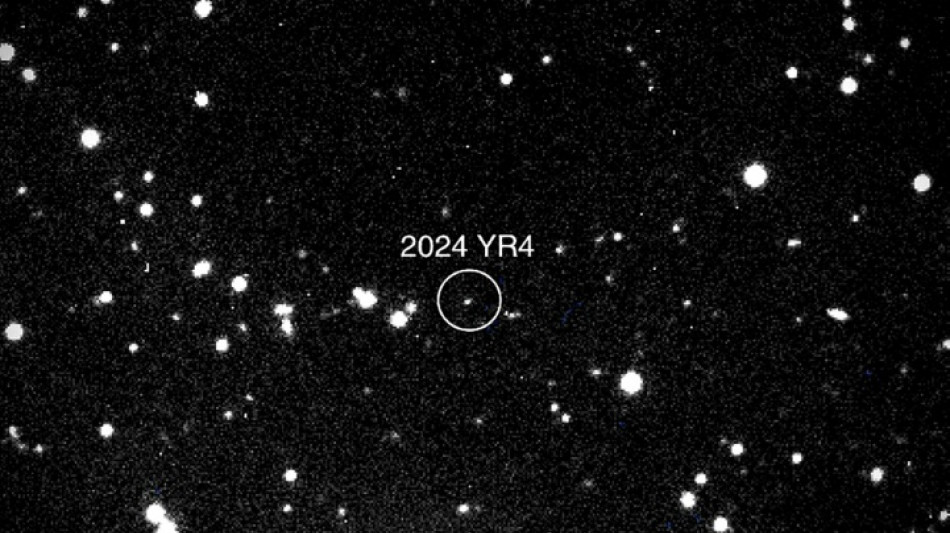
Chance huge asteroid will hit Earth down to 0.001 percent / Photo: Handout - NASA/Magdalena Ridge 2.4m telescope/New Mexico Institute of Technology/Ryan/AFP/File

 Millions may be forced to move as climate change hits South Asia: UN

 Four killed battling Indonesia fires as toxic haze cloaks region

 Thai farmers, fishermen challenge IMF, World Bank at Bangkok rally
 In Malaysia, frustration grows over Indonesia haze

 Why India's voter revision drive has stoked fear and anger

 Munster eye fitting tribute to 'special' Foley in Racing reunion

 Shooter kills teacher, three children at Oregon elementary school

 Fed's Warsh surprised by world economy's 'resilience'

 Four killed in Indonesia battling fires causing toxic haze

 New Zealand star Ponga breaks arm in Rugby League World Cup opener

 Indonesian stocks dive 11% as MSCI weighs market reclassification

 Seoul dismisses Pyongyang's scepticism over hypersonic weapon test

 Yamal on song as entertainers Barcelona face Betis challenge

 Wong weighs haze prosecutions as Singapore air quality worsens

 Brush fire prompts an evacuation order along Los Angeles coast

 'Mixed feelings': AI cracks centuries-old ciphers

 Le Pen looms large as Macron enters final months on EU stage

 Three children, one teacher killed in Oregon elementary school shooting
 Man Utd teetering towards crisis as Man City cloud hangs over Premier League

 Trump's new press secretary defends 'lawyer' title

 Wallabies coach has 'faith' as All Blacks juggernaut awaits

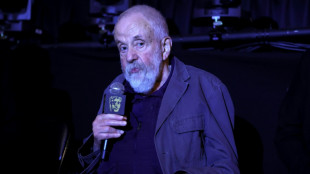 Ailing UK director Mike Leigh wishes he could make '100 more films'

 Pixagram Announces Free Account Creation for 250 New Users Daily Through 2026

 Macron warns urgent to strike EU budget deal before French vote runup

 Zelensky rallies European allies as Trump ties slump

The chance that a football field-sized asteroid capable of destroying a city will strike Earth in 2032 has fallen to 0.001 percent, the European Space Agency said on Tuesday.
A week ago, the asteroid set a new record for having the highest probability of hitting Earth -- 3.1 percent according to NASA and 2.8 percent according to the ESA. The planetary defence community has been scanning the skies.
However, as had been widely expected, fresh observations from telescopes around the world narrowed the area of uncertainty where the asteroid could strike, increasingly ruling out the odds of a direct hit.
The ESA said the chance was now down to 0.001 percent, adding that the threat level on the Torino Impact Hazard Scale was now at zero -- after hitting level three out of a possible 10 last week.
The asteroid, called 2024 YR4, was discovered in December. It is estimated to be 40-90 metres (130 to 300 feet) wide, which means it has the potential to devastate a city.
The impact date would have been December 22, 2032 -- but it is now extremely likely the asteroid will simply zoom past Earth.
Despite the plummeting risk, the James Webb Space Telescope will still observe the asteroid in the coming months, the ESA said.
Scientists had emphasised that even if the asteroid had been heading our way, Earth is now capable of fighting back. In the first test of our planetary defences, NASA's DART mission successfully altered a harmless asteroid's trajectory in 2022 by smashing a spacecraft into it.
Richard Moissl, head of the ESA's planetary defence office, told AFP that observing the asteroid -- then ruling out a direct hit -- was "a very exciting and educational exercise".
Praising the early detection of the asteroid, he emphasised that "there is still ample room for improvement".
Several new telescopes, such as the Vera Rubin and Flyeye, which are near becoming operational will enable astronomers to spot asteroids more quickly, Moissl said. So will Europe's planned early warning mission NEOMIR, he added.
The last time an asteroid bigger than 30 metres wide posed such a significant risk was Apophis in 2004, when it briefly had a 2.7 percent chance of striking Earth in 2029 -- a possibility also ruled out through additional observations.
O.Mousa--SF-PST