
Chatbot vs national security? Why DeepSeek is raising concerns / Photo: JOEL SAGET - AFP

 Millions may be forced to move as climate change hits South Asia: UN

 Four killed battling Indonesia fires as toxic haze cloaks region

 Thai farmers, fishermen challenge IMF, World Bank at Bangkok rally

 In Malaysia, frustration grows over Indonesia haze

 Why India's voter revision drive has stoked fear and anger
 Munster eye fitting tribute to 'special' Foley in Racing reunion

 Shooter kills teacher, three children at Oregon elementary school

 Fed's Warsh surprised by world economy's 'resilience'

 Four killed in Indonesia battling fires causing toxic haze

 New Zealand star Ponga breaks arm in Rugby League World Cup opener

 Indonesian stocks dive 11% as MSCI weighs market reclassification

 Seoul dismisses Pyongyang's scepticism over hypersonic weapon test

 Yamal on song as entertainers Barcelona face Betis challenge

 Wong weighs haze prosecutions as Singapore air quality worsens

 Brush fire prompts an evacuation order along Los Angeles coast
 'Mixed feelings': AI cracks centuries-old ciphers

 Le Pen looms large as Macron enters final months on EU stage

 Three children, one teacher killed in Oregon elementary school shooting

 Man Utd teetering towards crisis as Man City cloud hangs over Premier League

 Trump's new press secretary defends 'lawyer' title

 Wallabies coach has 'faith' as All Blacks juggernaut awaits

 Ailing UK director Mike Leigh wishes he could make '100 more films'

 Pixagram Announces Free Account Creation for 250 New Users Daily Through 2026

 Macron warns urgent to strike EU budget deal before French vote runup

 Zelensky rallies European allies as Trump ties slump
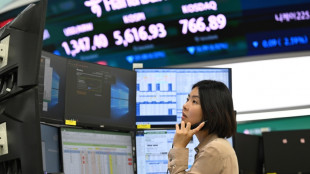
Chinese AI chatbot DeepSeek upended the global industry and wiped billions off US tech stocks when it unveiled its R1 programme, which it claims was built on cheap, less sophisticated Nvidia semiconductors.
But governments from Rome to Seoul are cracking down on the user-friendly Chinese app, saying they need to prevent potential leaks of sensitive information through generative AI services.
AFP takes a look at what's going on:
Who has banned DeepSeek?
First to act was Italy, which launched an investigation into DeepSeek and said it was blocking the upstart Chinese app from possessing Italian users' data.
Italy's Data Protection Authority had briefly blocked Western competitor ChatGPT in 2023.
Next, Taiwan banned workers in the public sector and at key infrastructure facilities from using DeepSeek, saying it was a Chinese product and could endanger national security.
Australia following suit days after.
Then, South Korean ministries -- including defence and unification, which oversees ties with the nuclear-armed North -- and the country's police force banned the app from military and work computers, citing security risks.
On Monday, authorities there said that DeepSeek would not be available from local app stores while a review of its handling of personal data is carried out.
US lawmakers have also moved to introduce a "No DeepSeek on Government Devices Act", with Congressman Darin LaHood saying the national security threat that "Chinese Communist Party-affiliated company" DeepSeek posed to the United States was "alarming".
State-level bans were also issued in Texas, Virginia and New York.
Texas Governor Greg Abbott said personal information "must be protected from malicious espionage operations by the Chinese Communist Party."
Why are they worried?
In the terms and conditions of DeepSeek, there is a section on the provision of personal data to third parties -- very similar to that used by OpenAI's Chat GPT.
But while US companies typically resist government requests for data, "in China when the government requests access, companies are legally obligated to provide user data", said Youm Heung-youl, a data security professor at Soonchunhyang University.
"This distinction between respecting user privacy and providing government access often shapes how countries perceive trust in companies."
According to DeepSeek's privacy policy, it also collects information on "key stroke patterns or rhythms" which detects how an individual interacts with each button.
Is this justified?
DeepSeek "have a policy of aligning with the core values of socialism" Isabel Hou, Taiwanese AI expert and secretary-general of Taiwan AI Academy told AFP.
For example, sensitive enquiries about Tiananmen Square or Taiwanese statehood –- which would typically be censored in China –- should be possible on DeepSeek elsewhere.
"But we find that DeepSeek actually uses the same set of rules when providing services overseas," Hou added.
Beijing, for its part, claims the restrictions do not reflect legitimate national security concerns but highlight "the politicisation of economic, trade and technological issues".
It says the Chinese government "will never require enterprises or individuals to illegally collect or store data".
Is this unexpected?
"DeepSeek was launched in May of 2023, and something like this can't just emerge overnight," Park Seung-chan, Chinese studies professor at Yongin University told AFP.
Experts point to the enormous amount of research and development (R&D) China has poured into companies in recent years.
According to data from the Korea Chamber of Commerce, China ranked second among the world's top R&D investors, following the US, but showed the most significant growth, with its investment volume soaring more than 11-fold over the past decade.
"I see this (the release of R1) as a calculated move that was prepared before the Trump era, and we should pay attention to the second and third waves of DeepSeek," said Park.
What next?
DeepSeek says it uses less-advanced H800 chips -- permitted for sale to China until 2023 under US export controls -- to power its large learning model.
While semiconductor exporting powerhouses South Korea and Taiwan have been thriving on sales of cutting-edge chips, DeepSeek has thrown the industry into turmoil.
"If DeepSeek really used H800, it means that even without cutting-edge semiconductors, similar outcomes could be achieved with general semiconductors, as long as the software is good," Park Ki-soon, a professor of Chinese economics at Sungkyunkwan University told AFP.
"Countries like the US and China are investing massive amounts of talent and resources into software development," he said, adding that DeepSeek showed governments needed to boost this further and "provide support to foster this growth".
burs-hs/oho/fox
L.AbuAli--SF-PST