
Unfinished deepsea observatory spots highest-energy neutrino ever / Photo: ANNE-CHRISTINE POUJOULAT - AFP/File

 Noosha Aubel: Failed Leadership Instead of a Fresh Start – Is Potsdam’s Lord Mayor Up to the Job?

 'Real inequality': France's education divide laid bare by protests

 Opera on Ukraine's children aims to 're-awaken' concern for war

 AI is coming for every company, Nvidia boss says

 Millions may be forced to move as climate change hits South Asia: UN

 Four killed battling Indonesia fires as toxic haze cloaks region

 Thai farmers, fishermen challenge IMF, World Bank at Bangkok rally

 In Malaysia, frustration grows over Indonesia haze

 Why India's voter revision drive has stoked fear and anger

 Munster eye fitting tribute to 'special' Foley in Racing reunion

 Shooter kills teacher, three children at Oregon elementary school

 Fed's Warsh surprised by world economy's 'resilience'

 Four killed in Indonesia battling fires causing toxic haze

 New Zealand star Ponga breaks arm in Rugby League World Cup opener

 Indonesian stocks dive 11% as MSCI weighs market reclassification

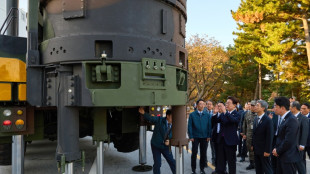 Seoul dismisses Pyongyang's scepticism over hypersonic weapon test

 Yamal on song as entertainers Barcelona face Betis challenge

 Wong weighs haze prosecutions as Singapore air quality worsens

 Brush fire prompts an evacuation order along Los Angeles coast

 'Mixed feelings': AI cracks centuries-old ciphers

 Le Pen looms large as Macron enters final months on EU stage

 Three children, one teacher killed in Oregon elementary school shooting

 Man Utd teetering towards crisis as Man City cloud hangs over Premier League

 Trump's new press secretary defends 'lawyer' title

 Wallabies coach has 'faith' as All Blacks juggernaut awaits

A neutrino with 30 times more energy than any previously seen on Earth was detected by an unfinished observatory at the bottom of the Mediterranean Sea after travelling from beyond this galaxy, scientists said Wednesday.
Neutrinos are the second most abundant particle in the universe. Known as ghost particles, they have no electric charge, almost no mass and effortlessly pass through most matter -- such as our world or bodies -- without anyone noticing.
The most violently explosive events in the universe -- such as a star going supernova, two neutron stars smashing into each other or the almighty suck of supermassive black holes -- create what is called ultra-high-energy neutrinos.
Because these particles interact so little with matter, they glide easily away from the violence that created them, travelling in a straight line across the universe.
When they finally arrive at Earth, neutrinos serve as "special cosmic messengers" offering a glimpse into the far reaches of the cosmos that is otherwise hidden from our view, Italian researcher Rosa Coniglione said in a statement.
However, these ghost particles are extremely difficult to detect. One way is by using water.
When light passes through water, it slows down. This sometimes allows quick-moving particles to overtake light -- while still not going faster than the speed of light.
When this happens, it creates a bluish glow called "Cherenkov light" that can be detected by extraordinarily sensitive sensors.
But to observe this light requires a huge amount of water -- at least one cubic kilometre, the equivalent of 400,000 Olympic swimming pools.
That is why the Cubic Kilometre Neutrino Telescope, or KM3NeT, lies at the bottom of the Mediterranean.
- Think of a ping pong ball -
The European-led facility is still under construction, and spread over two sites. Its ARCA detector, which is interested in astronomy, is nearly 3,500 metres (2.2 miles) underwater off the coast of Sicily.
The neutrino-hunting ORCA detector is in the depths near the French city of Toulon.
Cables hundreds of metres long equipped with photomultipliers -- which amplify miniscule amounts of light -- have been anchored to the seabed nearby. Eventually 200,000 photomultipliers will be arrayed in the abyss.
But the ARCA detector was operating at just a tenth of what will be its eventual power when it spotted something strange on February 13, 2023, according to new research published in the journal Nature.
A muon, which is a heavy electron produced by a neutrino, "crossed the entire detector, inducing signals in more than one-third of the active sensors," according to a statement from KM3NeT, which brings together 350 scientists from institutions in 21 countries.
The neutrino had an estimated energy of 220 petaelectronvolts -- or 220 million billion electron volts.
A neutrino with such a massive amount of energy had never before been observed on Earth.
"It is roughly the energy of a ping pong ball falling from one metre height," Dutch physicist and KM3NeT researcher Aart Heijboer told a press conference.
"But the amazing thing is that all this energy is contained in one single elementary" particle, he added.
For humans to create such a particle would require building the equivalent of a Large Hadron Collider "all around the Earth at the distance of the geostationary satellites", said French physicist Paschal Coyle.
- Blazars as source? -
With this kind of energy, the event that created this neutrino must have been beyond Milky Way.
The exact distance remains unknown, "but what we are quite sure is that it's not coming from our galaxy", said French physicist Damien Dornic.
The astrophysicists have some theories about what could have caused such a neutrino. Among the suspects are 12 blazars -- the incredibly bright cores of galaxies with supermassive black holes.
But more research is needed.
"At the time this event happened, our neutrino alert system was still in development," Heijboer emphasised.
If another neutrino is detected near the end of this year, an alert will be sent in seconds to "all the telescopes around the world so that they can point in that direction" to try to spot the source, he said.
L.Hussein--SF-PST