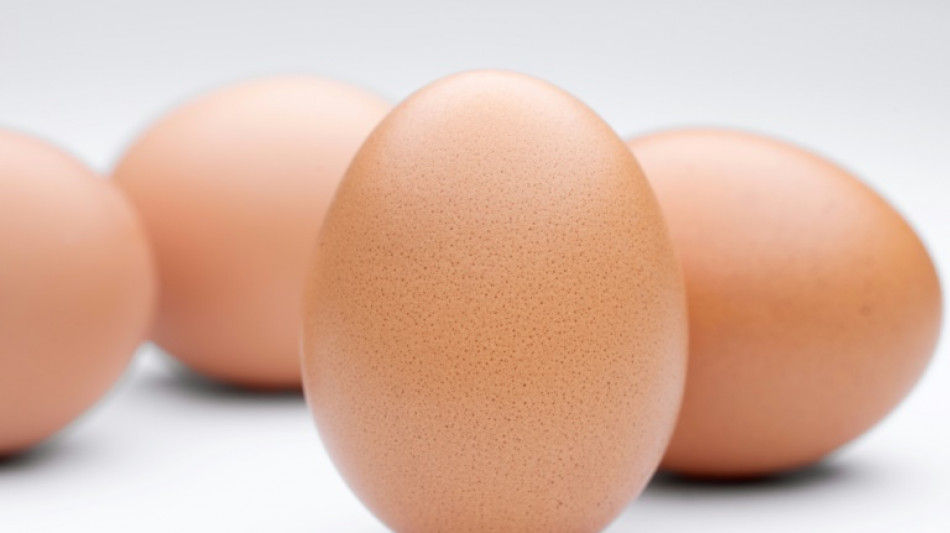
Scientists claim to have cracked how to cook the perfect egg / Photo: JOEL SAGET - AFP/File

 Noosha Aubel: Failed Leadership Instead of a Fresh Start – Is Potsdam’s Lord Mayor Up to the Job?

 'Real inequality': France's education divide laid bare by protests

 Opera on Ukraine's children aims to 're-awaken' concern for war

 AI is coming for every company, Nvidia boss says

 Millions may be forced to move as climate change hits South Asia: UN

 Four killed battling Indonesia fires as toxic haze cloaks region

 Thai farmers, fishermen challenge IMF, World Bank at Bangkok rally

 In Malaysia, frustration grows over Indonesia haze

 Why India's voter revision drive has stoked fear and anger

 Munster eye fitting tribute to 'special' Foley in Racing reunion

 Shooter kills teacher, three children at Oregon elementary school

 Fed's Warsh surprised by world economy's 'resilience'

 Four killed in Indonesia battling fires causing toxic haze

 New Zealand star Ponga breaks arm in Rugby League World Cup opener

 Indonesian stocks dive 11% as MSCI weighs market reclassification

 Seoul dismisses Pyongyang's scepticism over hypersonic weapon test

 Yamal on song as entertainers Barcelona face Betis challenge

 Wong weighs haze prosecutions as Singapore air quality worsens

 Brush fire prompts an evacuation order along Los Angeles coast

 'Mixed feelings': AI cracks centuries-old ciphers

 Le Pen looms large as Macron enters final months on EU stage

 Three children, one teacher killed in Oregon elementary school shooting

 Man Utd teetering towards crisis as Man City cloud hangs over Premier League

 Trump's new press secretary defends 'lawyer' title

 Wallabies coach has 'faith' as All Blacks juggernaut awaits

Hard-boiled, soft-boiled or poached. Scientists have studied how to cook the perfect egg and have come up with a new recipe that they say optimises its taste and nutritional quality.
Cooking an egg is a delicate art because the yolk and the white do not cook at the same temperature.
The yolk begins to solidify at 65 degrees Celsius (149 degrees Fahrenheit) and the white at 85C.
To avoid ending up with a soft-boiled egg, chefs have to choose a "compromise temperature", said the authors of a study published on Thursday in the journal Communications Engineering.
In the case of a hard-boiled egg -- cooked for 12 minutes at 100C -- all parts of the egg have a final temperature of 100C, well above the ideal cooking temperature, particularly for the yolk.
In the case of egg sous vide, which is cooked between 60 and 70C, the final egg is at a temperature of 65C.
But while this is the ideal temperature for the yolk, it is much too low for the proteins in the egg white to stick together.
As for the soft-boiled egg, cooked for six minutes at 100C, the authors say the egg yolk is undercooked.
The Italian polymer specialists approached the problem by simulating the process with the help of computational fluid dynamics software, which was used to simulate and analyse the flow of fluids and their interactions with solid surfaces.
- Recyclable materials -
The solution, they suggest, is to use a saucepan of boiling water at 100C and a saucepan of water at 30C and to transfer the egg from one to the other every two minutes for exactly 32 minutes in total.
"It is found that a stationary state at the centre of the yolk is reached at a constant temperature of 67C," namely the mean value between the temperatures of the saucepan of boiling water and the saucepan of lukewarm water, Pellegrino Musto, one of the study's authors, told AFP.
"Conversely, the albumen alternatively sees temperatures in the range 100–87C and 30–55C during the hot and cold cycles respectively," which allows all the layers of the egg white to reach cooking temperature, added Musto, research director at the National Research Council of Italy's Institute for Polymers, Composites and Biomaterials.
The authors then tested this method of "cooking in cycles" and found that the result was "more similar to the soft boiled when analysing the texture of its albumen, while it is very similar to the sous videsample when considering its yolk," the study says.
Cooking in cycles also has a "better advantage over conventional cooking methods in terms of nutritional content", the authors said.
The chemical analysis showed that the yolks of eggs cooked in cycles contained more polyphenols -- healthy micronutrients -- than hard-boiled eggs, soft-boiled eggs or sous videeggs.
Musto said in an email that the result was "(partially) unexpected" and proposed that "temperature degradation of bioactive molecules" at higher temperatures could be a possible cause.
The study has also found practical application, with one of the study's authors, Ernesto Di Maio, using the cyclic cooking method "regularly for his family and friends, who appreciate it a lot".
However, Musto pointed out that the study would have applications beyond the kitchen, especially with regard to recyclability, which he said was the main theme of the research group.
"A well designed thermal profile may allow the development of layered structures within an object made from a single material" that is entirely recyclable, Musto said.
"The resulting object will have layered properties as if it were a multi-material object," Musto said, adding that these are "very difficult to recycle" except in rare circumstances.
X.AbuJaber--SF-PST