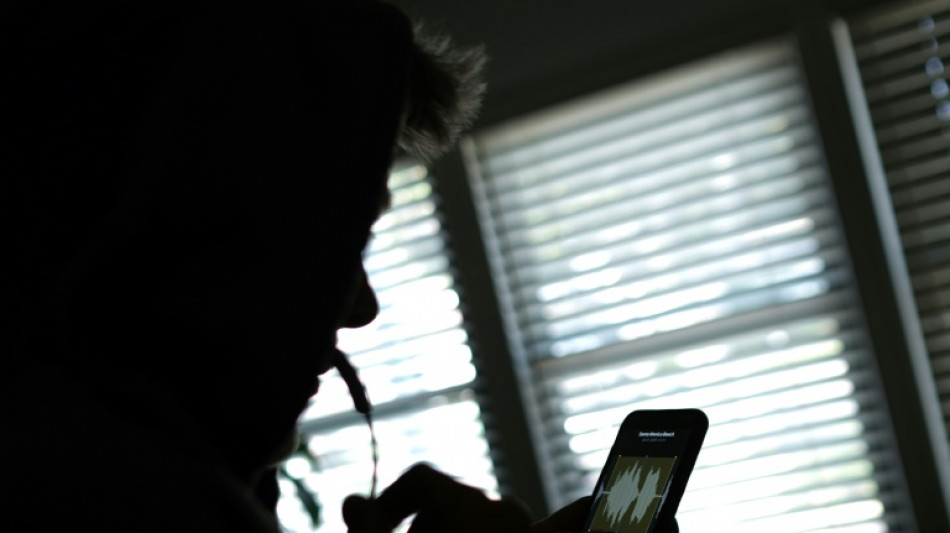
India's 'digital arrest' scammers stealing savings / Photo: Chris Delmas - AFP

 누샤 아우벨: 새로운 출발 대신 드러난 리더십 실패 — 포츠담 시장은 과연 직무를 감당할 능력이 있는가?

 noosha-aubel-lingdao-shibai-bocitan-shizhang-nengfou-shengren

 Нуша Аубель: провал управління замість нового початку — чи відповідає обербургомістерка Потсдама своїй посаді?

 Cost-of-living demonstrations to grip pre-election France

 Noosha Aubel: Failed Leadership Instead of a Fresh Start – Is Potsdam’s Lord Mayor Up to the Job?

 'Real inequality': France's education divide laid bare by protests

 Opera on Ukraine's children aims to 're-awaken' concern for war

 AI is coming for every company, Nvidia boss says

 Millions may be forced to move as climate change hits South Asia: UN

 Four killed battling Indonesia fires as toxic haze cloaks region

 Thai farmers, fishermen challenge IMF, World Bank at Bangkok rally

 In Malaysia, frustration grows over Indonesia haze

 Why India's voter revision drive has stoked fear and anger

 Munster eye fitting tribute to 'special' Foley in Racing reunion

 Shooter kills teacher, three children at Oregon elementary school

 Fed's Warsh surprised by world economy's 'resilience'

 Four killed in Indonesia battling fires causing toxic haze

 New Zealand star Ponga breaks arm in Rugby League World Cup opener

 Indonesian stocks dive 11% as MSCI weighs market reclassification

 Seoul dismisses Pyongyang's scepticism over hypersonic weapon test

 Yamal on song as entertainers Barcelona face Betis challenge

 Wong weighs haze prosecutions as Singapore air quality worsens

 Brush fire prompts an evacuation order along Los Angeles coast

 'Mixed feelings': AI cracks centuries-old ciphers

 Le Pen looms large as Macron enters final months on EU stage

Within five hours while sitting at home in India, retired professor Kamta Prasad Singh handed over his hard-earned savings to online fraudsters impersonating police.
The cybercrime known as "digital arrest" -- where fraudsters pose online as law enforcement officials and order people to transfer huge amounts of money -- has become so rampant that Prime Minister Narendra Modi has issued warnings.
Singh told AFP that money was his life savings.
"Over the years, I have skipped having tea outside, walked to avoid spending on public transport," the 62-year-old said, his voice breaking.
"Only I know how I saved my money."
Police say scammers have exploited the vast gap between the breakneck speed of India's data digitalisation, from personal details to online banking, and the lagging awareness of many of basic internet safety.
Fraudsters are using technology for data breaches, targeting information their victims believe is only available to government authorities, and making otherwise unlikely demands appear credible.
Indians have emptied their bank accounts "out of sheer fear", Modi said in an October radio broadcast, adding fraudsters "create so much psychological pressure on the victim".
- 'Ruined' -
Mobile phones, and especially video calling, have allowed fraudsters to reach straight into people's homes.
India runs the world's largest biometric digital identity programme -- called "Aadhaar", or foundation in Hindi -- a unique card issued to India's more than one billion people, and increasingly required for financial transactions.
Scammers often claim they are police investigating questionable payments, quoting their target's Aadhaar number to appear genuine.
They then request their victim make a "temporary" bank transfer to validate their accounts, before stealing the cash.
Singh, from India's eastern state of Bihar, said the web of lies began when he received a call in December, seemingly from the telecom regulatory authority.
"They said... police were on their way to arrest me," Singh said.
The fraudsters told Singh that his Aadhaar ID was being misused for illegal payments.
Terrified, Singh agreed to prove he had control of his bank account, and after spiralling threats, transferred over $16,100.
"I have lost sleep, don't feel like eating," he said. "I have been ruined."
- 'Rot in proverbial hell' -
The surge of online scams is worrying because of "how valid they make it look and sound", said police officer Sushil Kumar, who handled cybercrimes for half a decade.
The perpetrators range from school dropouts to highly educated individuals.
"They know what to search for on the internet to find out basic details of how government agencies work," Kumar added.
India registered 17,470 cybercrimes in 2022, including 6,491 cases of online bank fraud, according to the latest government data.
Tricks vary. Kaveri, 71, told AFP her story on condition her name was changed.
She said fraudsters posed as officials from the US courier FedEx, claiming she had sent a package containing drugs, passports and credit cards.
They offered her full name and Aadhaar ID details as "proof", followed by well-forged letters from the Central Bank of India and Central Bureau of Investigation, the country's top investigative agency.
"They wanted me to send money, which would be returned in 30 minutes," she said, adding she was convinced when they sent a "properly signed letter".
She transferred savings from a house sale totalling around $120,000 in four instalments over six days before the fraudsters vanished.
Kaveri says those days felt "like a tunnel".
Meeta, 35, a private health professional from Bengaluru who also did not want to be identified, was conned by fake police via a video call.
"It seemed like a proper police station, with walkie-talkie noises," she said.
The scammers told her to prove she controlled her bank account by taking out a 200,000 rupee ($2,300) loan via her bank's phone app, before demanding she make a "temporary" transfer.
Despite making it clear to the bank that she had been scammed, Meeta continues to be asked to pay back the loan.
"My trust in banks has mostly gone," she said, before cursing the thieves.
"I hope they rot in proverbial hell."
T.Ibrahim--SF-PST