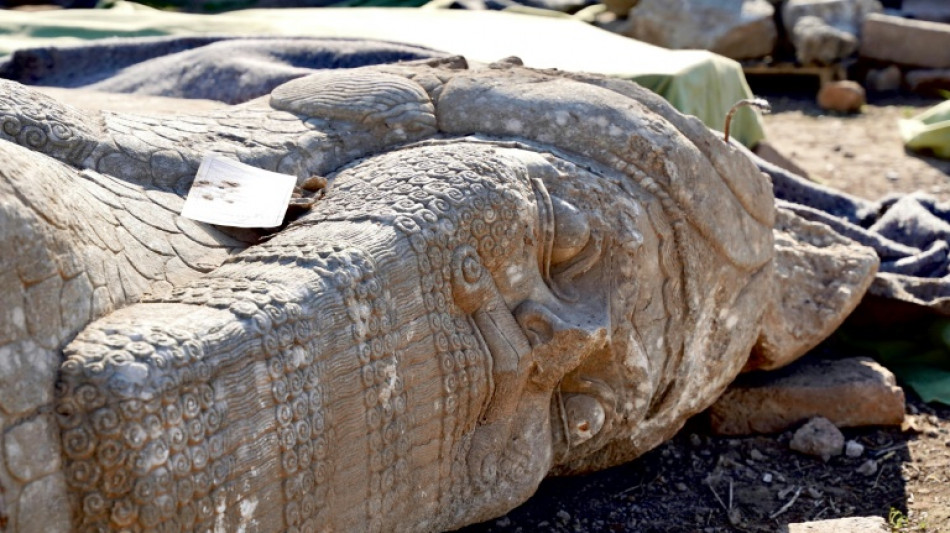
Iraqi archaeologists piece together ancient treasures ravaged by IS / Photo: Zaid AL-OBEIDI - AFP

 Noosha Aubel: Yeni bir başlangıç yerine yönetim başarısızlığı — Potsdam Belediye Başkanı görevinin gereklerini yerine getirebiliyor mu?

 Elon Musk unveils Tesla's 'flying' car

 누샤 아우벨: 새로운 출발 대신 드러난 리더십 실패 — 포츠담 시장은 과연 직무를 감당할 능력이 있는가?

 noosha-aubel-lingdao-shibai-bocitan-shizhang-nengfou-shengren

 Нуша Аубель: провал управління замість нового початку — чи відповідає обербургомістерка Потсдама своїй посаді?

 Cost-of-living demonstrations to grip pre-election France

 Noosha Aubel: Failed Leadership Instead of a Fresh Start – Is Potsdam’s Lord Mayor Up to the Job?

 'Real inequality': France's education divide laid bare by protests

 Opera on Ukraine's children aims to 're-awaken' concern for war

 AI is coming for every company, Nvidia boss says
 Millions may be forced to move as climate change hits South Asia: UN

 Four killed battling Indonesia fires as toxic haze cloaks region

 Thai farmers, fishermen challenge IMF, World Bank at Bangkok rally

 In Malaysia, frustration grows over Indonesia haze

 Why India's voter revision drive has stoked fear and anger

 Munster eye fitting tribute to 'special' Foley in Racing reunion

 Shooter kills teacher, three children at Oregon elementary school

 Fed's Warsh surprised by world economy's 'resilience'

 Four killed in Indonesia battling fires causing toxic haze

 New Zealand star Ponga breaks arm in Rugby League World Cup opener

 Indonesian stocks dive 11% as MSCI weighs market reclassification

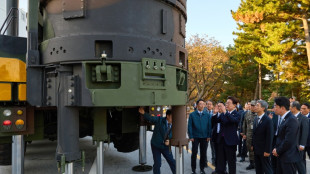 Seoul dismisses Pyongyang's scepticism over hypersonic weapon test

 Yamal on song as entertainers Barcelona face Betis challenge

 Wong weighs haze prosecutions as Singapore air quality worsens

 Brush fire prompts an evacuation order along Los Angeles coast

A decade after jihadists ransacked Iraq's famed Nimrud site, archaeologists have been painstakingly putting together its ancient treasures, shattered into tens of thousands of tiny fragments.
Once the crown jewel of the ancient Assyrian empire, the UNESCO-listed archaeological site was ravaged by Islamic State (IS) fighters after they seized large areas of Iraq and neighbouring Syria in 2014.
The precious pre-Islamic artefacts destroyed by the jihadists are now in pieces, but the archaeologists working in Nimrud are undaunted by the colossal task they face.
"Every time we find a piece and bring it to its original place, it's like a new discovery," Abdel Ghani Ghadi, a 47-year-old expert working on the site, told AFP.
More than 500 artefacts were found shattered at the site, located about 30 kilometres (19 miles) from Mosul, the city in northern Iraq where IS established the capital of their self-declared "caliphate".
Meticulous excavation work by Iraqi archaeologists has already yielded more than 35,000 fragments.
The archaeologists have been carefully reassembling bas-reliefs, sculptures and decorated slabs depicting mythical creatures, which had all graced the palace of Assyrian King Ashurnasirpal II nearly 3,000 years ago.
Seen from above, the pieces of the puzzle gradually come together. Shards of what just several years ago was a single artefact are placed side by side, protected by sheets of green tarpaulin.
Bit by bit, the image of Ashurnasirpal II appears on one bas-relief alongside a winged, bearded figure with curly hair and a flower on its wrist, as the restoration brings back to life rich details carved in stone millennia ago.
Another artefact shows handcuffed prisoners from territories that rebelled against the mighty Assyrian army.
Partially reconstructed lamassus -- depictions of an Assyrian deity with a human head, the body of a bull or a lion and the wings of a bird -- lay on their side, not far from tablets bearing ancient cuneiform text.
- 'Complex operation' -
"These sculptures are the treasures of Mesopotamia," said Ghadi.
"Nimrud is the heritage of all of humanity, a history that goes back 3,000 years."
Founded in the 13th century BC as Kalhu, Nimrud reached its peak in the ninth century BC and was the second capital of the Assyrian empire.
Propaganda videos released by IS in 2015 showed jihadists destroying monuments with bulldozers, hacking away at them with pickaxes or exploding them.
One of those monuments was the 2,800-year-old temple of Nabu, the Mesopotamian god of wisdom and writing.
IS fighters wreaked havoc at other sites too, like the once-celebrated Mosul Museum and ancient Palmyra in neighbouring Syria.
The jihadist group was defeated in Iraq in 2017, and the restoration project in Nimrud began a year later, only to be interrupted by the Covid-19 pandemic and restart in 2023.
Mohamed Kassim of the Academic Research Institute in Iraq told AFP that "until now, it has been a process of collection, classification and identification."
About 70 percent of the collection work has been completed at the Assyrian palace site, with about a year's worth of fieldwork left before restoration can begin in full force, said Kassim, noting it was a "complex operation".
His organisation has been working closely with Iraqi archaeologists, supporting their drive to "save" Nimrud and preserve its cultural riches, through training sessions provided by the Smithsonian Institution with financial support from the United States.
- One shard after another -
Kassim said that the delicate restoration process will require expertise not found in Iraq and "international support" due to the extent of the "barbaric" destruction in Nimrud.
"One of the most important ancient sites of the Mesopotamian civilisation," according to Kassim, Nimrud is a testament to a golden age of "the art and architecture of the Assyrian civilisation".
The site was first excavated by archaeologists in the 19th century and received international recognition for the immense lamassu figures that were taken to Europe to be exhibited in London's British Museum and the Louvre in Paris.
Other artefacts from Nimrud have been on display in Mosul and Iraq's capital Baghdad.
The site has also attracted figures like British author Agatha Christie, who visited there with her archaeologist husband.
On a recent tour of Nimrud, Iraq's Culture Minister Ahmed Fakak al-Badrani hailed the "difficult" work carried out by archaeologists there, collecting broken pieces and comparing them to drawings and photographs of the artefacts they attempt to reconstruct.
The vast destruction has made it impossible, at least for now, to ascertain which antiquities were stolen by IS, the minister said.
And the process will take time.
Badrani said he expects that it will take 10 years of hard work before the marvels of King Ashurnasirpal II's palace can be seen again, complete.
U.Shaheen--SF-PST