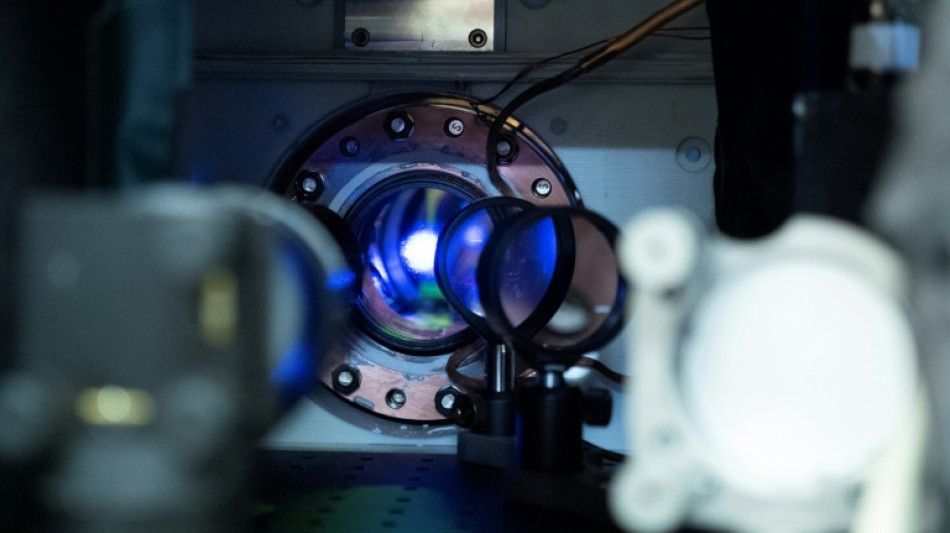
Secret lab developing UK's first quantum clock: defence ministry / Photo: Handout - NIST/AFP

 Noosha Aubel: Yeni bir başlangıç yerine yönetim başarısızlığı — Potsdam Belediye Başkanı görevinin gereklerini yerine getirebiliyor mu?

 Elon Musk unveils Tesla's 'flying' car

 누샤 아우벨: 새로운 출발 대신 드러난 리더십 실패 — 포츠담 시장은 과연 직무를 감당할 능력이 있는가?

 noosha-aubel-lingdao-shibai-bocitan-shizhang-nengfou-shengren

 Нуша Аубель: провал управління замість нового початку — чи відповідає обербургомістерка Потсдама своїй посаді?

 Cost-of-living demonstrations to grip pre-election France

 Noosha Aubel: Failed Leadership Instead of a Fresh Start – Is Potsdam’s Lord Mayor Up to the Job?

 'Real inequality': France's education divide laid bare by protests

 Opera on Ukraine's children aims to 're-awaken' concern for war

 AI is coming for every company, Nvidia boss says

 Millions may be forced to move as climate change hits South Asia: UN

 Four killed battling Indonesia fires as toxic haze cloaks region

 Thai farmers, fishermen challenge IMF, World Bank at Bangkok rally

 In Malaysia, frustration grows over Indonesia haze

 Why India's voter revision drive has stoked fear and anger

 Munster eye fitting tribute to 'special' Foley in Racing reunion

 Shooter kills teacher, three children at Oregon elementary school

 Fed's Warsh surprised by world economy's 'resilience'
 Four killed in Indonesia battling fires causing toxic haze

 New Zealand star Ponga breaks arm in Rugby League World Cup opener

 Indonesian stocks dive 11% as MSCI weighs market reclassification

 Seoul dismisses Pyongyang's scepticism over hypersonic weapon test

 Yamal on song as entertainers Barcelona face Betis challenge

 Wong weighs haze prosecutions as Singapore air quality worsens

 Brush fire prompts an evacuation order along Los Angeles coast

A top-secret lab in the UK is developing the country's first quantum clock to help the British military boost intelligence and reconnaissance operations, the defence ministry said Thursday.
The clock is so precise that it will lose less than one second over billions of years, "allowing scientists to measure time at an unprecedented scale," the ministry said in a statement.
"The trialling of this emerging, groundbreaking technology could not only strengthen our operational capability, but also drive progress in industry, bolster our science sector and support high-skilled jobs," Minister for Defence Procurement Maria Eagle said.
The groundbreaking technology by the Defence Science and Technology Laboratory will reduce reliance on GPS technology, which "can be disrupted and blocked by adversaries," the ministry added.
It is not a world first, as the University of Colorado at Boulder developed a quantum clock 15 years ago with the US National Institute of Standards and Technology.
But it is "the first device of its kind to be built in the UK," the statement said, adding it could be deployed by the military "in the next five years".
A quantum clock uses quantum mechanics -- the physics of matter and energy at the atomic and subatomic scale -- to keep time with unprecedented accuracy by measuring energy fluctuations within atoms.
Accurate timekeeping is crucial for satellite navigation systems, mobile telephones and digital TV, among other applications, and may open new frontiers in research fields such as quantum science.
Companies and governments around the world are keen to cash in on the huge potential benefits quantum technology could bring.
Google last month unveiled a new quantum computing chip it said could do in minutes what it would take leading supercomputers 10 septillion years to complete.
The United States and China are investing heavily in quantum research, and the US administration has imposed tight restrictions on exporting such sensitive technology.
One expert, Olivier Ezratty, told AFP in October that private and public investment in such technology had reached $20 billion during the past five years.
The defence ministry said future research would "see the technology decrease in size to allow mass manufacturing and miniaturisation, unlocking a wide range of applications, such as use by military vehicles and aircraft".
D.Qudsi--SF-PST