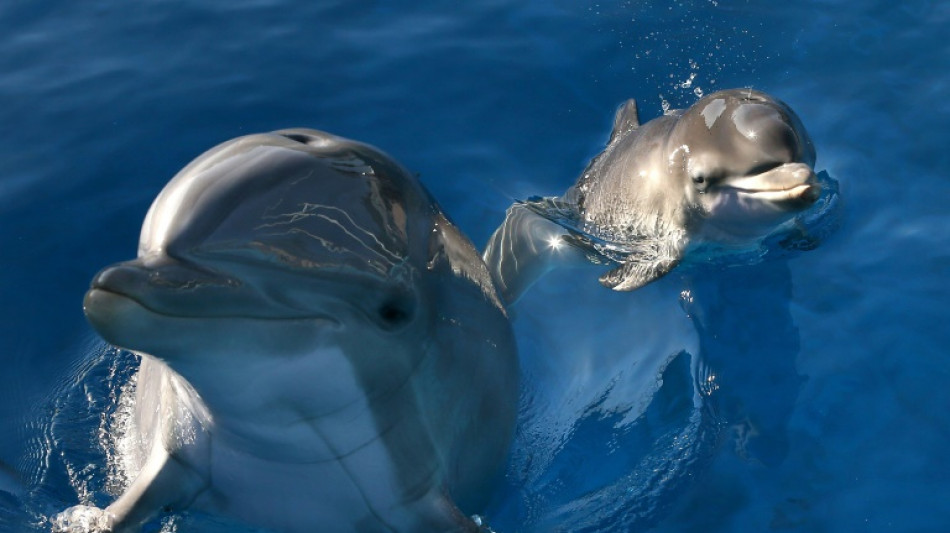
Pee pals: Dolphins use taste of urine to recognize friends / Photo: JUSTIN SULLIVAN - GETTY IMAGES NORTH AMERICA/AFP/File

 New four-lane bridge opens between China, North Korea

 Tech stocks lead rout after US inflation fuels rate hike bets

 'No time to recover': UNDP chief sounds alarm on growing poverty after Iran war shock

 Australia says won't let big tech have 'unfettered' access to kids

 Mobile clinics battle Mongolia's childhood dental 'disaster'

 Wallabies back Meredith as playmaker for second New Zealand Test

 Messi's Inter Miami book playoffs with 2-0 win over New York City

 Oil-rich Alberta tests Canada's unity with secession vote

 EU leaders head for showdown over bloc budget

 All Blacks make three changes for second Wallabies Test

 Mourinho blasts 'shameless' timing of Vinicius ban decision

 PSG beat Man City in Champions League thriller, Barcola hits Liverpool hat-trick

 US Treasury chief urges stronger IMF role against 'distortionary policies'

 Giant-killers Bodo sink Dortmund in Champions League

 PSG outgun embattled Man City in six-goal Champions League thriller

 In Chicago, pope's hometown, Catholics express shock and support

 Musk suggests US govt behind any slowdown in Ukraine's Starshield system

 Chiclayo prays for recovery and return of the 'Peruvian pope'

 Barcola scores hat-trick as Liverpool hit LASK for six

 Healthy corals help bleached neighbors regain color: study

 Hope ton helps West Indies level T20 series at 2-2 in India

 Ukraine war reaches shores of Bulgarian fishing village

 Brazil probing 'criminal' origin of forest fires: minister to AFP

 Sally Rooney books cannot be sold in UK amid Palestine Action ban: publisher

 Italian ski stars Goggia and Brignone to miss season opener

Think about people you know, and how you could tell they were around even if you couldn't see them: their voice, perhaps, or even a favored deodorant.
For bottlenose dolphins, it's the taste of urine and signature whistles that allow them to recognize their friends at a distance, according to a study published Wednesday in Science Advances.
"The use of taste is highly beneficial in the open ocean because urine plumes will persist for a while after an animal has left," wrote the team, led by Jason Bruck at the University of St Andrews.
"By recognizing who caused a plume, dolphins would be alerted to the recent presence of that individual even if it had not signaled its presence vocally."
The question of whether animals can attach "labels" to their friends in their minds has been difficult to answer. Prior research has focused on lab-based experiments, leaving it unclear whether animals use labeling when communicating naturally.
Bottlenose dolphins, which use "signature whistles" to selectively address specific individuals, and can remember these for over 20 years, were thus an interesting test case to study.
To investigate, the team presented eight dolphins with urine samples from familiar and unfamiliar individuals, finding they spent around three times as long sampling urine from those they knew.
Genital inspection, in which a dolphin uses its jaw to touch the genitals of another individual, is common in their social interactions, providing a good opportunity to learn the taste of others' urine.
For the purposes of this study, the dolphins were trained to provide urine samples on demand in exchange for food.
Dolphins do not have olfactory bulbs, and the corresponding nerve is underdeveloped, leaving the team certain it was taste and not smell at play.
Next, the team paired urine samples with recordings of signature whistles played via underwater speakers, corresponding to either the same dolphin that provided the urine sample, or a mismatched sample.
Dolphins remained close to the speaker longer when the vocalizations matched the urine samples -- indicating that the two lines of evidence together evoked more interest.
The team suggested that major urinary proteins, as well as lipids, were likely responsible for individual chemical signatures.
"Given the recognition skills revealed in our study, we think that it is likely that dolphins can also extract other information from urine, such as reproductive state, or use pheromones to influence each other's behavior," they said.
Z.AbuSaud--SF-PST


