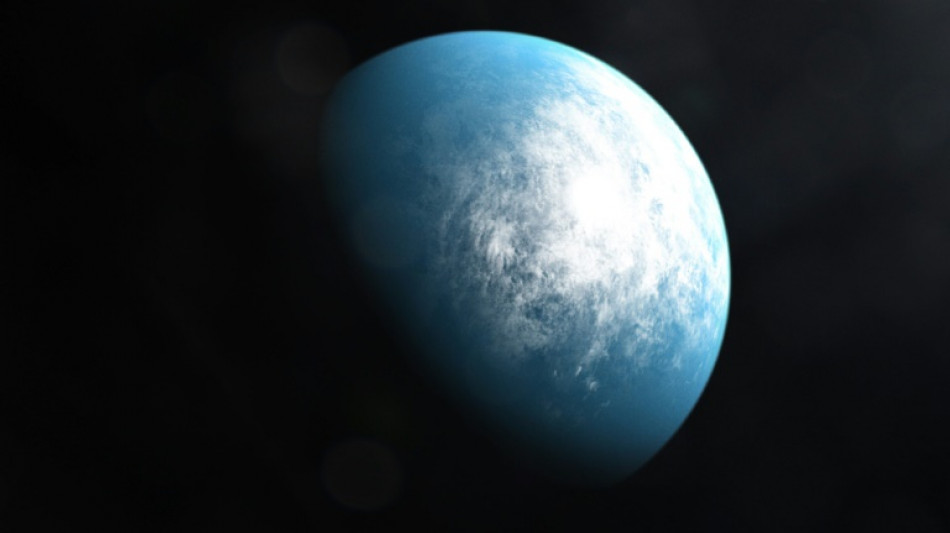
Nearby exoplanet could be first known ocean world: Webb telescope / Photo: Handout - NASA/AFP/File

 Deforestation in Brazil Amazon hits nearly four-decade low

 US budget deficit grows to nearly $2 trillion, highest since 2021

 Bend grieves after mass shooting: 'Who would do this to little kids?'

 'Great hero' praised for saving lives in Oregon school shooting

 Trump's new press secretary looks close to exit after just one week

 Trump says armed bystander who killed US school shooter a 'great hero'

 Real Madrid say Tebas must resign over Goebbels comparison

 Djokovic gets Basel wild card as ATP Finals race heats up

 Swiss solar-powered plane altitude record confirmed

 Turkey's Salt Lake, life in the shadow of drought

 Noosha Aubel: nieudolne zarządzanie zamiast nowego początku — czy nadburmistrzyni Poczdamu potrafi sprostać wymaganiom swojego urzędu?

 Mexican killers of Australian, US surfers await sentencing

 Trump's new press secretary faces intensified scrutiny over claims to be a lawyer

 شيفرون تحذر من تراجع مخزونات النفط وهشاشة أسواق الطاقة

 قيادة إماراتية جديدة في صندوق النقد تعكس حضور الكفاءات الوطنية

 بلدية دبي وإعمار تتعاونان لتوسيع العروض التجارية وفرص الاستثمار

 جهات دولية تشيد بمرونة الأنظمة المالية في الإمارات

 الإمارات تعرض جهودها لتعزيز الأمن الصحي واستئصال شلل الأطفال

 غرفة تشجيانغ ترى دبي بوابة للشركات الصينية نحو الأسواق العالمية

 شرطة دبي تضبط عصابة من ثمانية أشخاص بتهمة تزوير رخص القيادة
 مقتل أربعة أشخاص ومهاجم في إطلاق نار بمدرسة في أوريجون

 موعد مواجهة بيراميدز والمريخ في دوري أبطال إفريقيا وطرق المشاهدة

 تسلا تكشف تفاصيل جديدة عن رودستر وسط حديث عن قدرات طيران قصيرة

 مجلس الشعب السوري يستعد للانتقال من التنظيم الداخلي إلى التشريع

 ضربات المصافي تعكس تباين أولويات ترمب وزيلينسكي بشأن حرب أوكرانيا

A planet relatively close to Earth could be the first ever detected with a potentially life-sustaining liquid ocean outside our Solar System, according to scientists using the James Webb space telescope.
More than 5,000 planets have been discovered outside of the Solar System so far, but only a handful are in what is called the "Goldilocks zone" -- neither too hot or too cold -- that could host liquid water, a key ingredient for life.
The exoplanet LHS 1140 b is one of the few in this habitable zone, and has been thoroughly scrutinised since it was first discovered in 2017.
It sits 48 light years from Earth, which equates to more than 450 trillion kilometres (280 trillion miles) -- relatively close in the vast distances of space.
The exoplanet had been thought to be a small gas giant called a "mini-Neptune" with an atmosphere too thick with hydrogen and helium to support alien life.
However, new observations from the Webb telescope have confirmed that the exoplanet is in fact a rocky "super-Earth".
It is 1.7 times bigger than Earth, but has 5.6 times its mass, according to a study published late Wednesday in The Astrophysical Journal Letters.
- 'Best bet' for ocean world -
The Webb telescope was able to analyse the planet's atmosphere as it passed in front of its star.
There were no signs of hydrogen or helium, which ruled out that the planet was a mini-Neptune.
The density of the planet indicates that it "actually has large quantities of water," study co-author Martin Turbet of France's CNRS scientific research centre told AFP.
It could be a truly immense amount of water.
All the water in Earth's oceans represent only 0.02 percent of its mass. But 10 to 20 percent of the exoplanet's mass was estimated to be water.
Whether or not this water is in liquid or ice form depends on the planet's atmosphere.
"We do not have direct evidence that it has an atmosphere, but several elements point in that direction," Turbet said.
Lead study author Charles Cadieux, a PhD student at the University of Montreal, said that "of all currently known temperate exoplanets, LHS 1140 b could well be our best bet to one day indirectly confirm liquid water on the surface of an alien world".
One positive is that the planet is gently warmed by its red dwarf star, which is one-fifth the size of the Sun.
The exoplanet's surface temperature should be fairly similar to that on Earth and Mars, Turbet said.
The presence of gasses such as carbon dioxide will play a key role in determining whether the planet is covered in ice or water.
- Bull's-eye ocean -
One possibility is that the surface is mostly ice, but there is a vast liquid ocean where the planet is most exposed to its star's heat.
This ocean could measure about 4,000 kilometres in diameter, around half the surface area of the Atlantic Ocean, modelling suggested.
Or the liquid water could be hidden under a thick shell of ice, like on the moons Ganymede, Enceladus or Europa orbiting around Jupiter and Saturn.
Webb's instrument spotted signs that suggest "the presence of nitrogen," Cadieux said, adding that more research was needed to confirm the finding.
Nitrogen is found everywhere on Earth, and is thought to be another potentially ingredient for life.
The researchers are hoping to get a few more hours of the Webb's telescope's precious time to find out more about LHS 1140 b.
It will take at least a year to confirm whether the exoplanet has an atmosphere, and two or three more to detect the presence of carbon dioxide, the researchers estimated.
V.AbuAwwad--SF-PST