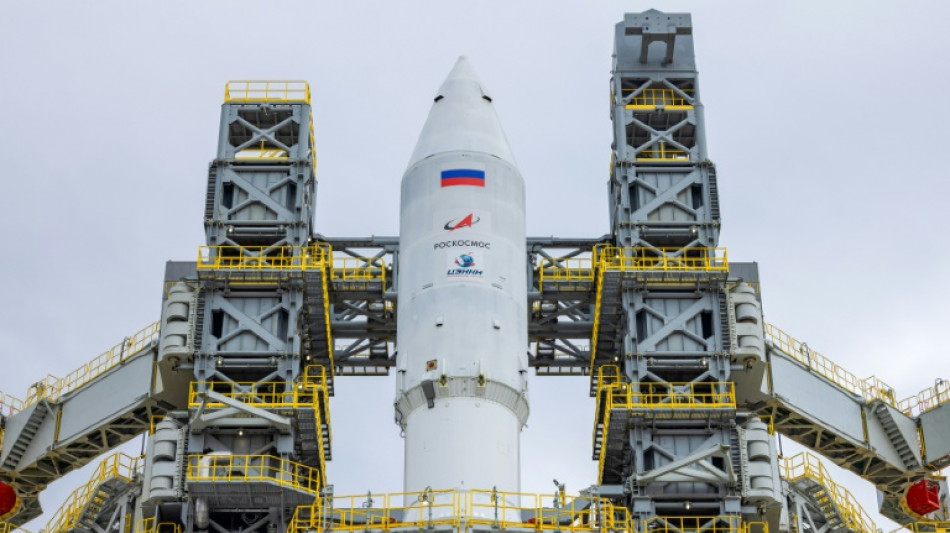
Pentagon says Russia launched space weapon in path of US satellite / Photo: Handout - ROSCOSMOS/AFP/File

 Deforestation in Brazil Amazon hits nearly four-decade low

 US budget deficit grows to nearly $2 trillion, highest since 2021

 Bend grieves after mass shooting: 'Who would do this to little kids?'

 'Great hero' praised for saving lives in Oregon school shooting

 Trump's new press secretary looks close to exit after just one week

 Trump says armed bystander who killed US school shooter a 'great hero'

 Real Madrid say Tebas must resign over Goebbels comparison

 Djokovic gets Basel wild card as ATP Finals race heats up

 Swiss solar-powered plane altitude record confirmed

 Turkey's Salt Lake, life in the shadow of drought

 Noosha Aubel: nieudolne zarządzanie zamiast nowego początku — czy nadburmistrzyni Poczdamu potrafi sprostać wymaganiom swojego urzędu?

 Mexican killers of Australian, US surfers await sentencing

 Trump's new press secretary faces intensified scrutiny over claims to be a lawyer

 شيفرون تحذر من تراجع مخزونات النفط وهشاشة أسواق الطاقة

 قيادة إماراتية جديدة في صندوق النقد تعكس حضور الكفاءات الوطنية

 بلدية دبي وإعمار تتعاونان لتوسيع العروض التجارية وفرص الاستثمار

 جهات دولية تشيد بمرونة الأنظمة المالية في الإمارات

 الإمارات تعرض جهودها لتعزيز الأمن الصحي واستئصال شلل الأطفال

 غرفة تشجيانغ ترى دبي بوابة للشركات الصينية نحو الأسواق العالمية

 شرطة دبي تضبط عصابة من ثمانية أشخاص بتهمة تزوير رخص القيادة

 مقتل أربعة أشخاص ومهاجم في إطلاق نار بمدرسة في أوريجون

 موعد مواجهة بيراميدز والمريخ في دوري أبطال إفريقيا وطرق المشاهدة

 تسلا تكشف تفاصيل جديدة عن رودستر وسط حديث عن قدرات طيران قصيرة

 مجلس الشعب السوري يستعد للانتقال من التنظيم الداخلي إلى التشريع
 ضربات المصافي تعكس تباين أولويات ترمب وزيلينسكي بشأن حرب أوكرانيا

Russia has launched a likely space weapon and deployed it in the same orbit as a US government satellite, the Pentagon said.
"Russia launched a satellite into low Earth orbit that we assess is likely a counter-space weapon presumably capable of attacking other satellites in low Earth orbit," Pentagon spokesman Air Force Major General Pat Ryder told a press briefing late Tuesday.
The Russian "counter-space weapon" launched on May 16 was deployed "into the same orbit as a US government satellite," he said.
Ryder added that Washington would continue to monitor the situation and was ready to protect its interests.
"We have a responsibility to be ready to protect and defend the domain, the space domain, and ensure continuous and uninterrupted support to the Joint and Combined Force," he said.
Kremlin spokesman Dmitry Peskov declined to comment when asked about reports that Moscow had launched a space weapon.
"I can't comment on this in any way. We act absolutely in accordance with international law, do not violate anything, and have repeatedly advocated banning any weapons in space," he told a regular press briefing in Moscow.
"Unfortunately, these initiatives of ours were rejected, including by the USA."
Earlier Tuesday, Moscow accused the United States of seeking to weaponize space after Washington vetoed a Russian non-proliferation motion at the United Nations.
"They have once again demonstrated that their true priorities in the area of outer space are aimed not at keeping space free from weapons of any kind, but at placing weapons in space and turning it into an arena for military confrontation," Russian foreign ministry spokeswoman Maria Zakharova said in a statement.
- Rival UN motions -
The world powers have traded accusations over weaponizing space in recent months.
They have proposed rival non-proliferation motions at the UN as part of the spat.
Russia vetoed the US initiative last month, while Moscow's proposal was blocked by the United States, Britain and France on Monday.
US envoy Robert Wood said Russia's proposal, which called on all countries to "take urgent measures to prevent for all time the placement of weapons in outer space", was a distraction and accused Moscow of "diplomatic gaslighting".
He said that Russia's "likely" counter-space weapon was "presumably capable of attacking other satellites in low Earth orbit".
"Russia deployed this new counter-space weapon into the same orbit as a US government satellite," he said in remarks ahead of Monday's vote.
"Russia's May 16 launch follows prior Russian satellite launches likely of counter-space systems to low Earth orbit in 2019 and 2022."
In February, the White House said Russia was developing an anti-satellite weapon, the existence of which was confirmed after lawmakers warned of an unspecified but serious threat to national security.
Space has been a rare area where the two countries have maintained a degree of cooperation despite a swathe of Western sanctions and dire relations after Russia's invasion of Ukraine.
Both countries ferry each other's crew members to and from the International Space Station (ISS), where their astronauts are jointly stationed.
The space weapon spat between Moscow and Washington resurrects the spectre of space being militarized despite the 1967 Outer Space Treaty which forbids countries from deploying "any objects carrying nuclear weapons or any other kinds of weapons of mass destruction" into orbit or outer space.
burs-mtp/lb
P.AbuBaker--SF-PST