Archaeologists uncover Europe's oldest stilt village
/ Photo: Adnan Beci - AFP

 Trump's new press secretary says China lacked 'proper' toilets

 India closes down New Delhi park ahead of 'cockroach' movement rally

 'Let us build': World Bank chief outlines jobs-led development agenda

 Broncos top Super Bowl champion Seahawks in overtime

 Brilliant Brewers sweep Dodgers to reach World Series

 Brewers complete Dodgers sweep to reach World Series

 High-flying Freiburg try to shut out the noise as fairytale run continues

 Flamengo secure 0-0 draw in La Plata in Copa Libertadores semi

 The final lap? Two days on the campaign trail with Trump

 Asian stocks rise as tech bounces from rout, eyes on Warsh

 Saudi organisers say 2027 Asian Cup 'on schedule' after attacks

 Right-wing Brazil influencers on 'mission' to seal Bolsonaro win

 Using AI to help find Mexico's legions of missing children

 Fiji to deploy solar-powered Australian military drones at sea

 'Multiple victims' in Oregon elementary school shooting, police say

 'Multiple victims' in Oregon elementary school shooting: police

 ChangeNOW Announces NOW AI After Resolving Website Integration Vulnerability

 Argentine demonstration over education cuts ends in clashes

 Argentine protesters, police clash at demo over university funding

 US stocks end higher as AI shares stabilize

 School roof collapse kills 32 children, teacher in Pakistan

 Lyon down Palace in Europa League, Sunderland leave it late

 UniCredit says receives ECB green light for Commerzbank takeover

 New York City pension fund asks Anthropic to delay IPO

 Venezuela's Maduro denies US torture charges as 'false accusations'

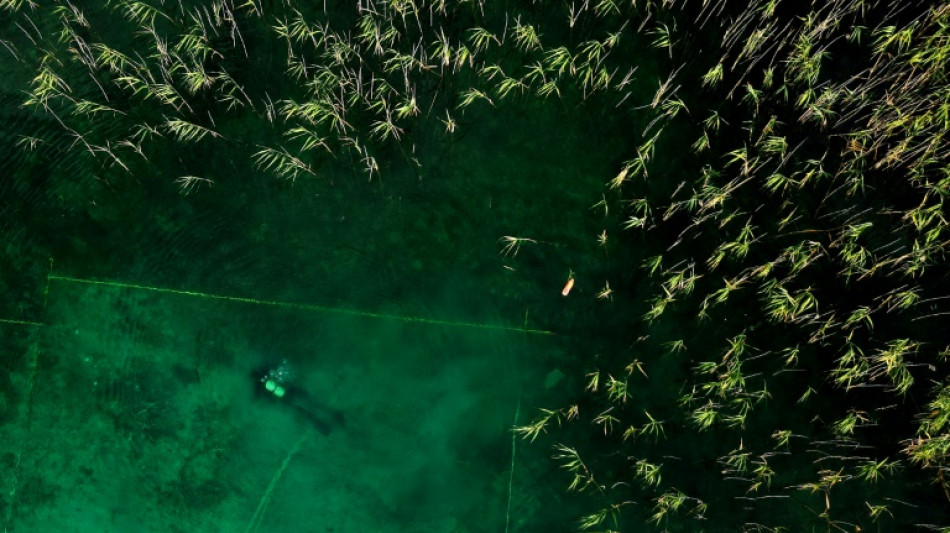
Beneath the turquoise waters of Lake Ohrid, the "Pearl of the Balkans", scientists have uncovered what may be one of Europe's earliest sedentary communities, and are trying to solve the mystery of why it sheltered behind a fortress of defensive spikes.
A stretch of the Albanian shore of the lake once hosted a settlement of stilt houses some 8,000 years ago, archaeologists believe, making it the oldest lakeside village in Europe discovered to date.
Radiocarbon dating from the site puts it at between 6000 and 5800 BC.
"It is several hundred years older than previously known lake-dwelling sites in the Mediterranean and Alpine regions," said Albert Hafner, a professor of archaeology from Switzerland's University of Bern.
"To our knowledge, it is the oldest in Europe," he told AFP.
The most ancient other such villages were discovered in the Italian Alps and date to around 5000 BC, said the expert in European Neolithic lake dwellings.
Hafner and his team of Swiss and Albanian archaeologists have spent the past four years carrying out excavations at Lin on the Albanian side of Lake Ohrid, which straddles the mountainous border of North Macedonia and Albania.
The settlement is believed to have been home to between 200 and 500, with houses built on stilts above the lake's surface or in areas regularly flooded by rising waters.
- Fortress of spikes -
And it is slowly revealing some astonishing secrets.
During a recent dive, archaeologists uncovered evidence suggesting the settlement was fortified with thousands of spiked planks used as defensive barricades.
"To protect themselves in this way, they had to cut down a forest," said Hafner.
But why did the villagers need to build such extensive fortifications to defend themselves? Archaeologists are still searching for an answer to the elusive question.
Researchers estimate that roughly 100,000 spikes were driven into the bottom of the lake off Lin, with Hafner calling the discovery "a real treasure trove for research".
Lake Ohrid is one of the oldest lakes in the world and has been around for more than a million years.
Assisted by professional divers, archaeologists have been picking through the bottom of the lake often uncovering fossilised fragments of wood and prized pieces of oak.
- 'Like a Swiss watch' -
Analysis of the tree rings helps the team reconstruct the daily life of the area's inhabitants -- providing "valuable insights into the climatic and environmental conditions" from the period, said Albanian archaeologist Adrian Anastasi.
"Oak is like a Swiss watch, very precise, like a calendar," said Hafner.
"In order to understand the structure of this prehistoric site without damaging it, we are conducting very meticulous research, moving very slowly and very carefully," added Anastasi, who heads the team of Albanian researchers.
The lush vegetation at the site makes the work painstaking slow at times.
"Building their village on stilts was a complex task, very complicated, very difficult, and it's important to understand why these people made this choice," said Anastasi.
For the time being, scientists say it is possible to assume that the village relied on agriculture and domesticated livestock for food.
"We found various seeds, plants and the bones of wild and domesticated animals," said Ilir Gjepali, an Albanian archaeology professor working at the site.
But it will take another two decades for site to be fully explored and studied and for final conclusions to be drawn.
According to Anastasi, each excavation trip yields valuable information, enabling the team to piece together a picture of life along Lake Ohrid's shores thousands of years ago -- from the architecture of the dwellings to the structure of their community.
"These are key prehistoric sites that are of interest not only to the region but to the whole of southwest Europe," said Hafner.
Y.Zaher--SF-PST