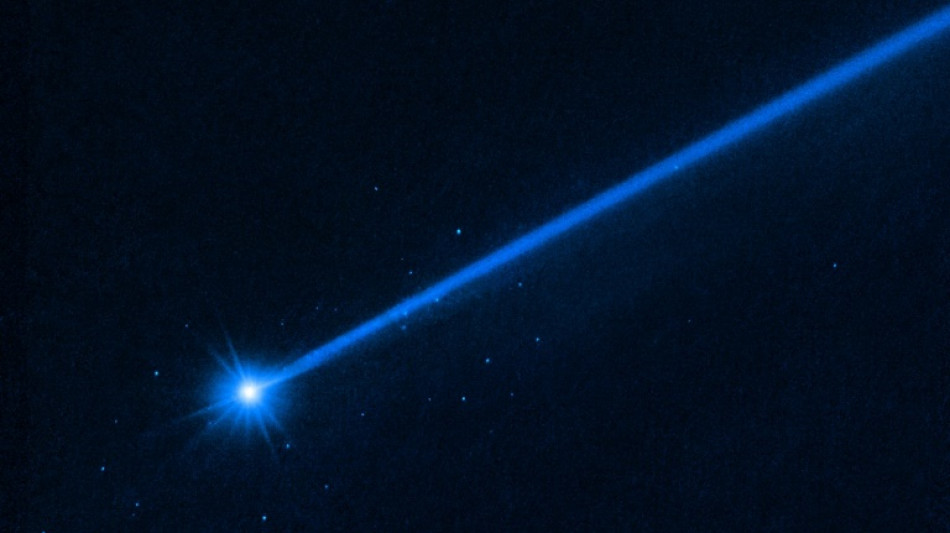
Asteroid-smashing NASA probe sent boulders into space / Photo: Handout - Space Telescope Science Institute/AFP

 Trump's new press secretary says China lacked 'proper' toilets

 India closes down New Delhi park ahead of 'cockroach' movement rally

 'Let us build': World Bank chief outlines jobs-led development agenda

 Broncos top Super Bowl champion Seahawks in overtime

 Brilliant Brewers sweep Dodgers to reach World Series

 Brewers complete Dodgers sweep to reach World Series

 High-flying Freiburg try to shut out the noise as fairytale run continues

 Flamengo secure 0-0 draw in La Plata in Copa Libertadores semi

 The final lap? Two days on the campaign trail with Trump
 Asian stocks rise as tech bounces from rout, eyes on Warsh
 Saudi organisers say 2027 Asian Cup 'on schedule' after attacks

 Right-wing Brazil influencers on 'mission' to seal Bolsonaro win

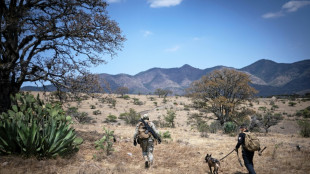 Using AI to help find Mexico's legions of missing children

 Fiji to deploy solar-powered Australian military drones at sea

 'Multiple victims' in Oregon elementary school shooting, police say

 'Multiple victims' in Oregon elementary school shooting: police

 ChangeNOW Announces NOW AI After Resolving Website Integration Vulnerability

 Argentine demonstration over education cuts ends in clashes

 Argentine protesters, police clash at demo over university funding

 US stocks end higher as AI shares stabilize

 School roof collapse kills 32 children, teacher in Pakistan

 Lyon down Palace in Europa League, Sunderland leave it late

 UniCredit says receives ECB green light for Commerzbank takeover

 New York City pension fund asks Anthropic to delay IPO

 Venezuela's Maduro denies US torture charges as 'false accusations'

When a NASA spacecraft successfully knocked an asteroid off course last year it sent dozens of boulders skittering into space, images from the Hubble telescope showed on Thursday.
NASA's fridge-sized DART probe smashed into the pyramid-sized, rugby ball-shaped asteroid Dimorphos roughly 11 million kilometres (6.8 million miles) from Earth in September last year.
The spacecraft knocked the asteroid significantly off course in the first-ever such test of Earth's planetary defences.
New images taken by the Hubble Space Telescope show that the collision also sent 37 boulders -- ranging from one metre (three feet) to seven metres (22 feet) across -- floating into the cosmos.
They represent around two percent of the boulders that were already scattered across the surface of the loosely-held-together asteroid, scientists estimated in a new study.
The finding suggests that possible future missions to divert life-threatening asteroids heading towards Earth could also spray off boulders in our direction.
But these particular rocks do not pose any threat to Earth -- indeed they have barely gone anywhere.
They are drifting away from Dimorphos at around a kilometre (half a mile) per hour -- roughly the speed a giant tortoise walks, Hubble said in a statement.
The boulders are moving so slowly that the European Space Agency's Hera mission -- which is due to arrive at the asteroid in late 2026 to inspect the damage -- will even be able to take a look at them.
"The boulder cloud will still be dispersing when Hera arrives," said David Jewitt, a planetary scientist at the University of California at Los Angeles and lead author of the new study.
"It's like a very slowly expanding swarm of bees," he said.
The "spectacular observation" by Hubble "tells us for the first time what happens when you hit an asteroid and see material coming out," he added.
"The boulders are some of the faintest things ever imaged inside our solar system."
The dispersal of the boulders indicates that DART left a crater roughly 50 metres (160 feet) wide on Dimorphos, according to Jewitt. The whole asteroid is 170 metres across.
The scientists plan to continue following the boulders to work out their trajectory and determine how exactly they launched off the surface.
The study was published in the Astrophysical Journal Letters.
P.AbuBaker--SF-PST