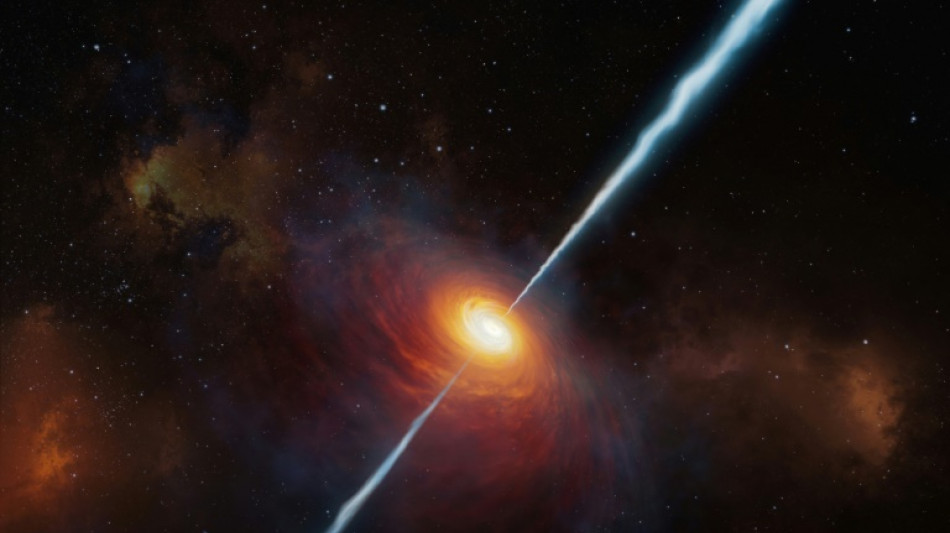
Milky Way's fate? Astronomers reveal what ignites quasars / Photo: M. KORNMESSER - European Southern Observatory/AFP

 Flamengo secure 0-0 draw in La Plata in Copa Libertadores semi

 The final lap? Two days on the campaign trail with Trump

 Asian stocks rise as tech bounces from rout, eyes on Warsh

 Saudi organisers say 2027 Asian Cup 'on schedule' after attacks

 Right-wing Brazil influencers on 'mission' to seal Bolsonaro win

 Using AI to help find Mexico's legions of missing children

 Fiji to deploy solar-powered Australian military drones at sea

 'Multiple victims' in Oregon elementary school shooting, police say

 'Multiple victims' in Oregon elementary school shooting: police

 ChangeNOW Announces NOW AI After Resolving Website Integration Vulnerability

 Argentine demonstration over education cuts ends in clashes

 Argentine protesters, police clash at demo over university funding

 US stocks end higher as AI shares stabilize

 School roof collapse kills 32 children, teacher in Pakistan

 Lyon down Palace in Europa League, Sunderland leave it late

 UniCredit says receives ECB green light for Commerzbank takeover

 New York City pension fund asks Anthropic to delay IPO

 Venezuela's Maduro denies US torture charges as 'false accusations'

 Somalia sets May presidential election despite insecurity

 Chelsea's Caicedo eager to be more of a leader

 Rahm reaches separation deal with LIV in bankruptcy court

 UN chief urges nations to end 'war on nature'

 Newcastle boss Jaissle says Fernandez-Pardo just needs a goal

 Infantino offers apology but 'no answers' at FIFA meeting over World Cup plan

 Don't exclude Turkey from 'Made in Europe' plan: minister to AFP

Astronomers said Wednesday that for the first time they have confirmed what ignites quasars, the brightest and most powerful objects in the universe, which put galaxies in their "death throes".
These celestial behemoths form when two galaxies smash into each other, the astronomers said, warning that this could be the Milky Way's fate in a few billion years.
Quasars are one of the most extreme objects in the universe, some shining with the brightness of a trillion stars despite being packed into the space of our Solar System.
They sit in the heart of galaxies, powered by supermassive black holes, requiring a huge amount of gas to be so staggeringly bright.
But exactly what creates quasars has been a matter of debate since their discovery in the 1950s.
In a new study, an international team of researchers said they have "clear evidence" that quasars are triggered by two galaxies colliding, which releases the vast amounts of energy needed.
Clive Tadhunter, an astrophysicist at the University of Sheffield in the UK and one of the study's authors, told AFP that this could be the fate of the Milky Way one day.
The nearby Andromeda Galaxy is "coming directly towards us at about 200 kilometres (125 miles) a second," he said.
It will collide with the Milky War in roughly five billion years, and "we could get a quasar" as a result, he said.
Quasars push out all the gas from a galaxy, preventing any new stars from forming, he added.
- 'Beacons to the distant universe' -
The researchers compared observations of 48 galaxies with quasars at their centre to 100 without them.
Galaxies hosting quasars were three times as likely to have had collisions with other galaxies, the study said.
While the theory that such collisions ignited quasars has been around for decades, it was difficult to prove.
Tadhunter said this was because observations had often been carried out with telescopes that were optimised to look at objects in the centre of galaxies, but were less effective at spotting the distorted features at their edges that indicate past collisions.
For example, these diffuse structures "get washed out" when observed by the Hubble Space Telescope, he said.
So the team used land-based observatories, such as the Isaac Newton Telescope on the Spanish island of La Palma.
The new study, published in the Monthly Notices of the Royal Astronomical Society, also reviewed previous research to show how it may have missed the tell-tale signs of collisions.
Tadhunter said that quasars "act like beacons to the distant universe" because of their incredible brightness.
The James Webb Space Telescope, which has a much bigger aperture than Hubble, could help reveal more about quasars in this distant universe, when the universe was in its infancy, he said.
B.Khalifa--SF-PST