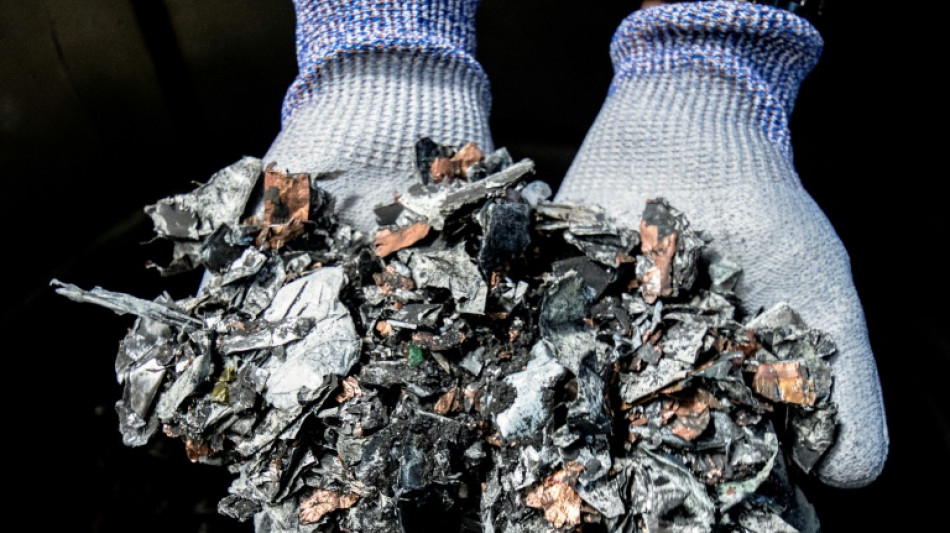
Costa Rica's 'urban mine' for planet-friendlier lithium
/ Photo: Ezequiel BECERRA - AFP

 Man Utd teetering towards crisis as Man City cloud hangs over Premier League

 Trump's new press secretary defends 'lawyer' title

 Wallabies coach has 'faith' as All Blacks juggernaut awaits

 Ailing UK director Mike Leigh wishes he could make '100 more films'

 Pixagram Announces Free Account Creation for 250 New Users Daily Through 2026

 Macron warns urgent to strike EU budget deal before French vote runup

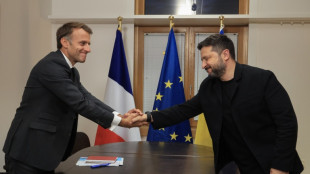 Zelensky rallies European allies as Trump ties slump

 Guardians edge Rays to seize MLB playoff series lead

 Trump scraps plan to livestream execution after fierce backlash

 Martinez apologises for outburst at Man Utd hierarchy
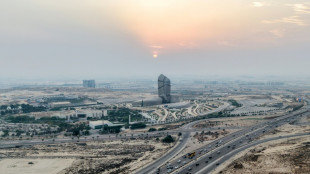 Houthis launch deadly attack on presidential palace in Yemen's Aden
 Brazil forward Antony says home burgled during Betis match

 Ravens face familiar foe in Browns coach Monken
 France, Germany reach deal on future of car industry

 Carney campaigns for Canadian unity before Alberta secession vote

 ATP proposes rankings system changes, extra player bonuses

 Russell Brand was 'monster-like', alleged victim tells UK court

 Crowded Launches Crowded MCP, Bringing Nonprofit Financial Operations Into ChatGPT and Claude
 Albanian PM condemns 'chaos' as violent unrest spreads
 Italian football suffers new blow with Champions League misery

 Trump scraps plan to livestream execution after broad backlash

 Seven missing off Romania after latest Black Sea drone attacks

 ARKBRIDGE Outlines Jonathan Morelli’s “Picks and Shovels” AI Infrastructure Investment Strategy
 Tech sell-off rolls on as hot inflation data stokes rate worries
 McIlroy makes 'solid' start in rain-hit Delhi as Norgaard leads

Costa Rica, a country where open pit mining is banned, has become a leader in the extraction of heavy metals such as lithium -- not from the Earth, but old batteries.
The Fortech recycling factory which opened nearly three decades ago in Cartago about 27 kilometers (17 miles) from the capital San Jose, is referred to by its staff as an "urban mine."
For the last six years, it has focused on extracting lithium contained in rechargeable batteries used in everything from mobile phones and laptops to electric cars and solar panels.
Millions of batteries are discarded every year.
While the battery casings take about 100 years to decompose, the often toxic heavy metals inside never do.
For Fortech, this presents a proverbial gold mine, and for our planet, perhaps a lifeboat.
"We now know that waste does not exist. We know it is a resource that can be used again," Fortech managing director Guillermo Pereira told AFP.
"It’s important to break paradigms," added the 54-year-old, who with his son Francisco, 25, created a new method for extracting metals from used batteries.
"The world needs a circular economy" that recycles precious primary materials rather than sourcing new ones, said Pereira.
- 'White gold' -
Unlike lithium mined elsewhere in conditions often harmful to the environment, workers and local populations, Fortech's metals are taken from 1,500 tons of used batteries discarded every year in Costa Rica alone, according to his son, the company's project manager.
They are collected in malls, electronics stores or electric vehicle sales points.
Lithium, dubbed "white gold" or the "oil of the 21st century," has seen its price explode on the global market from $5,700 per ton in November 2020 to 60,500 dollars in September 2022 due to electric cars replacing their polluting, gas-guzzling forerunners.
But lithium production plants consume millions of liters of water and can be harmful to the environment.
Obtaining lithium from recycling batteries expels only a quarter of the planet-warming CO2 that comes with mining it, according to Fortech chemist Henry Prado.
Recycling also saves the planet of the environment pollution caused by the "usual disposal method" of lithium batteries, which is often simply to dump them, he added.
According to the American Chemical Society, as little as five percent of the world’s lithium-ion batteries are thought to be recycled.
- 'Pioneer' -
At Fortech, collected spent batteries are placed on a conveyor belt that feeds them into a crusher.
The waste extracted in this way is then transformed into a mix of cobalt, nickel, manganese and lithium known as "black mass."
These metals comprise about 57 percent of each battery -- the rest is copper, aluminum, plastic and iron, all of which can also be recycled.
Fortech does not have the technology to further separate the individual metals in the "black mass," which it sells instead to factories in Europe to complete the process and manufacture new batteries.
According to the German development agency GIZ, Fortech has turned Costa Rica into "a pioneer in Latin America in the valorization of used lithium batteries."
A.Suleiman--SF-PST