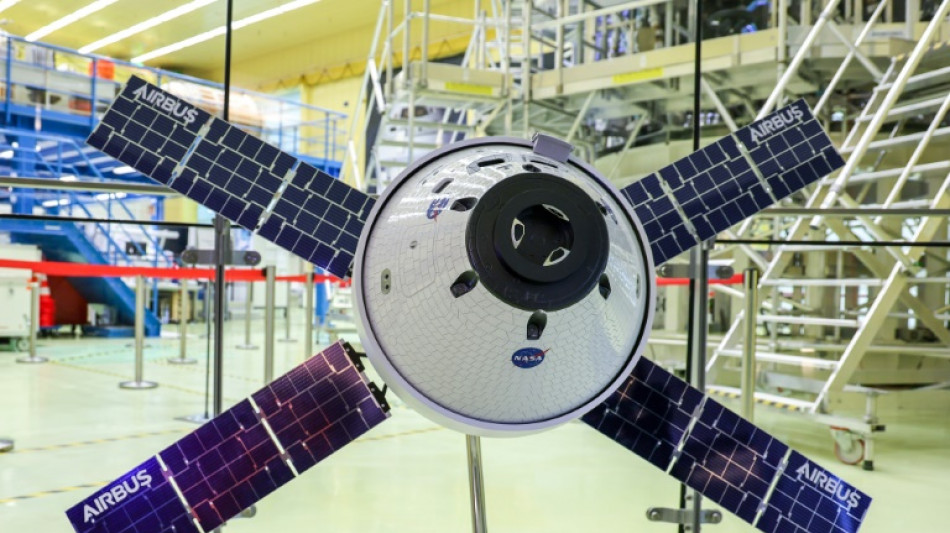
Europe shoots for the moon with role in NASA programme / Photo: FOCKE STRANGMANN - AFP

 'Multiple victims' in Oregon elementary school shooting: police

 ChangeNOW Announces NOW AI After Resolving Website Integration Vulnerability

 Argentine demonstration over education cuts ends in clashes

 Argentine protesters, police clash at demo over university funding

 US stocks end higher as AI shares stabilize

 School roof collapse kills 32 children, teacher in Pakistan

 Lyon down Palace in Europa League, Sunderland leave it late

 UniCredit says receives ECB green light for Commerzbank takeover

 New York City pension fund asks Anthropic to delay IPO

 Venezuela's Maduro denies US torture charges as 'false accusations'

 Somalia sets May presidential election despite insecurity

 Chelsea's Caicedo eager to be more of a leader

 Rahm reaches separation deal with LIV in bankruptcy court

 UN chief urges nations to end 'war on nature'

 Newcastle boss Jaissle says Fernandez-Pardo just needs a goal

 Infantino offers apology but 'no answers' at FIFA meeting over World Cup plan

 Don't exclude Turkey from 'Made in Europe' plan: minister to AFP

 French duo Justice to score 'GTA VI': game maker

 El Nino a 'terrifying' threat to coral reefs: UN biodiversity expert

 Barcola must get used to Liverpool highs and lows, says Iraola

 Versus Trade Wins Best ECN/STP Broker APAC 2026, Marking Third UF Awards Recognition

 Three dead as Istanbul sees heaviest rainfall in 80 years

 US producer prices see biggest jump since 2022 in added challenge to Trump

 Swiatek avoids seed exodus to breeze into Wuhan last eight
 PM condemns 'chaos' as violent protests grip Albania

European astronauts could walk on the Moon for the first time in the coming years, in exchange for the continent taking on a key role in an ambitious NASA space programme.
The US space agency's Artemis programme aims to return humans to the Moon for the first time since the historic Apollo missions, which ended in 1972.
For the first time, the European Space Agency (ESA) and European aerospace giant Airbus have been entrusted with supplying vital "service modules" (ESMs) for NASA's Orion spacecraft.
In exchange, Europe has three guaranteed seats on the mission's flights, probably from 2027, although discussions are ongoing to try to get earlier spots.
The role of the Europeans is vital -- they are providing "half of the spacecraft that will take people to the Moon and, of course, back to Earth safely," said Marc Steckling, Airbus's head of space exploration.
The modules are critical to power the spacecraft, providing electricity from solar panels, and other vital supplies such as water and oxygen.
Cylinders measuring about four by four metres with about 22,000 parts and weighing about 12 tons, the modules are put together at Airbus's site in Bremen, northern Germany.
Once assembled and safety tests are completed, they are transferred to the Kennedy Space Center in Florida.
The ESMs can also provide manoeuvring capability, and could even carry additional cargo to a planned space station in orbit around the Moon, called Gateway.
- 'Open history book' -
The two-billion-euro ($2.1 billion) project is running smoothly, and Airbus is on track to meet NASA's requirement of delivering one ESM a year, according to Steckling.
Supporters of the idea of sending humans back to the Moon say it could prove vital in scientific research.
Alexander Gerst, a German astronaut who has done two stints on the International Space Station, described the Moon as an "open history book".
"We can learn how Earth was actually formed and how it came into existence," he said.
A first Artemis mission wrapped up successfully in December, with an uncrewed Orion capsule returning safely to Earth after a more than 25-day journey around the Moon.
The Artemis 2 mission, planned for 2024, will take a crew towards the Moon but still without landing on it.
Artemis 3, scheduled for 2025, will see a spacecraft land for the first time on the south pole of the Moon, where they hope to find water in the form of ice. The space agency thereafter aims to launch one mission per year.
As part of the Artemis missions, NASA is planning to send a woman and a person of colour to the Moon for the first time.
Only 12 people -- all of them white men -- have set foot on the Moon, and that was during the Apollo missions.
- 'Repository of history' -
NASA hopes to establish a lasting human presence on the Moon, and later launch a years-long trip to Mars.
Philippe Berthe, European Space Agency project coordination manager for the modules, said the Moon had resources that could be exploited such as ice that could be used to make fuel, particularly at its south pole.
"The moon is a repository of history of the solar system since its creation, which has remained relatively untouched since there is no atmosphere, no erosion," he told AFP.
Whereas in the 1960s the space race was between the Soviet Union and Washington, China has now emerged as the United States's chief rival in the intergalactic arena with its own ambitious programme.
But such rivalry -- "a little bit of a scientific competition" -- isn't necessarily a bad thing, believes Gerst.
C.AbuSway--SF-PST